Year-End Bookkeeping Checklist: 10 Reviews for 2026
A practical ten-step review for cleaner financial statements, smoother tax planning, and a faster filing season.
SAPIR EA year-end bookkeeping readiness guide for 2026.
Year-end bookkeeping is more than categorizing the last few bank transactions. It is the process of making sure the income statement, balance sheet, payroll records, contractor records, inventory, debt, and owner activity tell one consistent story before tax planning and return preparation begin.
When the books are incomplete, a tax projection can be wrong, estimated payments can be missed, deductions can be overlooked, and a business owner may make December decisions using unreliable numbers. The IRS explains that good records help a business monitor progress, prepare financial statements, track receipts and deductions, prepare returns, and support reported amounts. That is the practical standard for a year-end close.
This 2026 guide covers the ten areas most small business owners should review before December 31, including current changes affecting 2026 Forms W-2 and 1099, the new information-return threshold for certain payments, and the transition to the IRS Information Returns Intake System for the 2027 filing season.
Key point: A profit-and-loss statement can look reasonable while the balance sheet is still wrong. Tax-ready books require both statements, the supporting schedules, and the underlying records to agree.
Year-End Bookkeeping Readiness at a Glance
A business is usually ready for year-end when it can produce the following without major unexplained differences:
- Reconciled bank, credit-card, loan, payroll, and payment-processor accounts
- A complete profit-and-loss statement and balance sheet
- Accounts-receivable and accounts-payable aging reports, when applicable
- A current inventory count and cost-of-goods-sold support
- A fixed-asset and depreciation schedule
- A list of owner contributions, draws, distributions, and loans
- Payroll reports that tie to quarterly employment tax filings
- Complete Forms W-9 and a contractor payment report
- A schedule of federal, state, local, payroll, sales-tax, and PTET payments
- Supporting documentation for material income, expenses, and year-end adjustments
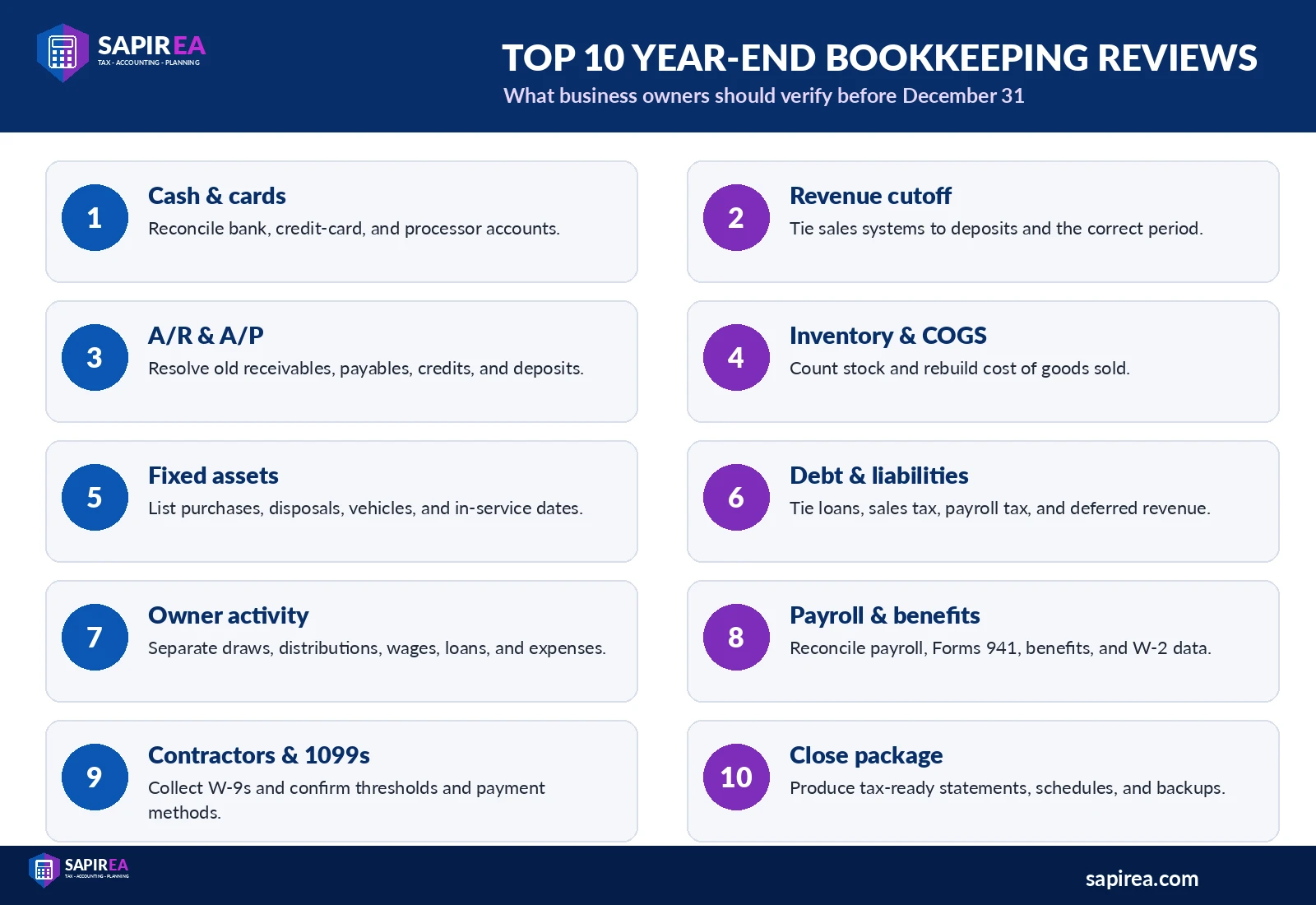
The ten reviews that turn ordinary bookkeeping into a tax-ready year-end close.
The following ten reviews provide a practical close process.
1. Reconcile Every Bank, Credit-Card, and Payment-Processor Account
Start with cash because every other part of the books eventually connects to it.
Each bank and credit-card balance should agree to a statement after legitimate outstanding items are considered. Review old unreconciled items instead of relying only on the software status.
Common problems include:
- Duplicate transactions imported from a bank feed
- Transfers recorded as income or expenses
- Credit-card payments recorded twice
- Loan proceeds posted to revenue
- Merchant deposits recorded net of processing fees without recording gross sales
- Stale checks that may need to be voided or investigated
- Personal accounts connected to the business file
- Unexplained opening-balance equity entries
- Cash withdrawals with no documented business purpose
Payment processors often deposit net amounts after fees, refunds, chargebacks, reserves, or loan repayments. Reconcile gross activity to those reductions and the net deposits so revenue and expenses are not understated and Form 1099-K differences can be explained.
Learn more about SAPIR EA Virtual Bookkeeping and QuickBooks Services.
2. Confirm That Revenue Is Complete and Recorded in the Right Period
Revenue completeness is one of the most important year-end tests.
Compare revenue in the general ledger with all major source systems, including invoices, point-of-sale reports, merchant processor summaries, e-commerce platforms, bank deposits, cash logs, property-management reports, and client-management systems. Investigate significant differences instead of assuming one system is correct.
A Form 1099-K is not a revenue ledger. It may report gross activity without reflecting refunds, fees, shared revenue, sales tax, or other adjustments, and the absence of a form does not make receipts nontaxable.
Review the cutoff around December 31. Questions include:
- Were December sales deposited in January?
- Were deposits recorded twice, once from an invoice and again from the bank feed?
- Are customer advances actually revenue, or are they deposits for future work?
- Were refunds and chargebacks recorded in the correct period?
- Does the business use the cash, accrual, or another permitted accounting method consistently?
Cash-method and accrual-method businesses can have different income-recognition results. The bookkeeping method used for tax reporting should clearly reflect income and should be applied consistently. Do not change the year-end cutoff simply to reach a preferred tax result.
3. Review Accounts Receivable, Accounts Payable, and Customer Deposits
Accounts receivable and accounts payable should reflect amounts that are real, collectible, and assigned to the correct period.
Run an accounts-receivable aging report. For old balances, determine whether the customer still owes the amount, a credit was never applied, a payment was posted to the wrong customer, or the receivable is no longer collectible. An old balance should not remain indefinitely just because no one wants to research it.
Bad-debt treatment depends on the accounting method. A cash-method business generally cannot deduct an invoice never included in income; an accrual-method business may have a deduction when a previously recognized receivable becomes worthless.
For accounts payable, look for:
- Duplicate vendor bills
- Bills paid personally by an owner but not reimbursed
- Old checks that never cleared
- Vendor credits that were not applied
- Expenses recorded in the wrong year
- Related-party accruals that may have special tax timing rules
- Credit-card charges recorded both through a bill and through the bank feed
Customer deposits, retainers, gift cards, and prepaid service amounts also need review. Some amounts are current income; others remain liabilities until the business performs. The contract terms, facts, and accounting method control. Do not move balances between revenue and liabilities without support.
4. Count Inventory and Rebuild Cost of Goods Sold
For businesses that sell products, year-end inventory can materially change taxable income.
Schedule a physical count close to year-end and retain count sheets, scanner reports, photographs, or other support. Compare the count to the inventory system and investigate shrinkage, negative quantities, damage, returns, obsolete items, and inventory located with third parties.
The count should cover units, cost, freight or landed costs, work in process, raw materials, consigned goods, obsolete items, goods in transit, and customer-owned property.
Then reconcile beginning inventory, purchases, direct costs, ending inventory, and cost of goods sold. A gross-margin percentage that changes sharply from the prior year may signal a count problem, missing purchases, incorrect sales, or misclassified labor and materials.
Certain small business taxpayers may qualify to use simplified inventory methods, but that does not eliminate the need for records. Whatever method the business uses should be applied consistently and should clearly reflect income.
Inventory close warning signs
| Warning sign | Possible cause | Year-end action |
|---|---|---|
| Negative quantity on hand | Sales posted before purchases or item mapping errors | Correct item history and confirm actual stock |
| Gross margin changed dramatically | Missing sales, missing purchases, or count error | Compare monthly margins and investigate exceptions |
| Inventory never changes | Counts are not being entered | Perform and document a physical count |
| Large obsolete balance | Old items carried at unsupported values | Identify, document, and evaluate proper treatment |
| Purchases coded directly to expense | Inventory and COGS are incomplete | Reclassify based on the accounting method and records |
5. Update Fixed Assets, Vehicles, Depreciation, and Disposals
A year-end fixed-asset review should identify every major purchase, disposal, trade-in, and change in business use.
List each material asset's description, purchase and placed-in-service dates, cost, financing, business-use percentage, and any replaced property. Review whether large purchases were expensed incorrectly or routine costs were capitalized unnecessarily.
For sold, traded, abandoned, or destroyed assets, provide the date and proceeds and identify what happened to the old property. Leaving disposed assets on the depreciation schedule can create incorrect deductions and future gain calculations.
Vehicle records should distinguish business, commuting, and personal mileage. If the business uses the standard mileage method, the 2026 log must also separate miles driven through June 30 from miles driven beginning July 1 because the federal business mileage rate changed midyear.
Related resources: 2026 business mileage rate guide and year-end tax planning checklist for small business owners.
6. Reconcile Loans, Leases, Credit Lines, and Other Liabilities
A loan payment is rarely all expense. It generally includes principal, interest, and sometimes fees. Reconcile every debt account to a lender statement or amortization schedule.
Review:
- Bank loans and lines of credit
- Vehicle and equipment financing
- Credit cards
- Mortgages
- Merchant cash advances
- Shareholder or partner loans
- Finance and operating leases
- Payroll tax liabilities
- Sales-tax liabilities
- Customer deposits and gift cards
- Deferred revenue
- Accrued expenses
Common problems include expensing the full loan payment, recording loan proceeds as revenue, and leaving paid-off debt on the balance sheet. Reconcile sales-tax and payroll-tax liabilities to filed returns and payments; unexplained negative liabilities usually signal an error.
Balance-sheet red flags to fix before filing
- Negative bank or credit-card balances that do not match statements
- Old uncleared checks or deposits in transit
- Accounts receivable or payable with no supporting detail
- Loans that do not agree with lender statements
- Large balances in suspense, ask-my-accountant, or uncategorized accounts
- Negative fixed assets or accumulated depreciation
- Payroll or sales-tax liabilities that do not match filed returns
- Owner loan balances that move without documentation
- Opening balance equity remaining after the setup period
- Assets or liabilities that have not changed for years
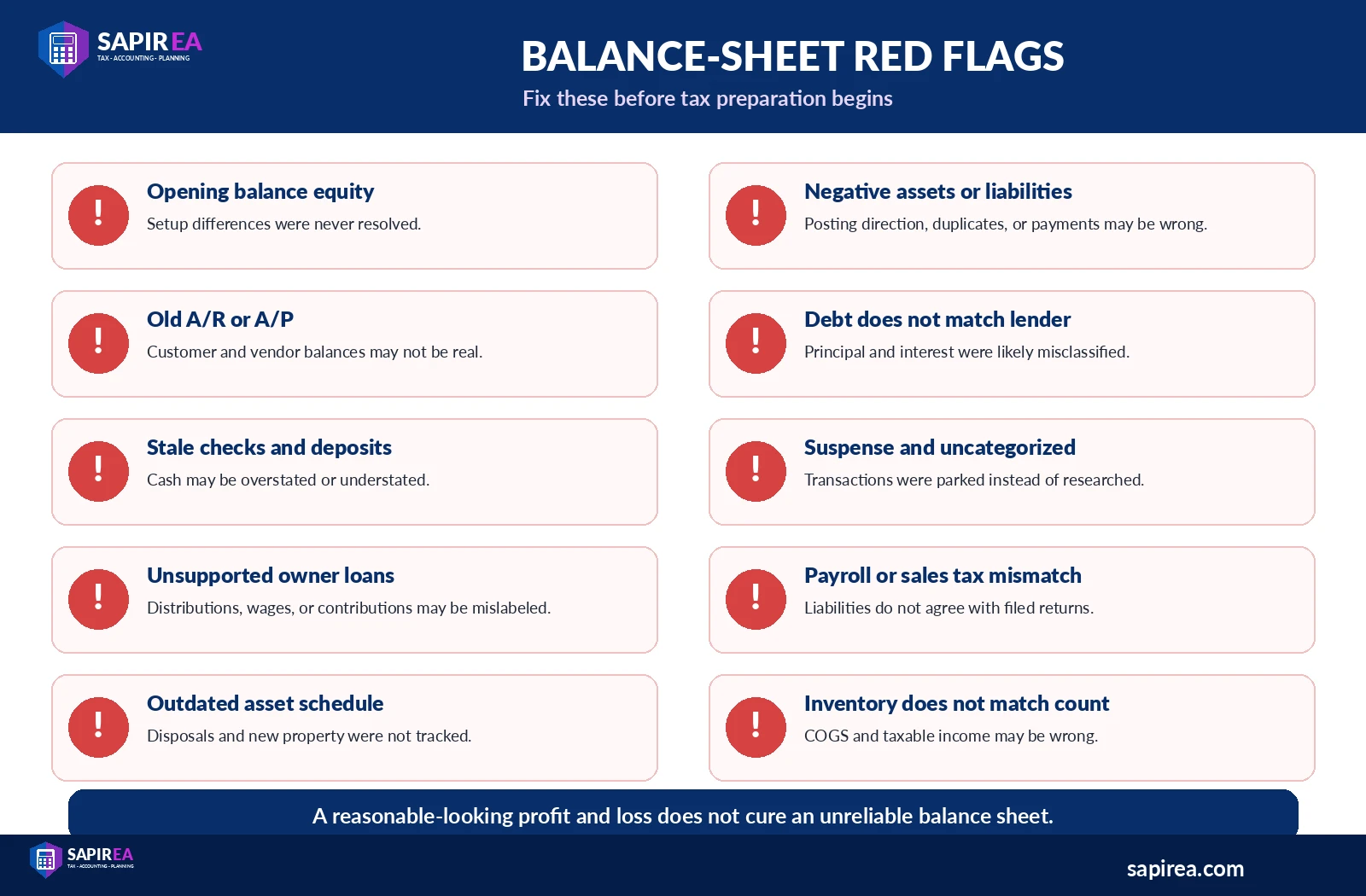
Balance-sheet problems that can distort taxable income and financial reporting.
7. Clean Up Owner, Shareholder, and Partner Transactions
Owner activity should never be buried in ordinary operating expenses.
Separate contributions, draws, distributions, wages, reimbursements, loans, personal expenses, and business expenses paid personally. The correct treatment depends on the entity type and the facts.
| Transaction | Sole proprietor or single-member LLC | S corporation | Partnership or multi-member LLC |
|---|---|---|---|
| Owner cash withdrawal | Owner draw | Distribution, loan, or wages depending on facts | Distribution or guaranteed payment depending on facts |
| Owner deposits cash | Owner contribution | Capital contribution or loan | Capital contribution or partner loan |
| Owner performs services | No W-2 to owner | Shareholder-employee may require reasonable W-2 compensation | Partner generally is not a W-2 employee of the partnership |
| Business pays personal cost | Owner draw | Distribution, wages, or receivable from shareholder | Distribution or receivable from partner |
| Owner pays business cost personally | Business expense plus owner contribution | Reimbursement, contribution, or loan | Reimbursement, contribution, or partner loan |
S corporation owners should separately review compensation, health insurance, reimbursements, distributions, and shareholder loans. Partnerships should review guaranteed payments, allocations, contributions, distributions, and debt. Owner loans should have written support and actual repayment activity.
Related resources: SAPIR EA Business Tax Strategy and Compliance and the S corporation tax strategies guide.
8. Reconcile Payroll, Benefits, and Year-End Forms W-2
Payroll should tie across the payroll provider, general ledger, bank account, quarterly Forms 941, state payroll returns, and year-end Forms W-2 and W-3.
Before the final payroll, review:
- Employee legal names, addresses, and Social Security numbers
- Gross wages by employee
- Federal, Social Security, Medicare, state, and local withholding
- Employer payroll taxes
- Pretax retirement and benefit deductions
- Taxable fringe benefits
- Personal use of company vehicles
- Group-term life insurance
- Third-party sick pay
- More-than-2% S corporation shareholder health insurance
- Bonuses and owner compensation
- Outstanding payroll tax notices or deposit differences
For 2026 Forms W-2, employers have new reporting items for cash tips and qualified overtime compensation. Code TP is used for total cash tips reported to the employer, code TT is used for qualified overtime compensation, and Box 14b identifies the Treasury Tipped Occupation Code when applicable. Businesses with tipped employees or overtime should confirm that their payroll systems captured the required data before the final payroll closes.
The due date for filing 2026 Forms W-2 with the Social Security Administration and furnishing them to employees is February 1, 2027. The W-2/W-3 totals should agree with the related employment tax returns. Employment tax records generally should be retained for at least four years after filing the fourth-quarter return for the year.
The employer remains responsible even when a payroll company processes the forms, so review all year-end adjustments.
9. Prepare Contractor Records and Forms 1099 Before January
The best time to obtain a Form W-9 is before the first payment, not after year-end.
Run a vendor payment report and confirm each potential payee's legal name, address, entity type, taxpayer identification number, payment method, and total paid.
Worker classification also matters. Calling someone a contractor, paying by check, or receiving an invoice does not determine status. The IRS considers behavioral control, financial control, and the relationship of the parties. A misclassified employee can create employment-tax exposure.
Important 2026 information-reporting changes
Under the 2026 information-return instructions, the general reporting threshold for many categories on Forms 1099-NEC and 1099-MISC increased from $600 to $2,000 for tax years beginning after 2025. Do not apply that amount to every payment. Exceptions remain, including $10 royalty reporting and $600 reporting for certain attorney gross proceeds and cash purchases of fish for resale. State reporting thresholds can also differ.
The 2026 Form 1099-NEC and Form 1099-MISC revisions also include fields for cash tips, Treasury Tipped Occupation Codes, and qualified overtime compensation where applicable.
Businesses filing 10 or more information returns in the aggregate generally must e-file unless a waiver applies. For tax year 2026 filings, IRIS replaces FIRE, so self-filers should confirm IRIS access and a Transmitter Control Code before January.
Forms 1099-NEC for 2026 are generally due to the IRS and recipient on February 1, 2027 because January 31 falls on a Sunday. Collecting W-9s, reviewing payment methods, and resolving missing taxpayer identification numbers before December ends is far easier than correcting forms later.
Contractor readiness comparison
| Not ready | Ready for filing season |
|---|---|
| W-9 requested after the final payment | W-9 collected before payment or onboarding |
| Contractor names do not match tax IDs | Legal names and TINs reviewed or matched |
| Card and ACH payments are mixed together | Payment methods are identified to avoid duplicate reporting |
| Employee-like workers are automatically treated as contractors | Classification facts are reviewed |
| Vendor report includes reimbursements and loan payments | Reportable service payments are separated from nonreportable items |
| Filing access is set up in late January | IRIS access and filing responsibility are confirmed in advance |
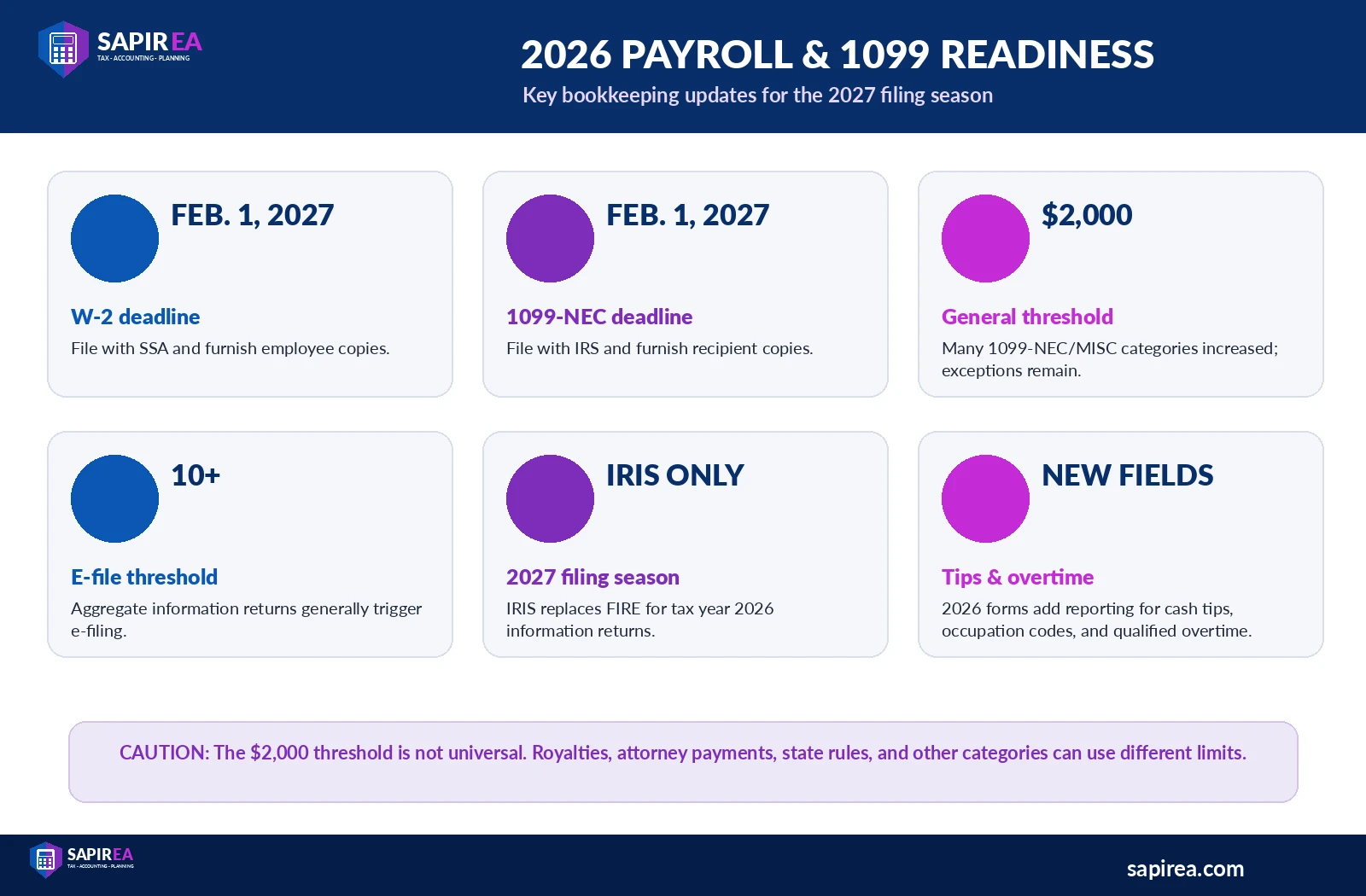
Key 2026 payroll and information-return changes for the 2027 filing season.
10. Produce a Tax-Ready Closing Package and Lock the Books
A year-end close should end with a package another qualified professional can follow. Retain:
- Year-end profit-and-loss statement
- Year-end balance sheet
- Trial balance and general ledger
- Bank and credit-card reconciliation reports
- Accounts-receivable and accounts-payable aging reports
- Inventory count and valuation support
- Fixed-asset additions and disposal list
- Loan and lease statements
- Payroll registers, Forms 941, and year-end payroll reconciliation
- Contractor report and Forms W-9
- Sales-tax and payroll-tax returns
- Owner contribution, distribution, and loan schedules
- Estimated tax and PTET payment confirmations
- Documentation for material or unusual transactions
Compare current results with the prior year and budget. Investigate material changes in revenue, margin, payroll, contractors, major expenses, and owner activity.
After adjustments are approved, lock the period, restrict edits, save the close package, and document later changes so the books continue to agree with the filed return.
Clean books vs. tax-ready books
| Clean-looking books | Tax-ready books |
|---|---|
| Transactions are categorized | Accounts are reconciled to external statements |
| Profit and loss appears reasonable | Profit and loss and balance sheet both agree to support |
| Bank feed has no open items | Old reconciliations and cutoff items were reviewed |
| Owner charges are coded somewhere | Owner activity is classified by entity and documented |
| Payroll expense matches cash withdrawals | Payroll ledger, Forms 941, W-2/W-3, and general ledger reconcile |
| Contractor expense has a total | W-9s, payment methods, thresholds, and filing requirements are reviewed |
| Equipment appears in an expense account | Fixed assets, disposals, and placed-in-service dates are documented |
| Reports can be printed | A complete close package can be reproduced and explained |
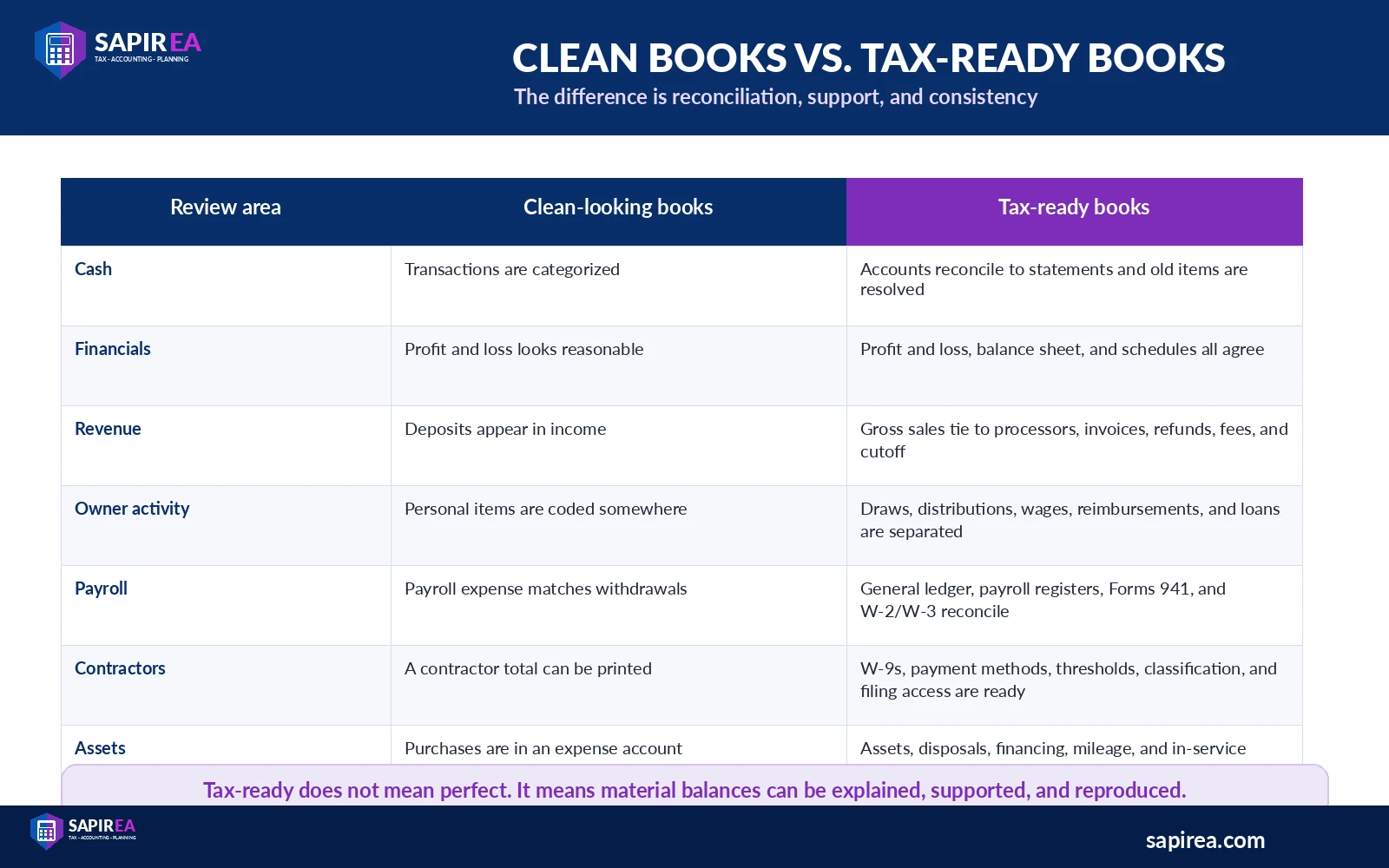
Tax-ready books go beyond categorization by tying every material balance to support.
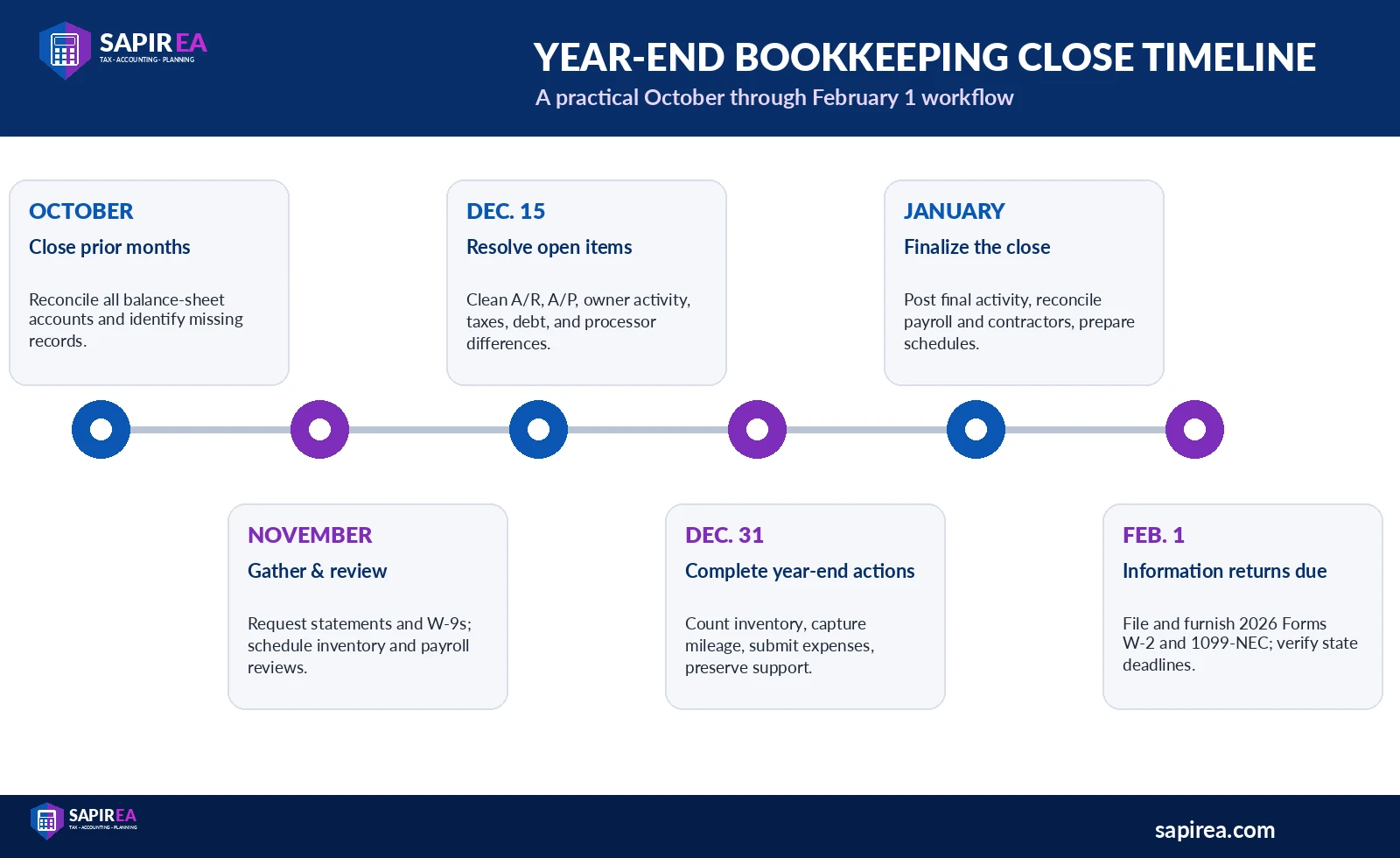
A practical October through February 1 year-end close workflow.
A Practical Year-End Bookkeeping Timeline
By October 31
Close the books through September or October, reconcile all balance-sheet accounts, review year-to-date profit, and identify cleanup projects that require source documents.
By November 30
Obtain missing bank, loan, payroll, processor, and credit-card statements. Request Forms W-9. Schedule inventory counts. Review payroll adjustments, owner compensation, benefits, and fixed-asset purchases.
By December 15
Resolve old receivables and payables, document owner loans and reimbursements, reconcile sales tax and payroll tax, and prepare preliminary financial statements for tax planning.
By December 31
Complete transactions that must occur within the tax year, perform inventory counts, capture year-end mileage and odometer readings, submit expense reports, and preserve supporting documents.
During January 2027
Post final bank and processor activity, complete payroll and contractor reconciliations, finalize the close package, prepare Forms W-2 and 1099, deliver records to the tax professional, and lock the books after approved adjustments.
Common Year-End Bookkeeping Mistakes
Avoid these recurring problems:
- Waiting until tax season to reconcile the entire year.
- Reviewing only the profit-and-loss statement and ignoring the balance sheet.
- Treating every deposit as income and every withdrawal as an expense.
- Recording loan principal, transfers, owner draws, or credit-card payments as deductions.
- Using Forms 1099-K as the revenue ledger.
- Leaving personal expenses mixed with business costs.
- Failing to record inventory, fixed assets, debt, or owner loans accurately.
- Requesting W-9s after contractors are no longer responsive.
- Assuming a payroll company will identify every taxable fringe benefit.
- Continuing to edit the books after tax preparation without tracking changes.
How SAPIR EA Helps Businesses Get Year-End Ready
SAPIR EA provides virtual bookkeeping, QuickBooks setup and cleanup, monthly reconciliations, financial reporting, business tax planning, and year-end tax support nationwide. Engagements can include cleanup, account reconciliation, missing-record review, owner and payroll organization, and tax-ready financial statements.
Related SAPIR EA resources:
- Virtual Bookkeeping and QuickBooks Services
- Business Tax Strategy and Compliance
- Tax Preparation and Year-Round Planning
- Year-End Tax Planning for Profitable LLC Owners
- 2026 Tax Changes for Business Owners
If your reports contain unexplained balances, unreconciled accounts, missing W-9s, or owner transactions that are difficult to classify, begin the review before December. The earlier the cleanup starts, the more time remains to make sound tax and business decisions.
Need help getting the books tax-ready? SAPIR EA provides QuickBooks cleanup, catch-up bookkeeping, recurring reconciliations, financial reporting, and year-end tax coordination. Schedule a bookkeeping consultation.
Frequently Asked Questions
When should a business begin the year-end bookkeeping close?
Begin in October or November by closing prior months, gathering statements, and resolving old items. Waiting until January compresses bookkeeping, payroll, information reporting, and tax planning into the same short period.
Can a business prepare a tax return from an unreconciled profit-and-loss statement?
Sometimes, but the risk of error is much higher. Unreconciled cash, debt, payroll, inventory, owner accounts, and liabilities can materially change the return.
Why does the balance sheet matter if the business is taxed on profit?
It reveals missing debt, owner transactions, unreconciled taxes, unrecorded assets, and prior-year differences. For pass-through entities, it also supports basis, distributions, loans, and return schedules.
Should Form 1099-K equal gross receipts on the tax return?
Not necessarily. Reconcile it to gross sales and document refunds, fees, shared revenue, sales tax, tips, and amounts captured elsewhere.
What is the Form 1099-NEC reporting threshold for 2026 payments?
The general threshold for many nonemployee service payments increased to $2,000 for tax years beginning after 2025. Exceptions and state rules remain.
When are 2026 Forms W-2 and 1099-NEC due?
The federal due date is February 1, 2027, because January 31 falls on a Sunday. State and local deadlines may differ.
What changed with electronic Form 1099 filing for 2027?
IRIS will be the only IRS information-return intake system for tax year 2026 filings. Self-filers should confirm access before January.
Do all contractors need a Form W-9?
Generally, obtain Form W-9 from U.S. vendors when it may be needed for reporting or backup withholding. Foreign payees may require other forms.
How long should employment tax records be kept?
Generally, keep employment tax records at least four years after filing the fourth-quarter return; some items require longer.
Does a business need a physical inventory count every year?
Product businesses need records supporting ending inventory and cost of goods sold. A physical or reliable cycle count verifies the system against goods on hand.
How should owner-paid business expenses be recorded?
Record the expense and the related reimbursement, contribution, or loan based on the entity and facts.
What should a business do with old unreconciled transactions?
Investigate them. They may be duplicates, stale checks, missing deposits, opening-balance errors, or legitimate outstanding items. Do not force a reconciliation without finding the cause.
Should the books be locked after year-end?
Yes. Lock the period after adjustments, restrict changes, and document later corrections, including any effect on tax or payroll filings.
Can SAPIR EA help with a one-time QuickBooks cleanup?
Yes. SAPIR EA offers setup, catch-up, cleanup, recurring bookkeeping, reconciliations, and tax-ready reporting. Scope depends on the file and records available.
Official Sources and Editorial Notes
This article is based in part on IRS Publication 583, Publication 538, the 2026 General Instructions for Forms W-2 and W-3, Publication 1099, the 2026 Instructions for Forms 1099-MISC and 1099-NEC, employment tax recordkeeping guidance, and worker-classification guidance.
Tax and information-reporting requirements can change. State and local rules may differ. This article is educational and does not constitute individualized tax, legal, payroll, or accounting advice.