2026 Business Mileage Rate: 76¢ After July 1
IRS Business Mileage Rate Increased to 76 Cents Effective July 1, 2026: A Complete Guide for Business Owners
Updated July 16, 2026
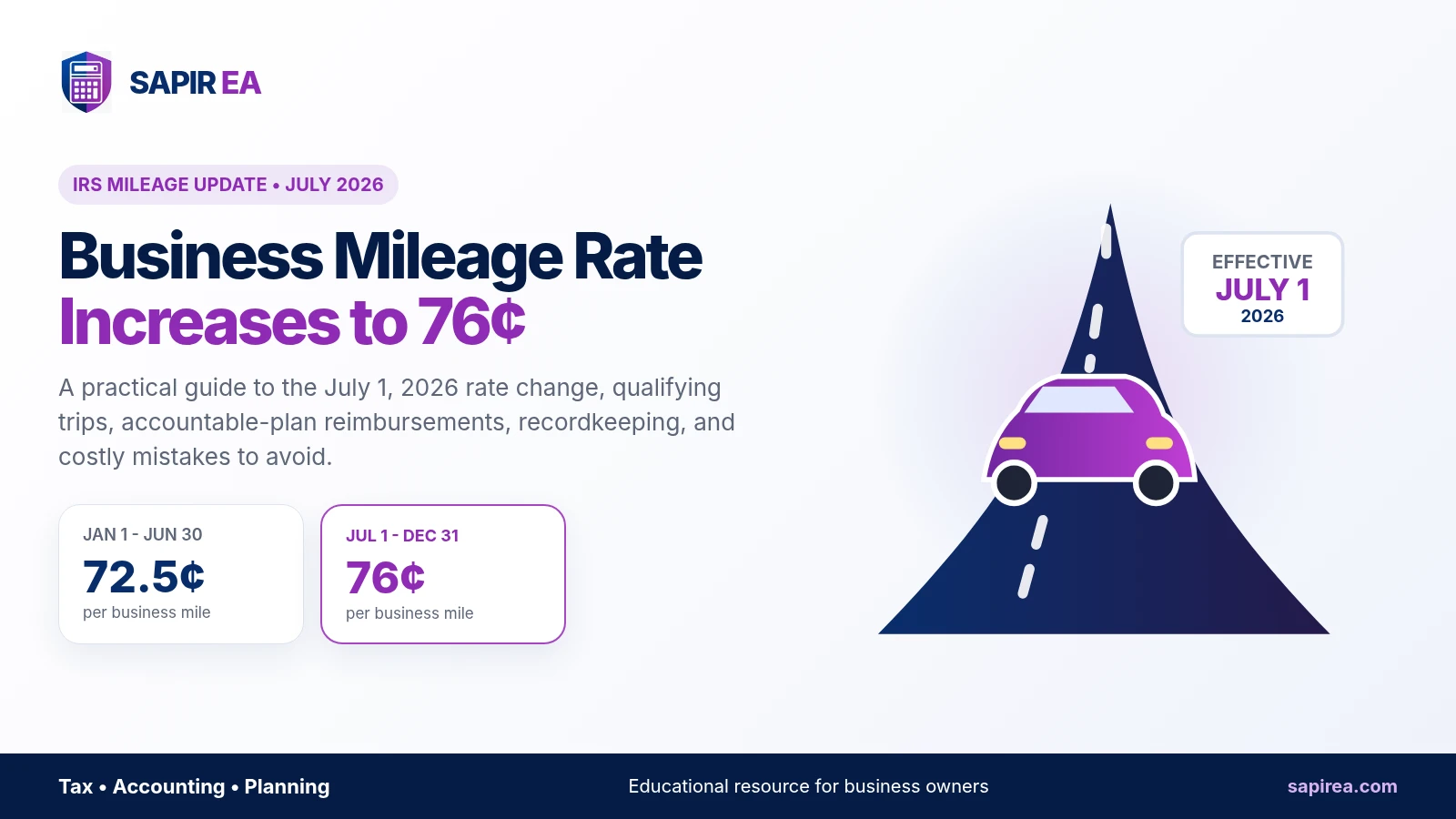
The IRS business mileage rate increased in the middle of 2026. Beginning July 1, 2026, the optional standard mileage rate for business driving is 76 cents per mile, up from 72.5 cents per mile for business miles driven from January 1 through June 30, 2026.
That 3.5-cent increase may look small, but it can materially affect deductions and employee reimbursements. A business with 20,000 qualifying miles in the second half of the year could generate $700 more in mileage deductions or tax-free reimbursements than it would have at the first-half rate. The change also creates a recordkeeping challenge: every 2026 mileage log, reimbursement policy, bookkeeping workflow, and year-end tax calculation must separate miles driven before July 1 from miles driven on or after July 1.
This guide explains the 2026 business mileage rate change, which trips qualify, how the standard mileage method compares with actual vehicle expenses, how accountable-plan reimbursements work, and the mistakes most likely to create an IRS problem. You can also download the SAPIR EA Excel mileage tracker and printable mileage log included with this article.
Quick answer: Use 72.5 cents per business mile for qualifying miles driven from January 1 through June 30, 2026, and 76 cents per business mile for qualifying miles driven from July 1 through December 31, 2026. Do not apply the 76-cent rate to the entire year.
Download the 2026 Excel Mileage Log | Download the Printable Mileage Log
2026 Standard Mileage Rates at a Glance
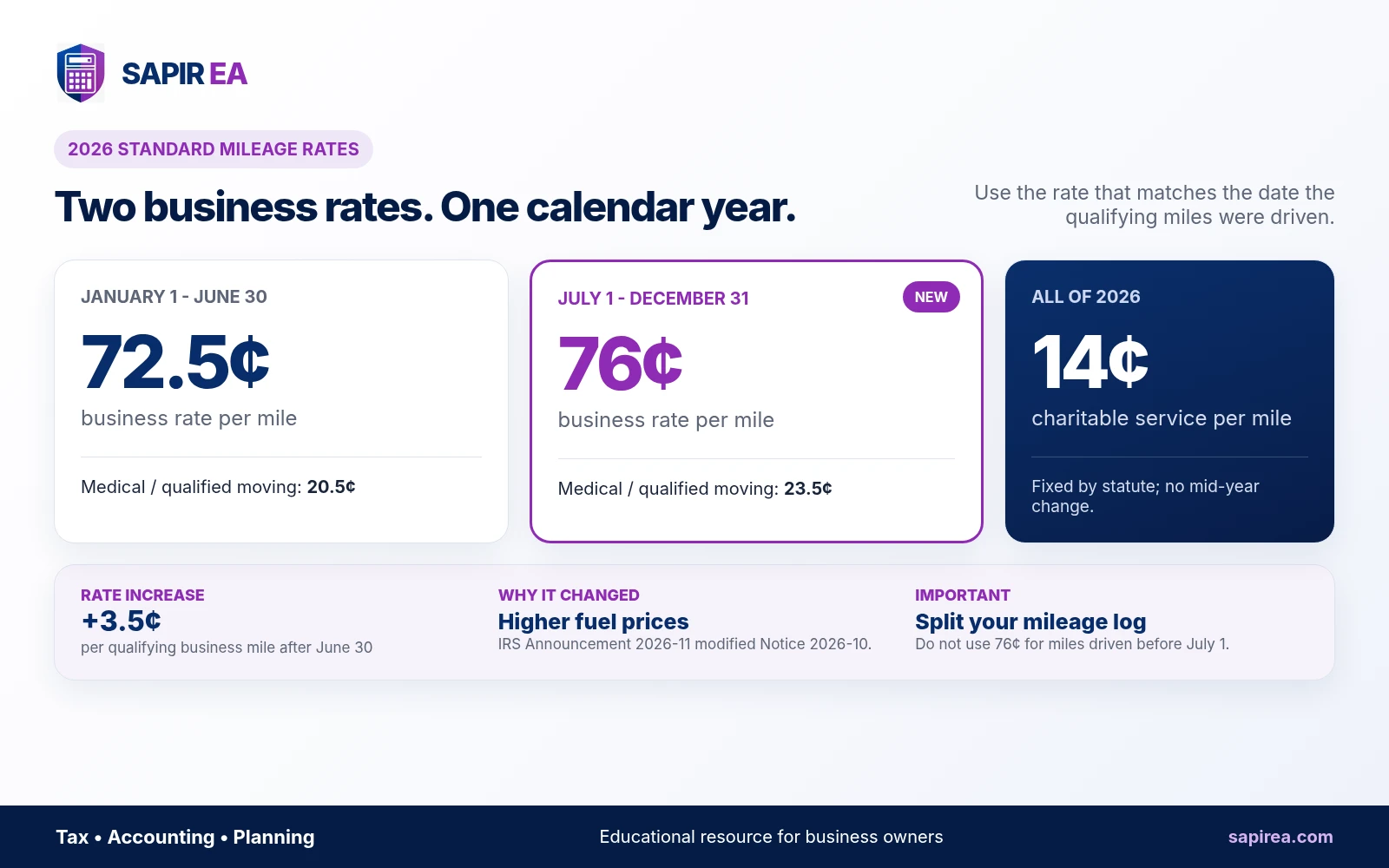
The IRS revised the optional business, medical, and moving mileage rates because of recent increases in fuel prices. The charitable mileage rate did not change because it is set by federal law rather than through the IRS annual cost study.
| Purpose | January 1-June 30, 2026 | July 1-December 31, 2026 | Mid-year change |
|---|---|---|---|
| Business use | 72.5 cents per mile | 76 cents per mile | +3.5 cents |
| Medical use | 20.5 cents per mile | 23.5 cents per mile | +3 cents |
| Qualified moving use | 20.5 cents per mile | 23.5 cents per mile | +3 cents |
| Charitable service | 14 cents per mile | 14 cents per mile | No change |
The moving rate is available only when the underlying moving expense is deductible. For 2026, that generally means qualifying active-duty Armed Forces moves and certain qualifying intelligence-community moves. Most business owners will be focused on the 76-cent business rate.
What Exactly Changed on July 1, 2026?
IRS Announcement 2026-11 modified the original 2026 mileage-rate notice. The revised business rate applies to deductible transportation expenses paid or incurred on or after July 1, 2026. For employee mileage allowances, the revised rate applies when the allowance is both paid on or after July 1 and relates to transportation expenses the employee incurred on or after July 1.
That second rule matters. Suppose an employee submits 600 business miles driven in June, but the employer processes the reimbursement on July 10. Those are still June miles, so the federal deemed-substantiation rate is 72.5 cents per mile, not 76 cents. The reimbursement date alone does not convert first-half miles into second-half miles.
The 76-cent rate is optional. It is not a government mandate requiring every employer to reimburse employees at 76 cents. An employer may reimburse at a lower rate, reimburse actual expenses, use a qualifying fixed-and-variable-rate plan, or choose not to reimburse unless state law, an employment agreement, or company policy requires it. The tax treatment depends on how the plan is structured and documented.
The mid-year announcement left the other provisions of Notice 2026-10 in place. One easily overlooked provision is the 35-cent-per-mile depreciation component for 2026. A taxpayer using the standard mileage method must reduce the vehicle's tax basis by the depreciation amount treated as included in the mileage rate. This basis adjustment can affect gain or loss when the vehicle is later sold or traded.
Why the Business Mileage Rate Changed
The rate approximates fixed and variable vehicle costs, including depreciation, insurance, repairs, tires, fuel, oil, registration, and licensing. The IRS attributed the July increase to higher fuel prices. It is a standardized substantiation method, not a statement that every driver spends exactly 76 cents per mile, so eligible taxpayers should still compare it with actual expenses.
Who Can Benefit From the 2026 Business Mileage Rate?
The rate is most commonly used by sole proprietors, independent contractors, farmers, and single-member LLC owners who deduct qualifying vehicle costs on their business returns. It is also commonly used by partnerships and corporations reimbursing employees - including S corporation shareholder-employees - for documented business use of personal vehicles. A few narrow categories of employees remain eligible to deduct unreimbursed travel expenses directly.
Most ordinary W-2 employees cannot claim a federal deduction for unreimbursed business mileage. The 2026 mileage notice reflects the permanent disallowance of most miscellaneous itemized deductions for unreimbursed employee travel. For many employees, the practical solution is not an individual tax deduction but a well-designed employer reimbursement arrangement.
Business owners should coordinate mileage with their broader year-round tax planning. A larger mileage deduction may reduce taxable business income and estimated tax needs, while an accountable-plan reimbursement may move vehicle costs from the owner personally to the business without treating the reimbursement as wages.
What Counts as Business Mileage?
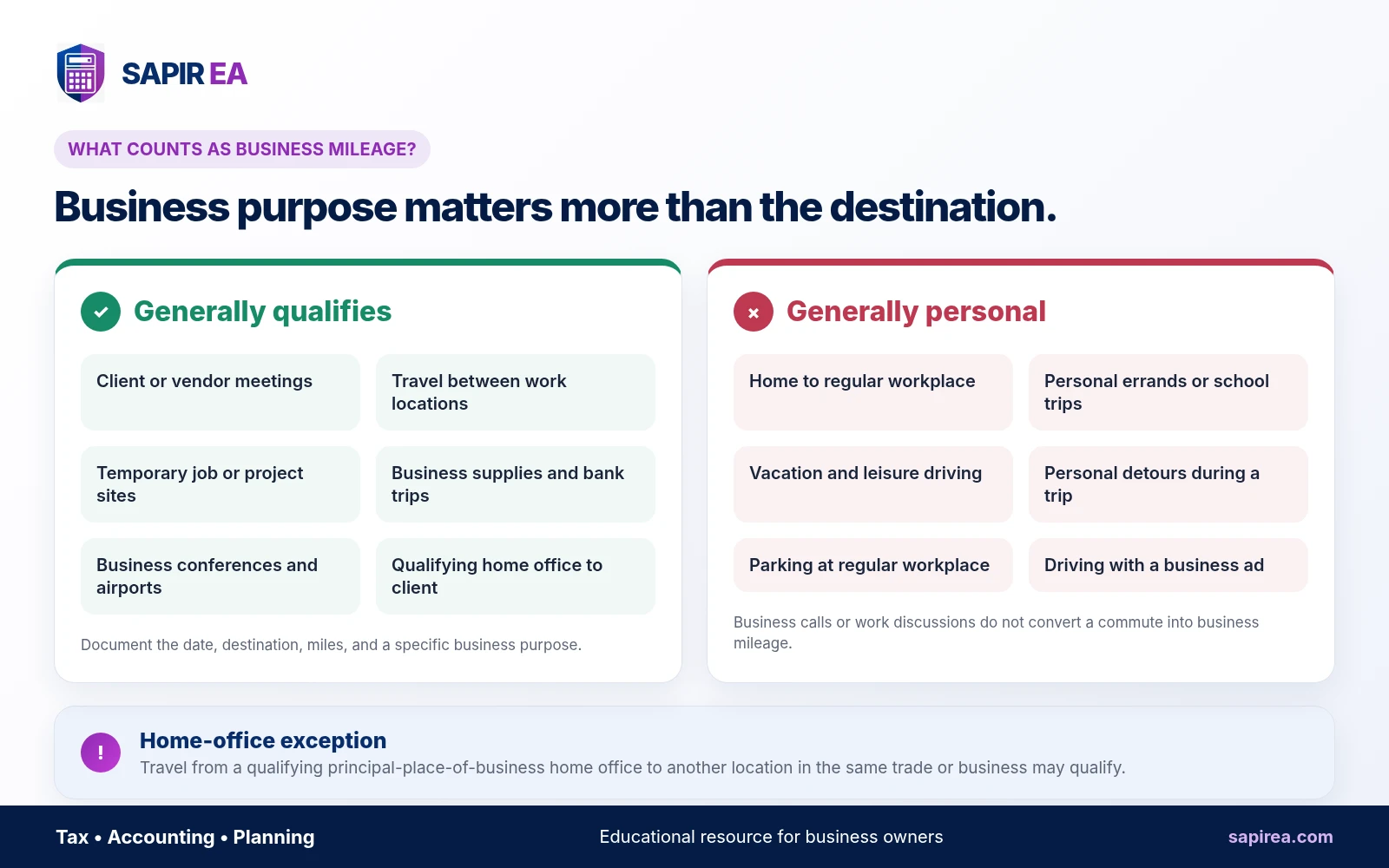
Business mileage generally means transportation that is ordinary and necessary for carrying on a trade or business. Common examples include driving:
- Between business locations or to a temporary job site.
- To meet customers, vendors, lenders, or other business contacts.
- To buy supplies, inventory, postage, or equipment.
- To an airport, conference, trade show, or professional-education event for business.
- Between a qualifying principal-place-of-business home office and another location in the same trade or business.
- To inspect or manage rental property when the travel is properly connected to the rental activity.
The business purpose should be specific enough that a reviewer can understand why the trip was connected to the business. "Meeting with ABC client about 2027 contract" is stronger than "business trip." "Pick up printer toner for office" is stronger than "errand."
What Does Not Count as Business Mileage?
The most common disallowed category is commuting. Driving between home and a main or regular workplace is generally personal even when the commute is long, you make business calls, a coworker rides with you, the vehicle displays advertising, or you carry ordinary work materials.
Other personal miles include school drop-offs, grocery trips, vacations, medical appointments unrelated to a deductible business purpose, and personal detours. A mixed-purpose trip must be divided. For example, if you drive ten miles to meet a client and add four miles to visit a friend, the four-mile personal detour does not become business mileage.
A qualifying home office can change the commuting analysis. When a home office meets the tax rules to be the principal place of business, transportation from that office to a client or other work location in the same business may qualify. Simply answering emails at the kitchen table does not automatically create a qualifying principal place of business.
How to Calculate the 2026 Business Mileage Deduction
Because 2026 has two rates, calculate each period separately.
Example: self-employed consultant
Assume a consultant drives 12,000 documented business miles during 2026:
- 5,000 miles from January 1 through June 30.
- 7,000 miles from July 1 through December 31.
The mileage deduction is:
| Period | Business miles | Rate | Deduction |
|---|---|---|---|
| January-June | 5,000 | $0.725 | $3,625 |
| July-December | 7,000 | $0.76 | $5,320 |
| Total | 12,000 | $8,945 |
Qualifying business parking fees and tolls may generally be deducted separately when using the standard mileage method. Gas, insurance, repairs, maintenance, tires, oil, registration, lease payments, and depreciation are not added separately because those operating costs are already represented in the standard rate.
Example: reimbursement processed after the rate change
An employee drives 400 qualifying miles in June and 500 qualifying miles in July. The employer reimburses both reports on July 15.
- June: 400 x $0.725 = $290.
- July: 500 x $0.76 = $380.
- Total federal-rate reimbursement: $670.
Using 76 cents for the June mileage would create an additional $14. That excess is not automatically tax-free merely because payment occurred after July 1. Under an accountable plan, reimbursements above the federal deemed-substantiation amount generally require appropriate treatment, such as return of the excess or inclusion of the excess in wages.
Standard Mileage Rate vs. Actual Vehicle Expenses
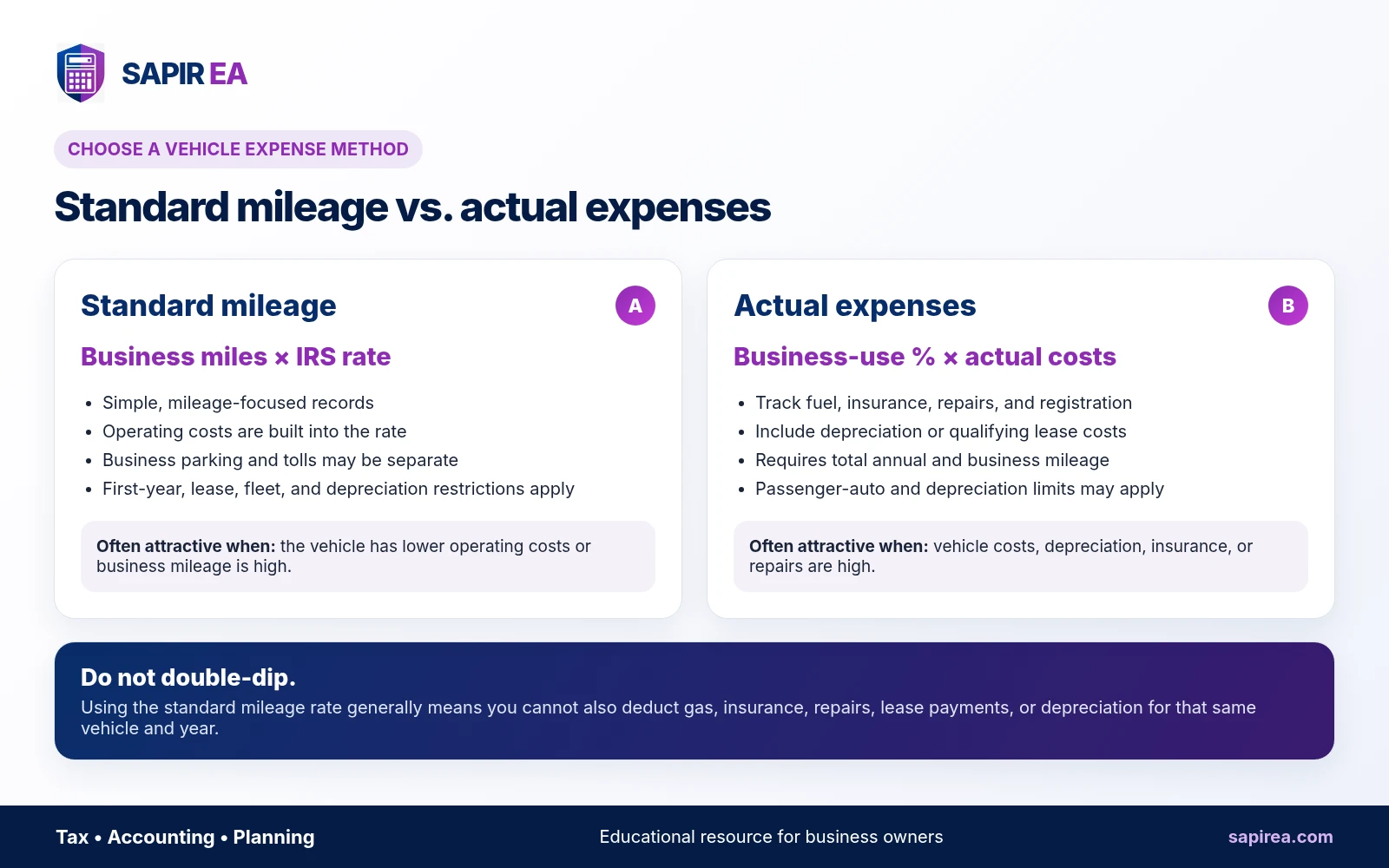
The IRS generally permits eligible taxpayers to use either the standard mileage method or actual vehicle expenses. The better result depends on the vehicle, annual costs, business-use percentage, and prior tax elections.
| Issue | Standard mileage method | Actual-expense method |
|---|---|---|
| Core calculation | Business miles x applicable IRS rate | Business-use percentage x allowable actual costs |
| Records needed | Mileage log, business purpose, annual mileage, parking and toll support | Mileage log plus receipts and records for all vehicle costs |
| Costs included | Depreciation, lease cost, fuel, oil, repairs, tires, insurance, licenses, registration | Actual depreciation or lease payments, fuel, repairs, insurance, registration, and other allowable costs |
| Administrative burden | Lower | Higher |
| Often attractive for | Lower-cost vehicles, high business mileage, simple recordkeeping | High-cost vehicles, high repairs, high insurance, heavy depreciation |
| Method limitations | First-year, lease, fleet, depreciation, Section 179, and bonus-depreciation rules apply | Passenger-auto limits and business-use rules apply |
| Parking and tolls | Generally added separately when business-related | Included as actual business expenses |
A simple comparison
Using the consultant above, the standard mileage deduction is $8,945 before separate business parking and tolls. Assume the consultant's total actual vehicle costs are $16,500 and the vehicle is used 55% for business. The preliminary actual-expense amount would be $9,075 before considering any special depreciation limits, inclusion amounts, or other adjustments.
In that simplified example, actual expenses are $130 higher. The final decision must still account for depreciation limits, method eligibility, vehicle basis, and the additional substantiation burden.
When the Standard Mileage Method Is Not Available
The standard mileage rate is convenient, but it is not available in every situation. Key restrictions include:
- Five or more vehicles used at the same time. A taxpayer generally cannot use the standard rate for vehicles used simultaneously in a fleet operation. Alternating among vehicles is different from operating five or more at once.
- Owned vehicle first-year rule. To preserve the ability to use the standard mileage method for an owned vehicle, the taxpayer generally must choose it in the first year the vehicle is available for business use.
- Leased vehicle consistency rule. Once the standard mileage method is selected for a leased vehicle, it generally must be used for the entire lease period, including renewals.
- Prior accelerated depreciation. The standard method is generally unavailable after claiming Section 179, bonus depreciation, MACRS, or another depreciation method that conflicts with the mileage rules.
- No double deduction. A taxpayer cannot use the standard mileage rate and also deduct the same vehicle's gas, insurance, repairs, lease payments, or depreciation for that year.
A large first-year depreciation deduction may be attractive, but it can eliminate the standard-mileage option. Compare methods as part of your business tax strategy before placing the vehicle in service.
Mileage Reimbursements and Accountable Plans
A properly operated accountable plan can allow an employer to deduct employee business reimbursements while excluding qualified reimbursements from the employee's taxable wages. This is particularly important for closely held corporations and S corporation shareholder-employees, who should not treat company deductions and personal expenses as interchangeable.
An accountable plan generally requires:
- Business connection. The expense must be connected to services performed for the employer.
- Substantiation. The employee must provide the date, mileage, destination, and business purpose within a reasonable period.
- Return of excess. The employee must return amounts that exceed substantiated expenses within a reasonable period.
If the arrangement fails these rules, reimbursements can become taxable wages subject to payroll-tax reporting. Flat monthly car allowances are often mishandled because the payment continues regardless of actual mileage and employees are not required to document business use or return unsubstantiated amounts.
For S corporation owners, a strong process usually looks like this: the shareholder-employee submits a contemporaneous mileage report, the corporation reimburses qualifying miles at the correct rate for the date driven, parking and tolls are separately documented, and the reimbursement is recorded in the company's books as a vehicle or travel expense. Clean accounting is essential; SAPIR EA's virtual bookkeeping services can help integrate mileage reports with the monthly close.
What a Defensible Mileage Log Should Include
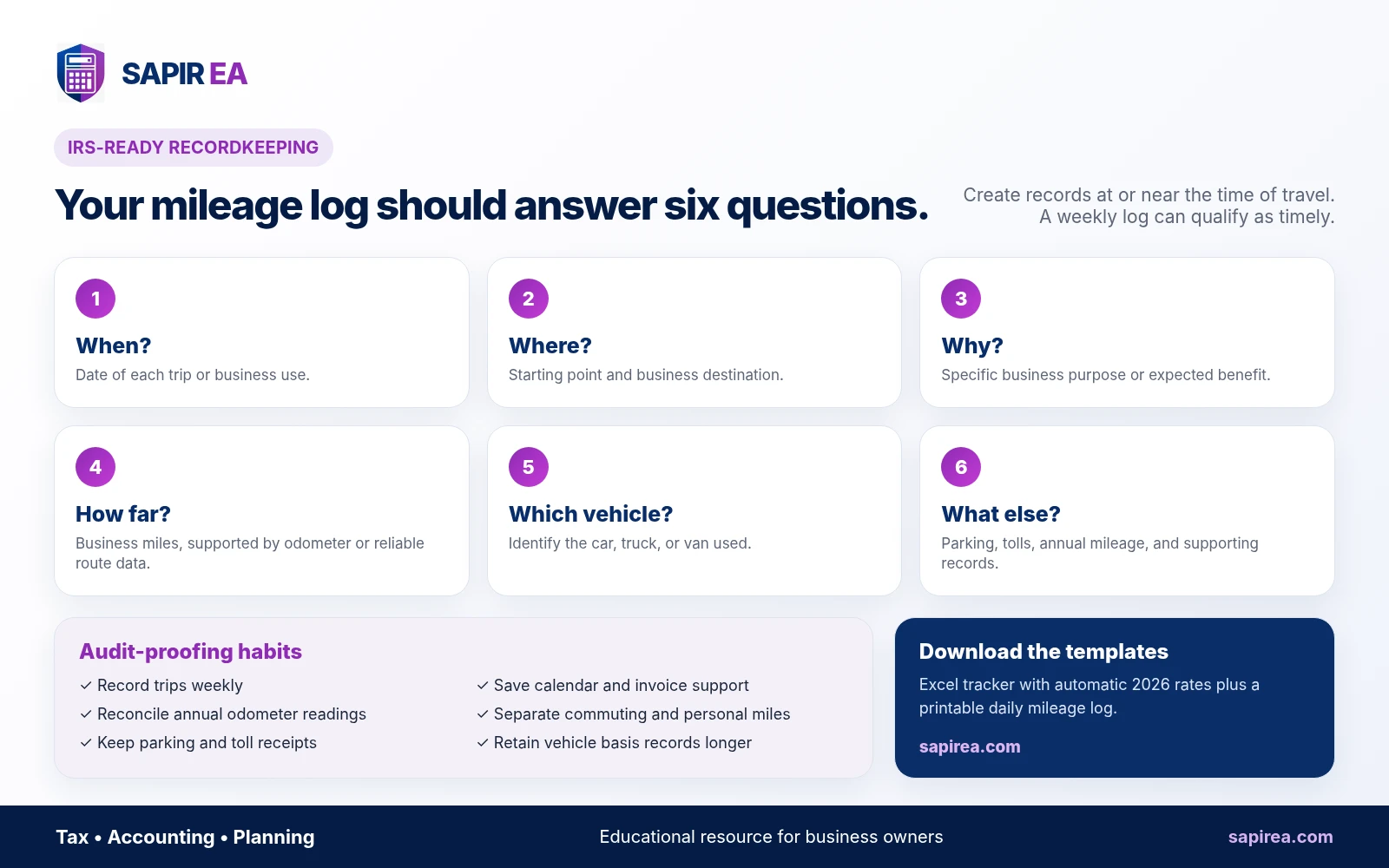
A mileage deduction is only as strong as the records supporting it. The IRS expects adequate records or other sufficient evidence. A reliable log should include:
- Date of each trip.
- Vehicle used.
- Starting point and destination.
- Specific business purpose.
- Beginning and ending odometer readings, or another reliable mileage calculation.
- Business miles for the trip.
- Personal or commuting miles when needed to reconcile total annual use.
- Parking and toll amounts.
- Annual beginning and ending odometer readings.
- Supporting documents such as appointment calendars, invoices, delivery records, conference registrations, or customer notes.
The record should be created at or near the time of the trip. The IRS recognizes that a weekly log can be timely, but a spreadsheet reconstructed eleven months later from memory is much less persuasive. GPS mileage apps can help, but an app that records only a route without a business purpose is incomplete.
Keep deduction records for at least three years after filing, and keep vehicle records longer when depreciation, basis, or business-use history can affect later years or a sale. See SAPIR EA's record retention guide.
Ten Business Mileage Mistakes to Watch For in 2026
1. Applying 76 cents to the entire year
This is the clearest 2026 error. The higher rate applies only to qualifying miles driven on or after July 1.
2. Using the reimbursement payment date instead of the travel date
A July reimbursement for June mileage remains tied to the June rate. Payroll and expense systems should apply the rate based on when the miles were driven.
3. Claiming commuting as business mileage
Home-to-regular-workplace travel generally remains personal, even when the driver handles calls or carries work materials.
4. Reconstructing a round-number log at year-end
Claims such as "1,000 miles every month" without trip-level detail invite questions. Build the record weekly and reconcile it to calendars and odometer readings.
5. Deducting gas on top of the standard rate
The standard rate already represents fuel and other operating costs. Parking and tolls may be separate; gas generally is not.
6. Switching methods without reviewing prior depreciation
A vehicle that received Section 179 or bonus depreciation may not qualify for the standard rate later. A leased vehicle may be locked into the selected method for the lease term.
7. Ignoring the vehicle basis reduction
For 2026, 35 cents of each business mile under the standard method is treated as depreciation for basis purposes. Ignoring that adjustment can understate taxable gain when the vehicle is sold.
8. Paying shareholder expenses without an accountable plan
An S corporation owner cannot simply take a personal mileage deduction for corporate business and assume the result is the same. Reimbursements should be supported, approved, paid, and recorded through the entity.
9. Assuming the IRS rate satisfies every state rule
The federal mileage rate is a tax substantiation rate. State wage-and-hour laws, employment contracts, union agreements, or local rules may impose separate reimbursement obligations.
10. Failing to reconcile total annual mileage
The IRS may ask for total miles, business miles, commuting miles, and other personal miles. Record the odometer at the beginning and end of the year and when vehicles are placed in or removed from service.
A July 1, 2026 Action Plan for Business Owners
Use this checklist to update your process now rather than fixing it during tax season:
- Update mileage apps and expense software to 72.5 cents through June 30 and 76 cents beginning July 1.
- Review outstanding June expense reports so they are not accidentally reimbursed at the second-half rate.
- Communicate the new rate and effective-date rule to employees and managers.
- Confirm that your accountable plan requires timely substantiation and return of excess reimbursements.
- Record odometer readings as of June 30 or July 1 to create a clean mid-year checkpoint.
- Separate business, commuting, and personal mileage in the log.
- Compare standard mileage with actual expenses before making a year-end method decision.
- Preserve receipts for parking, tolls, and actual vehicle expenses even if you expect to use the standard rate.
- Review vehicle purchases, depreciation elections, and S corporation reimbursements with your tax professional.
- Download and use the SAPIR EA mileage log templates below.
Download the 2026 Excel Mileage Log | Download the Printable Mileage Log
Frequently Asked Questions About the 2026 Business Mileage Rate
What is the IRS business mileage rate after July 1, 2026?
The optional standard mileage rate is 76 cents per qualifying business mile driven from July 1 through December 31, 2026.
What rate applies from January 1 through June 30, 2026?
The business rate for the first half of 2026 is 72.5 cents per mile. The year must be split into two mileage-rate periods.
Can I use 76 cents for June mileage if I reimburse it in July?
Generally, no. The revised deemed-substantiation rate applies when the reimbursement is paid on or after July 1 and the related transportation expense was incurred on or after July 1. June mileage remains subject to the first-half rate.
Is an employer required to reimburse employees at 76 cents per mile?
Federal tax law does not generally require reimbursement at the IRS rate. The rate is an optional substantiation amount. Company policy, employment agreements, and state or local law may impose separate obligations.
Can I deduct gas, insurance, or repairs in addition to 76 cents per mile?
Not for the same vehicle and year when using the standard mileage method. Those operating costs are represented in the rate. Qualifying business parking and tolls may generally be deducted separately.
Can an S corporation reimburse its owner for business mileage?
Yes, when the owner is an employee and the reimbursement is made under a properly documented accountable plan. The owner should submit timely mileage records and the corporation should record and pay the reimbursement.
Do I need odometer readings if I use a GPS mileage app?
A GPS app is helpful, but annual odometer readings support total-mile reconciliation. The log should also contain dates, destinations, business purposes, and business miles.
Can I switch from actual expenses to the standard mileage rate?
It depends on the vehicle's history. Prior Section 179, bonus depreciation, MACRS, or certain other depreciation choices can prevent use of the standard rate. Leased vehicles are also subject to consistency rules.
Are commuting miles ever deductible?
Ordinary travel between home and a main or regular workplace is generally nondeductible commuting. Transportation from a qualifying home office that is the principal place of business to another work location in the same business may qualify.
How long should I keep mileage records?
Records supporting a deduction are generally kept for at least three years after filing, but vehicle records may need to be retained longer because depreciation, basis, and business-use history can affect later returns and a future sale.
The Bottom Line
The new 76-cent business mileage rate effective July 1, 2026 creates a larger potential deduction or reimbursement, but it also creates an easy compliance trap. Every taxpayer and employer using the rate must split the year, apply the rate based on the date of travel, distinguish business mileage from commuting, and maintain timely records.
The standard mileage method is convenient, not automatic. Vehicle history, depreciation elections, accountable-plan rules, state reimbursement laws, and actual operating costs can change the best answer. A clean mileage log and coordinated bookkeeping process are the foundation for claiming the deduction confidently.
SAPIR EA helps self-employed taxpayers and business owners evaluate vehicle deductions, establish accountable reimbursement plans, integrate mileage with bookkeeping, and prepare accurate business tax returns. Learn more about our tax preparation and planning services, explore our business tax consulting services, or contact SAPIR EA to schedule a review.
Primary IRS Sources
- IRS Announcement 2026-11: revised mileage rates effective July 1, 2026
- IRS Notice 2026-10: original 2026 rates, method rules, and basis-reduction amount
- IRS Publication 463: travel, vehicle-expense, reimbursement, and recordkeeping rules
- Revenue Procedure 2019-46: standard-mileage and mileage-allowance substantiation rules
This article is for general educational purposes and does not constitute individualized tax, legal, accounting, or employment-law advice. Tax results depend on your facts, vehicle history, entity structure, records, and applicable state law.