2026 Year-End Tax Planning Checklist for Small Business Owners

A practical 2026 checklist covering books, estimated taxes, payroll, depreciation, retirement plans, PTET, QBI, reporting and the actions that must occur before December 31.
Year-end tax planning is not the same as tax preparation. Preparation reports what already happened. Planning asks what can still be changed before the calendar closes.
For calendar-year businesses, December 31 is a hard dividing line for payroll, shareholder compensation, retirement deferrals, equipment placed in service, many reimbursements, and numerous owner-level transactions. The objective is not to manufacture deductions or spend unnecessarily. It is to lower taxes where appropriate, preserve cash, support every deduction, and begin 2027 with accurate books.
This guide provides a practical checklist for sole proprietors, LLCs, partnerships, S corporations, and closely held C corporations. It also highlights important 2026 changes, including permanent 100% bonus depreciation, higher Section 179 limits, updated QBI rules, split-year mileage rates, new W-2 reporting for tips and overtime, and the expanded individual SALT deduction limit.
Key point: Spending $100 solely to save $30 of tax still reduces cash by $70. Model the tax effect, cash-flow effect, and business purpose together.
Year-End Tax Planning at a Glance
Before December 31, most small business owners should complete five core tasks:
- Close the books through the latest available month and correct errors.
- Run a full-year tax projection for the business and its owners.
- Identify decisions that must be completed by December 31.
- Confirm federal, state, local, payroll, sales-tax, and PTET payments.
- Document the business purpose and support for every material deduction.
The sections below explain how to work through those tasks in an organized way.
1. Start With Accurate Books, Not Tax Ideas
Tax planning based on incomplete bookkeeping can produce false savings or missed payments. Before discussing deductions, reconcile every bank, credit-card, loan, payroll, merchant, receivable, payable, inventory, fixed-asset, owner-equity, and tax account.
Compare 2026 year-to-date results with the prior year and budget. Investigate large changes in gross margin, payroll, contractors, repairs, professional fees, travel, owner transactions, uncategorized expenses, and negative balances.
Review receivables, bad debts, and deposits
A cash-method business generally reports income when received and deductions when paid; an accrual-method business follows different timing rules. A cash-method business usually cannot deduct an unpaid receivable that was never included in income. An accrual-method business may deduct a debt that becomes worthless when the facts support that conclusion.
Customer deposits also require classification. Some are current income; others remain liabilities until performance. Contract terms and the accounting method control.
Reconcile inventory and fixed assets
Complete or schedule a physical inventory count. Investigate shrinkage, obsolete goods, damage, negative quantities, and unsupported values. Update the fixed-asset schedule for purchases, trade-ins, disposals, abandonment, and changes between business and personal use.
Internal link: Connect this section to SAPIR EA bookkeeping and QuickBooks services.
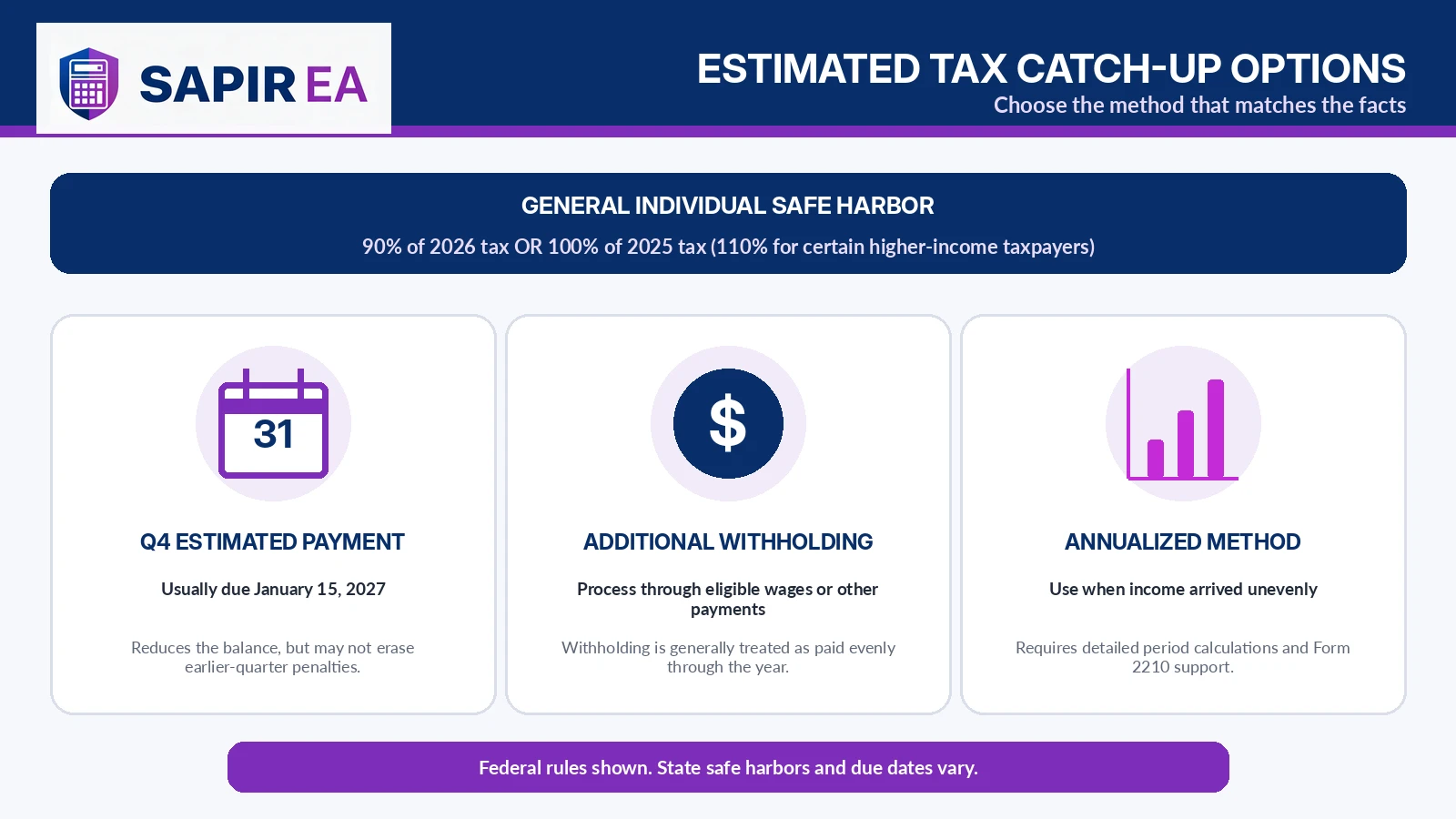 Compare a fourth-quarter estimate, additional withholding, and the annualized income method.
2. Run a 2026 Tax Projection and Recheck Estimated Payments
A year-end projection should combine the business and owner returns. Business profit alone does not capture spouse income, wages, investments, rentals, credits, state taxes, or owner-level limitations.
Estimate federal tax, payroll or self-employment tax, QBI, state and local tax, PTET credits, capital gains, prior payments, withholding, and the expected balance due.
For individuals, the general safe harbor is the smaller of 90% of current-year tax or 100% of prior-year tax. The prior-year percentage generally becomes 110% when prior-year AGI exceeded $150,000, or $75,000 for married filing separately. Taxpayers expecting to owe less than $1,000 after withholding and refundable credits generally are not required to make estimated payments.
Use the right catch-up method
| Catch-up option | How it works | Important limitation |
|---|---|---|
| Fourth-quarter estimate | Make an additional payment, generally due January 15, 2027 | Does not erase an earlier-quarter underpayment |
| Additional withholding | Increase withholding from salary, bonus, pension, or another eligible payment | Payroll and payment must be processed on time |
| Annualized method | Matches installments to income earned unevenly | Requires period-by-period calculations and Form 2210 support |
Federal withholding is generally treated as paid evenly through the year unless actual dates are elected. For an S corporation owner already receiving wages, properly processed year-end withholding may be more effective than a late estimate. Also review state, local, nonresident, composite, and PTET payments because federal safe harbors do not control state penalties.
Internal link: Link to SAPIR EA's tax preparation and year-round planning services.
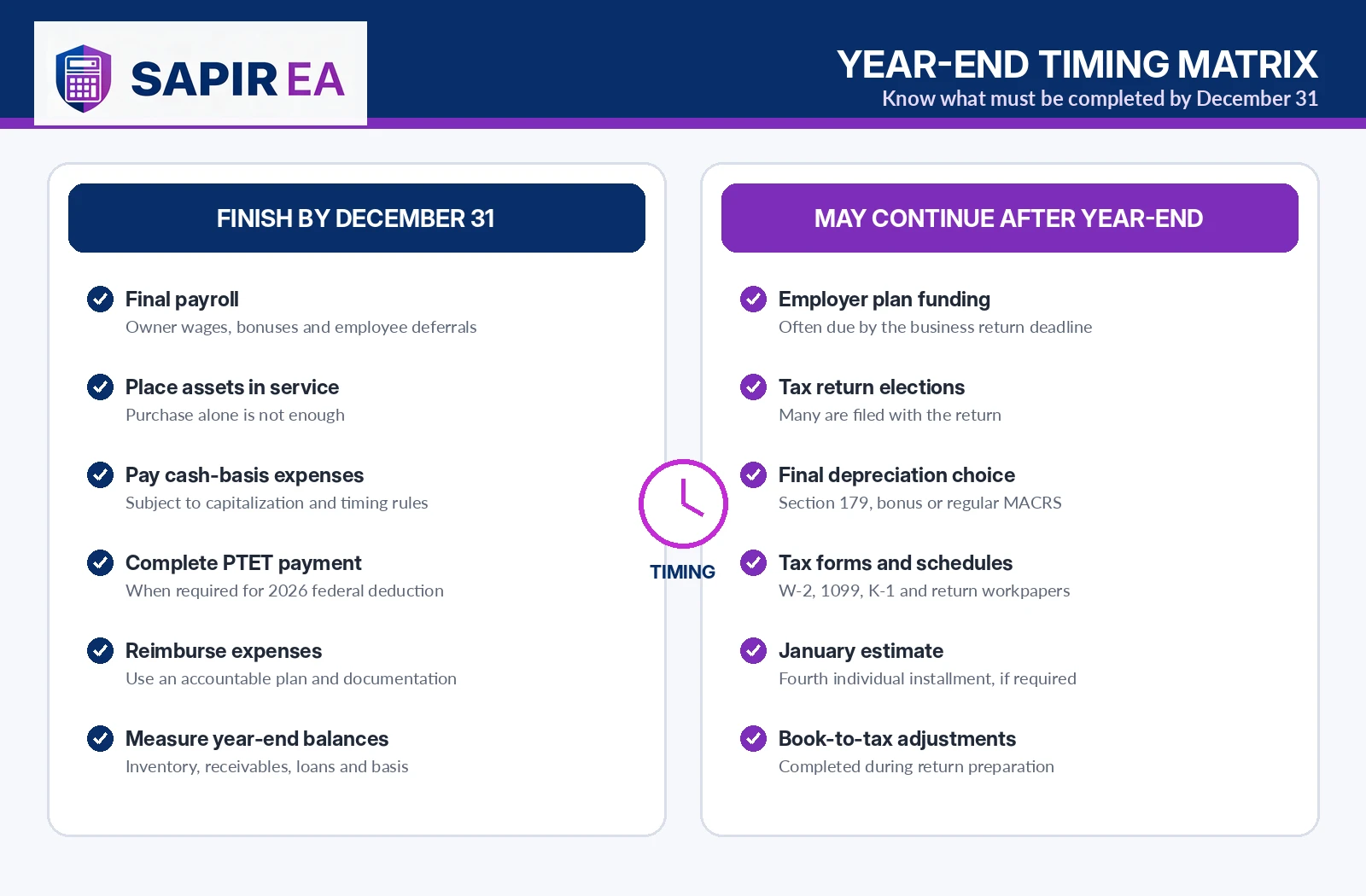
3. Separate December 31 Deadlines From Later Filing Deadlines
A common mistake is assuming every deduction can be decided when the return is prepared. Some elections and contributions may be completed after year-end, but the underlying transaction often cannot.
| Usually must occur by December 31 | May be completed after year-end, subject to the rules |
|---|---|
| Property must be purchased and placed in service | Employer retirement-plan contributions may be funded by the return deadline |
| S corporation shareholder wages and employee deferrals must run through payroll | Certain retirement plans may be established or funded after year-end if eligible |
| Cash-method expenses generally must be paid | Tax returns and many elections are filed later |
| PTET payment may be needed for a current federal deduction | Remaining PTET balance may be due with the state return |
| Accountable-plan expenses should be submitted and reimbursed under the policy | Supporting schedules can be finalized during return preparation |
| Charitable gifts generally must be completed | Appraisals and reporting forms may be prepared later |
| Inventory and year-end balances must be measured | Book-to-tax adjustments are computed later |
State PTET elections are a special risk. Some states require an election months before year-end; others make the election on the return. A December payment cannot fix a missed election deadline.
4. Evaluate Equipment Purchases and Depreciation
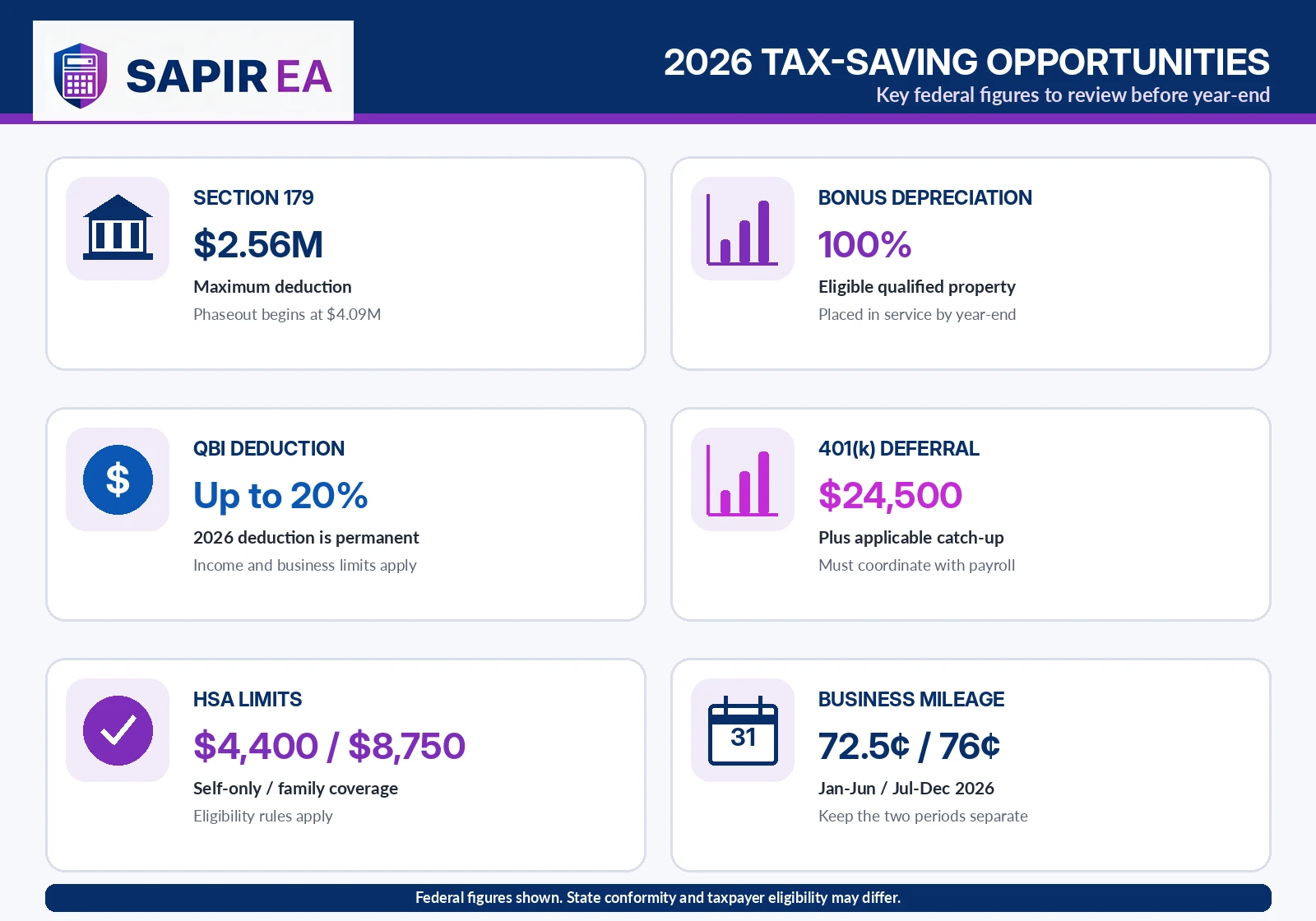
For tax years beginning in 2026, the Section 179 limit is $2,560,000, with phaseout beginning when qualifying property placed in service exceeds $4,090,000. The separate Section 179 limit for certain sport utility vehicles is $32,000.
Current law also provides permanent 100% bonus depreciation for eligible property acquired after January 19, 2025. Bonus depreciation may apply to new or used qualifying property, but not every asset qualifies.
Section 179 vs. bonus depreciation vs. regular depreciation
| Method | Potential advantage | Important restriction |
|---|---|---|
| Section 179 | Flexible asset-by-asset election; can cover certain real-property improvements | Limited by taxable business income and the investment phaseout |
| 100% bonus | May create or increase a loss and generally applies automatically | Can use too much deduction now and reduce future depreciation |
| Regular MACRS | Preserves deductions for later years | Less immediate tax relief |
The asset generally must be placed in service by December 31. An order, contract, or deposit is not enough when the property is not ready and available for use.
Model business need, financing, taxable-income limits, state conformity, vehicle limits, business-use percentage, recapture, QBI, basis, and future deductions. Do not purchase an asset solely for a write-off.
5. Review the Qualified Business Income Deduction
Eligible owners of sole proprietorships, partnerships, S corporations, and certain trusts may claim a deduction of up to 20% of qualified business income. For 2026, the Section 199A deduction is permanent and includes a minimum $400 deduction for qualifying taxpayers with at least $1,000 of active QBI, subject to the statutory rules.
The 2026 taxable-income threshold is $403,500 for married filing jointly, $201,775 for married filing separately, and $201,750 for other filers. Above the applicable threshold, W-2 wage, qualified-property, and specified-service-business limitations can reduce the deduction.
Year-end planning may include:
- Confirming that wages are reported by the correct entity
- Reviewing whether equipment placed in service affects qualified property
- Coordinating retirement contributions and other deductions with taxable income
- Evaluating aggregation of qualifying businesses
- Reviewing whether the activity is a specified service trade or business
- Preserving records for W-2 wages, basis, and business classifications
Do not assume that lowering business income always improves the total result. A deduction may reduce QBI, and salary paid by an S corporation is not QBI. The projection should compare income tax, payroll tax, retirement benefits, and the QBI deduction together.
Internal link: Add a link to the SAPIR EA article on S corporation tax strategies for high earners.
6. Maximize Retirement and Health-Benefit Opportunities
For 2026, the employee deferral limit for 401(k), 403(b), and most governmental 457 plans is $24,500. The general age-50 catch-up is $8,000, the higher catch-up for ages 60 through 63 is $11,250, and the general defined-contribution limit is $72,000, excluding catch-up contributions.
S corporation shareholder-employees make elective deferrals from W-2 wages; distributions do not support contributions. Review compensation before the final payroll.
Possible plans include a Solo 401(k), safe-harbor 401(k), profit-sharing plan, SEP IRA, SIMPLE IRA, or cash balance plan. Employer contributions may often be funded after year-end, but adoption, notices, employee eligibility, payroll deferrals, and funding rules vary.
HSA limits are $4,400 for self-only coverage and $8,750 for family coverage, plus the statutory age-55 catch-up when eligible. More-than-2% S corporation shareholder health insurance also requires special reimbursement and W-2 treatment before year-end forms are issued.
7. Complete Entity-Specific Year-End Reviews
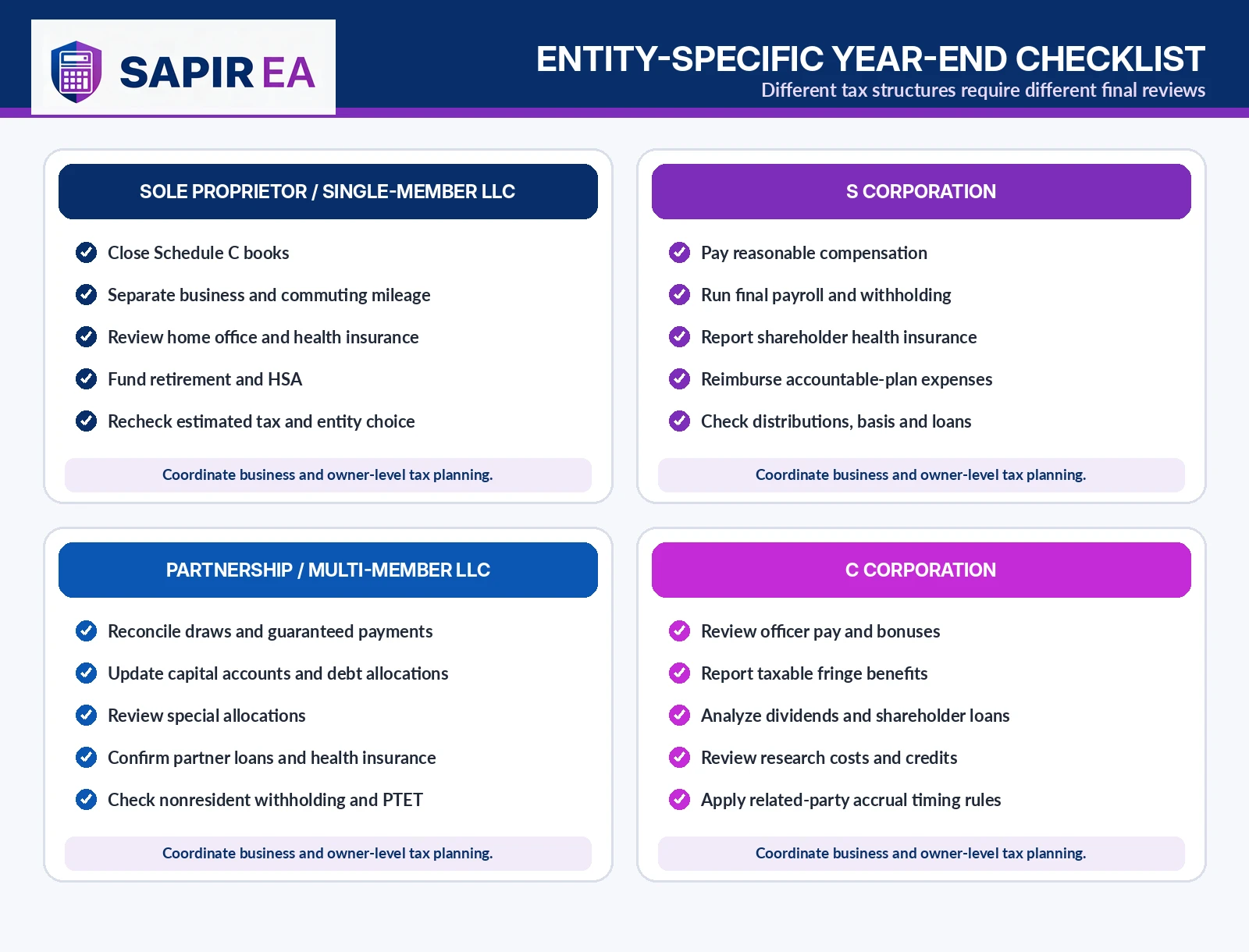
Sole proprietors and single-member LLCs
Review Schedule C categories, home-office eligibility, mileage, self-employed health insurance, retirement contributions, estimates, and whether the entity structure still fits. The 2026 business mileage rate is 72.5 cents per mile through June 30 and 76 cents from July 1 through December 31.
S corporations
Confirm reasonable compensation, final bonuses and withholding, shareholder health insurance, accountable-plan reimbursements, distributions and basis, shareholder loans, and payroll-to-ledger reconciliation. Distributions are not a substitute for reasonable wages.
Partnerships and multi-member LLCs
Review draws, guaranteed payments, capital accounts, debt allocations, special allocations, partner loans, health insurance, and state withholding. Partners are not employees of the partnership.
C corporations
Review officer pay, bonuses, fringe benefits, accumulated earnings, shareholder loans, dividends, charitable contributions, research costs, and related-party accrual rules. Some accrued related-party compensation is not deductible until paid.
8. Use an Accountable Plan and Clean Up Owner-Paid Expenses
Owners frequently pay business expenses personally and never receive reimbursement. For an S corporation or C corporation, that can leave deductions outside the entity and create messy owner accounts.
A properly operated accountable plan generally requires:
- A business connection
- Timely substantiation of the amount, date, place, and business purpose
- Return of any excess reimbursement or advance
Common reimbursable expenses include mileage, travel, professional dues, continuing education, supplies, business use of a personal phone or internet service, and qualifying home-office expenses.
Use expense reports. Attach receipts when required. Do not use flat monthly transfers without substantiation. Reconcile reimbursements before the books and payroll are finalized.
9. Review PTET, the SALT Cap, and Multi-State Exposure
The individual federal SALT deduction limit for 2026 is $40,400, or $20,200 for married filing separately. It begins to phase down when modified adjusted gross income exceeds $505,000, or $252,500 for married filing separately, but does not fall below the statutory floor.
A pass-through entity tax election may still create a federal benefit by moving qualifying state income tax to the partnership or S corporation level. The entity-level deduction can reduce federal pass-through income, while owners generally receive a state credit, deduction, or exclusion.
Before year-end, confirm:
- Whether the election was made on time
- Which owners and income items are included
- Estimated-payment and December payment requirements
- Resident-credit treatment
- Nonresident withholding and composite returns
- Whether the payment will be deductible federally in 2026
- Cash needed at the entity and owner levels
Also review nexus. Remote employees, inventory, travel, contractors, sales volume, property, or marketplace activity may create income-tax, sales-tax, payroll, or registration obligations in another state.
Internal link: Link to the SAPIR EA PTET guide and business tax services.
10. Prepare Payroll and Information Reporting Before January
Year-end payroll should not begin with the first January payroll report. Review employee and contractor data while there is time to correct it.
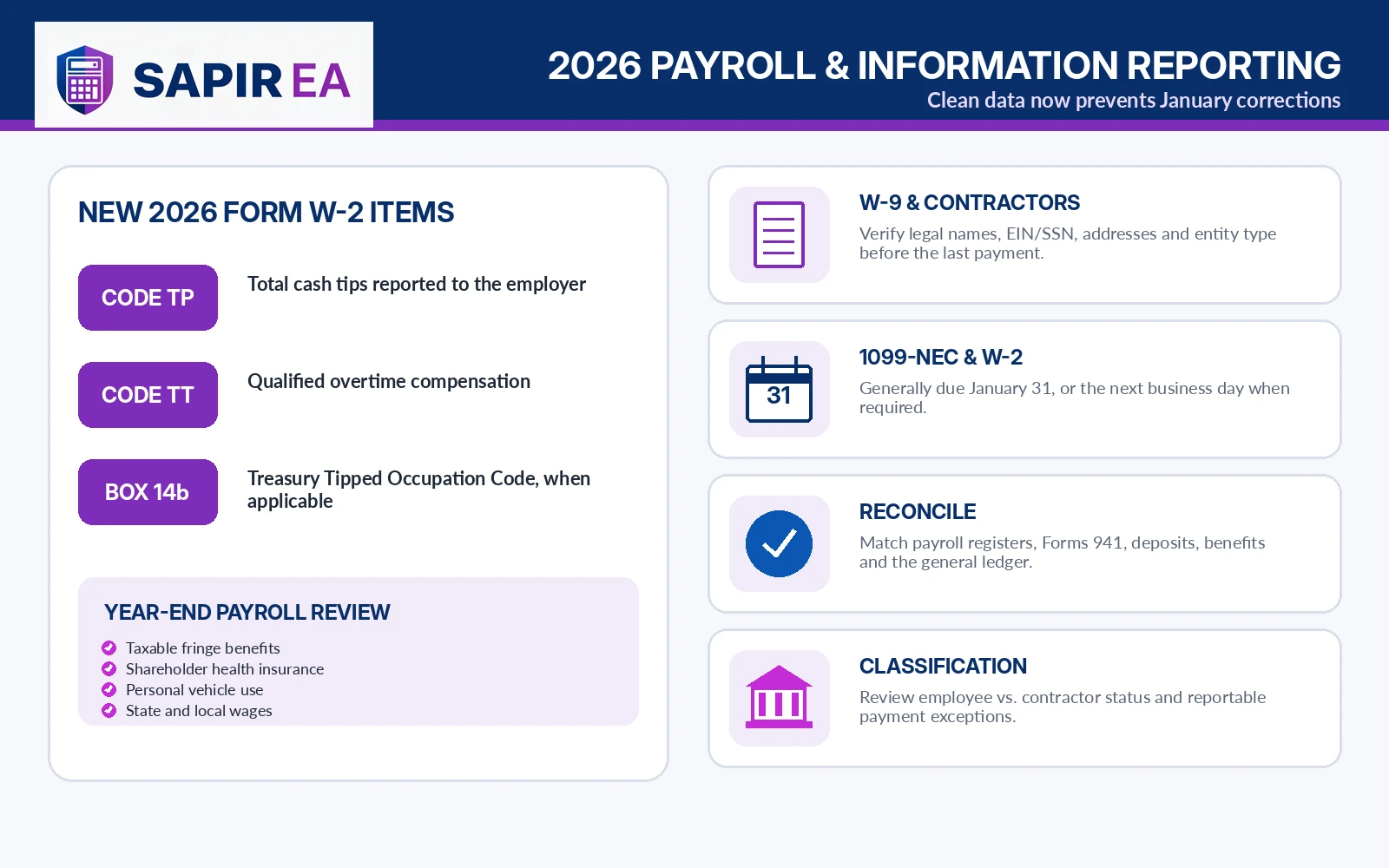
For 2026 Forms W-2, employers have new reporting responsibilities for qualified tips and qualified overtime. New W-2 code TP reports cash tips, code TT reports qualified overtime compensation, and a new Box 14b reports the Treasury Tipped Occupation Code when applicable. Restaurants, salons, delivery businesses, contractors, and other employers with tipped or overtime workers should confirm that payroll systems captured the required data throughout the year.
Complete the following before year-end:
- Verify employee names, addresses, and Social Security numbers
- Verify contractor legal names, addresses, entity types, and taxpayer identification numbers using Form W-9
- Reconcile Forms 941 to payroll registers and the general ledger
- Review taxable fringe benefits, personal vehicle use, group-term life insurance, and shareholder health insurance
- Identify reportable third-party payments and payment-card exceptions
- Confirm state and local wage reporting
- Review employee versus contractor classifications
Forms W-2 and 1099-NEC are generally due by January 31, or the next business day when January 31 falls on a weekend or legal holiday. Waiting until January to request missing W-9s creates avoidable risk.
11. Identify Additional Deductions, Credits, and Risk Areas
Research expenditures and credit
New Section 174A generally permits a current deduction for domestic research or experimental expenditures for tax years beginning after 2024, while foreign research remains subject to 15-year amortization. Businesses developing software, products, formulas, or processes should separately track domestic and foreign costs and evaluate the research credit.
Business interest
Leveraged businesses should revisit Section 163(j). Current law again permits depreciation, amortization, and depletion addbacks in adjusted taxable income for years beginning after 2024, but partnership and S corporation rules remain complex.
Meals, entertainment, gifts, losses, and basis
Business meals are generally 50% deductible when requirements are met; entertainment is generally nondeductible. Separate the two in the books. A business loss may also be limited by basis, at-risk, passive-activity, excess-business-loss, and other rules.
Charitable planning
Beginning in 2026, eligible nonitemizers may claim a limited deduction for qualifying cash contributions, while itemizers face a 0.5% of AGI floor. Owners planning significant gifts should compare cash, appreciated property, donor-advised funds, and bunching with their personal projection.
12. Follow a Practical Year-End Timeline
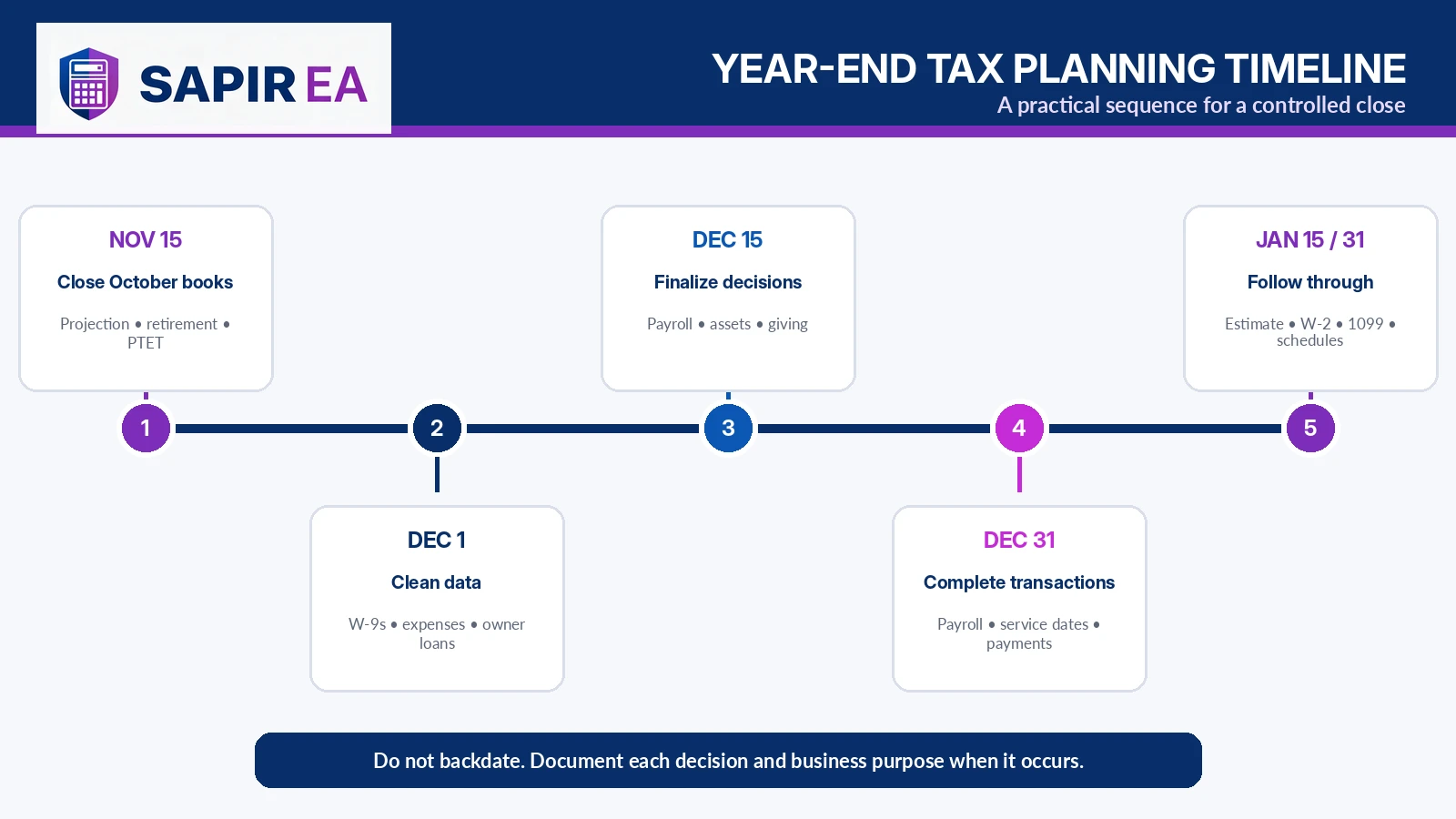
By November 15
Close books through October, run a projection, begin retirement-plan design, review PTET and state estimates, and identify equipment needs.
By December 1
Obtain W-9s, review owner compensation and bonuses, submit expense reports, resolve owner loans, and schedule inventory counts.
By December 15
Finalize assets that can be placed in service, payroll changes, withholding, retirement deferrals, PTET payments, and charitable decisions.
By December 31
Run final payroll, place assets in service, complete deductible payments and reimbursements, record inventory, and finish transactions that cannot be backdated.
January 2027
Make the fourth estimate if required, finalize W-2 and 1099 data, reconcile payroll and sales tax, and prepare tax-return closing schedules.
Common Year-End Tax Planning Mistakes
Avoid these recurring problems:
- Buying unnecessary assets solely for a deduction
- Estimating mileage after the fact
- Paying an S corporation owner only through distributions
- Missing PTET elections or payment deadlines
- Treating personal expenses as business expenses
- Ignoring shareholder or partner basis
- Waiting until January to collect W-9s
- Assuming a retirement plan can always be created retroactively
- Making a state payment without considering resident credits
- Running projections from unreconciled books
How SAPIR EA Helps Small Business Owners Plan Before Year-End
Effective year-end planning requires more than a list of deductions. The business return, owner return, payroll, retirement plan, state taxes, cash flow, and long-term goals must work together.
SAPIR EA helps small business owners with year-round tax projections, S corporation compensation, PTET analysis, estimated payments, bookkeeping review, entity planning, multi-state compliance, retirement coordination, and IRS representation.
A planning engagement typically begins with current financial statements, payroll reports, prior returns, estimated payments, owner-level income, and major expected transactions. The result should be a prioritized action plan with clear deadlines - not a generic list of ideas.
Call to action: Schedule a year-end tax strategy review with SAPIR EA.
Build Your Year-End Tax Strategy Before the Deadline
A strong year-end plan coordinates the business return, owner return, payroll, retirement benefits, state taxes and cash flow. SAPIR EA helps small business owners turn current numbers into a prioritized action plan.
Schedule a Year-End Tax Strategy ReviewFrequently Asked Questions
What is the most important year-end tax deadline for a small business?
There is no single deadline for every business. December 31 is critical for calendar-year payroll, property placed in service, cash-method payments, reimbursements, and many owner-level transactions. PTET elections and retirement-plan deadlines may occur earlier, so review them immediately.
Should I buy equipment before December 31 to lower taxes?
Only when the business needs the equipment and the cash-flow decision makes sense. The property generally must be placed in service by year-end. Compare Section 179, bonus depreciation, regular depreciation, financing, state conformity, and future-year deductions before choosing a method.
Can I prepay expenses for next year?
Some cash-method taxpayers may deduct qualifying prepaid expenses under the 12-month rule, but long-term benefits, deposits, inventory, capital assets, and other payments may need to be capitalized or deducted later. Review each material prepayment rather than applying a blanket rule.
Can an S corporation owner take only distributions and no salary?
Generally not when the owner provides more than minor services. An S corporation must pay reasonable compensation before making non-wage distributions to a shareholder-employee. Salary should reflect duties, time, experience, and comparable compensation.
Can I fix missed estimated payments with a large January payment?
A January payment can reduce the remaining balance but generally does not erase penalties for earlier underpaid installments. Additional year-end withholding may be treated as paid evenly during the year, and the annualized income method may help when income was earned unevenly.
What is the 2026 Section 179 limit?
The maximum federal Section 179 deduction for tax years beginning in 2026 is $2,560,000, subject to a phaseout beginning at $4,090,000 of qualifying property placed in service and other limitations. State limits may be different.
Is 100% bonus depreciation available in 2026?
Yes, current federal law provides permanent 100% additional first-year depreciation for eligible property acquired after January 19, 2025. Eligibility, acquisition dates, related-party rules, placed-in-service timing, and state conformity must still be reviewed.
How does year-end planning affect the QBI deduction?
Retirement contributions, business deductions, S corporation wages, equipment, taxable income, and business classification can affect the deduction. The goal is to model the total tax result rather than maximize or minimize one number in isolation.
What should I do about contractors before year-end?
Obtain and validate Form W-9 information, review worker classification, identify reportable payments, and reconcile vendor records. Form 1099-NEC is generally due by January 31, or the next business day when applicable.
Can my corporation reimburse expenses I paid personally?
Yes, when the expenses are legitimate business expenses and the corporation follows a properly operated accountable plan. The owner should submit timely documentation and return any excess advance.
Should every pass-through business make a PTET election?
No. The benefit depends on state law, owner residency, taxable income, the individual SALT limitation, resident credits, cash flow, and payment timing. Model the federal and state results before electing.
How long should I keep year-end tax records?
Retention periods depend on the item. Keep filed returns, depreciation schedules, basis records, ownership records, and property purchase documents long term. Payroll tax records generally require at least four years, and other substantiation should be kept for the applicable statute of limitations and longer when basis or carryovers remain relevant.
When should year-end tax planning begin?
Begin during the third quarter and update the plan after October or November books close. Early planning allows time for retirement design, payroll corrections, PTET, equipment, and cash management.
This article is for general educational purposes and does not constitute individualized tax, legal, retirement-plan, investment, or accounting advice. Federal and state rules change, and state conformity varies. Consult a qualified tax professional regarding your specific facts before implementing a strategy.
Official IRS Sources
- 2026 inflation adjustments and Section 179/QBI thresholds
- Permanent 100% bonus depreciation guidance
- 2026 retirement-plan contribution limits
- 2026 HSA limits
- 2026 standard mileage rates
- Estimated tax and withholding guidance
- S corporation compensation and shareholder health insurance
- Accountable plans, travel, meals, and vehicle records
- 2026 SALT deduction correction
- 2026 Form W-2 and W-3 instructions
- Information return reporting
- Domestic research expenditure guidance