Q3 2026 Tax Planning: September Deadlines
Q3 2026 Tax Planning Guide: September Deadlines, Estimated Payments, and Year-End Actions
Updated August 26, 2026
The end of the third quarter is a critical tax-planning checkpoint. By September 30, most income trends are visible, yet there is still time to adjust withholding and estimates, clean up books, make retirement and benefit decisions, and complete transactions that must occur before year-end.
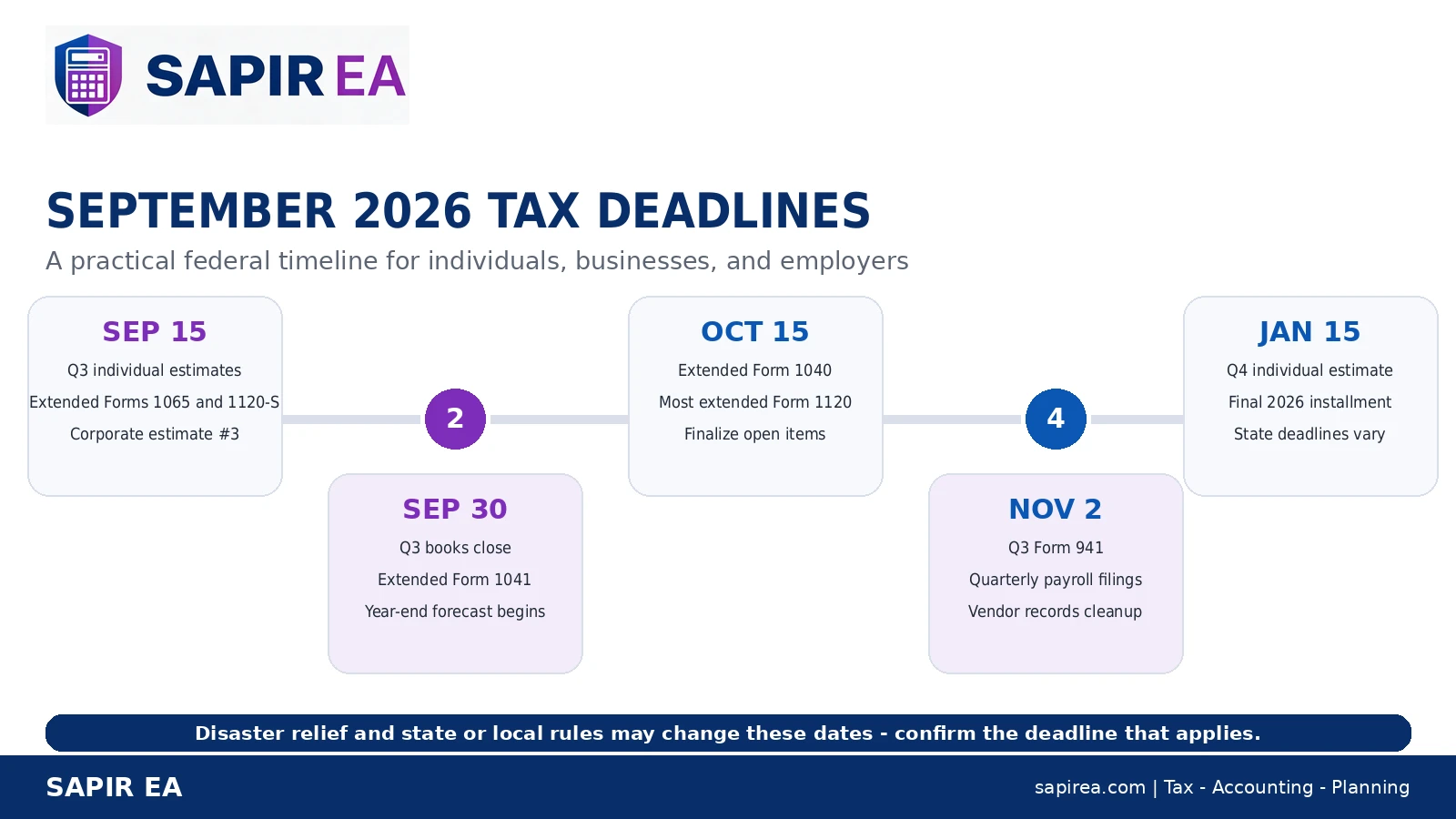
September also brings major federal deadlines. The third 2026 individual estimated tax installment is generally due September 15. Calendar-year corporations generally owe their third estimated tax installment on the same date. Extended 2025 partnership and S corporation returns are also generally due September 15, together with final Schedules K-1 and, when applicable, Schedules K-3.
This guide explains the approaching Q3 close, September deadlines, current 2026 tax updates, and practical actions for individual and business clients.
Short Q3 update: Confirm the September 15 estimated tax payment, finish extended partnership and S corporation returns, close the books through September 30, and complete a full-year tax projection before making major year-end decisions. Waiting until tax preparation season can mean discovering the problem after the best solutions have expired.
Q3 2026 Tax Deadlines at a Glance
| Date | Who should pay attention | What is generally due |
|---|---|---|
| September 15, 2026 | Individuals, sole proprietors, partners, S corporation shareholders, investors, and others with income not fully covered by withholding | Third 2026 individual estimated tax installment |
| September 15, 2026 | Calendar-year corporations and certain other corporate filers | Third 2026 corporate estimated tax installment |
| September 15, 2026 | Calendar-year partnerships that timely extended their 2025 returns | Form 1065, final Schedule K-1, and Schedule K-3 when applicable |
| September 15, 2026 | Calendar-year S corporations that timely extended their 2025 returns | Form 1120-S, final Schedule K-1, and Schedule K-3 when applicable |
| September 30, 2026 | Calendar-year estates and trusts on a timely extension | Generally, extended 2025 Form 1041 and beneficiary Schedules K-1 |
| September 30, 2026 | Every calendar-year business | Q3 bookkeeping and financial close |
| October 15, 2026 | Individuals with a valid extension and most calendar-year C corporations on extension | Extended 2025 Form 1040 or Form 1120, as applicable |
| November 2, 2026 | Employers | Third-quarter Form 941 and certain related quarterly filings because October 31 falls on a Saturday |
| January 15, 2027 | Individuals who need a fourth installment | Fourth 2026 estimated tax payment |
Disaster relief can postpone federal dates, and state or local deadlines may differ. Confirm the rule for the taxpayer, entity, jurisdiction, and filing period.
Why the Q3 Close Matters
Tax preparation reports completed transactions. A Q3 projection identifies decisions that can still change.
Current business books can reveal profit trends, compensation issues, owner-basis concerns, tax-payment needs, and purchase timing. An individual projection can identify estimated-tax shortfalls, capital gains, withholding gaps, Marketplace credit exposure, and retirement opportunities.
A useful Q3 review combines four sets of information:
- actual income and expenses through September;
- a realistic forecast for October through December;
- taxes already paid through withholding, estimates, extensions, and entity-level payments; and
- planned year-end transactions, including bonuses, equipment purchases, stock sales, retirement contributions, charitable gifts, and pass-through entity tax payments.
Without all four, a projection can be precise but wrong.
September 15 Estimated Tax Payments
Federal income tax is generally paid as income is earned, usually through paycheck withholding. Business owners, partners, S corporation shareholders, landlords, investors, and self-employed taxpayers often need estimated payments because some or all of their income arrives without withholding.
Individuals generally need estimated payments when they expect to owe at least $1,000 after subtracting withholding and refundable credits. Corporations generally make estimated payments when they expect to owe at least $500. The September 15 installment is the third payment date for calendar-year 2026 taxpayers.
What period does the September payment cover?
For individual estimated tax purposes, the third payment period generally covers income received from June 1 through August 31. Income earned in September falls in the fourth payment period, which is generally due January 15, 2027.
The payment dates do not divide the year into four equal three-month quarters. That uneven calendar is a common source of confusion.
Review the safe harbor, not just the projected balance
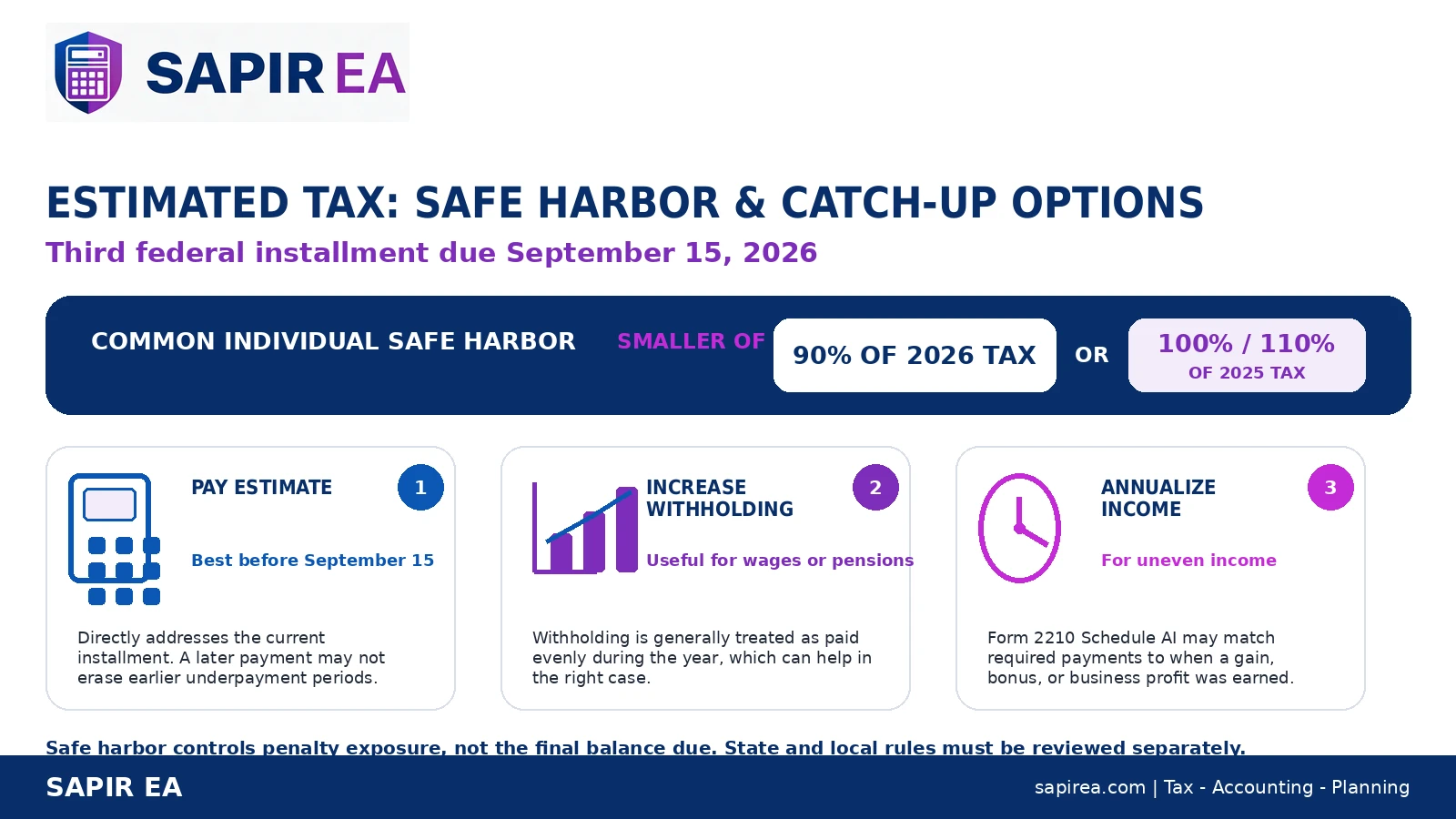
A projection should compare expected 2026 tax with the estimated-tax safe harbor. For many individuals, the required annual payment is generally the smaller of:
- 90% of current-year tax; or
- 100% of the tax shown on the prior-year return.
The prior-year percentage generally increases to 110% when prior-year adjusted gross income exceeded $150,000, or $75,000 for married filing separately. The prior return generally must cover a full 12-month year.
Meeting a safe harbor can reduce or eliminate an underpayment penalty, but it does not eliminate the final balance due. A taxpayer who pays the safe-harbor minimum can still owe a substantial amount with the return.
Three ways to correct a projected shortfall
| Option | When it may help | Important limitation |
|---|---|---|
| Make or increase the September 15 estimate | Best when the shortfall is identified before the deadline | A late payment generally does not erase an earlier underpayment period |
| Increase federal withholding for the rest of the year | Useful for employees, retirees, and S corporation shareholder-employees | Payroll or pension processing time is needed, and cash flow is reduced immediately |
| Use the annualized income installment method | Useful when income was earned unevenly, such as a large Q3 or Q4 gain | Requires a period-by-period calculation and Form 2210 Schedule AI |
Federal withholding is generally treated as paid evenly throughout the year for penalty purposes unless actual dates are elected. That can make additional late-year withholding useful in the right situation, but the result should be modeled.
Do not forget state and local estimates
The federal payment is only one part of the review. Depending on the taxpayer, September may also require state individual estimates, city or local estimates, PTET payments, nonresident withholding, composite-return payments, corporate franchise or income tax estimates, and payroll or excise tax deposits.
A federal safe harbor does not protect a taxpayer from state or local underpayment penalties.
Payment logistics
Individuals can generally pay through an IRS Online Account, Direct Pay, EFTPS, or electronic funds withdrawal. Businesses can use the business tax account, Direct Pay for businesses when available, or EFTPS. EFTPS payments should generally be scheduled by 8 p.m. Eastern Time at least one day early.
Save the confirmation and verify the taxpayer, form, year, and payment type.
Q3 Close Checklist for Business Clients
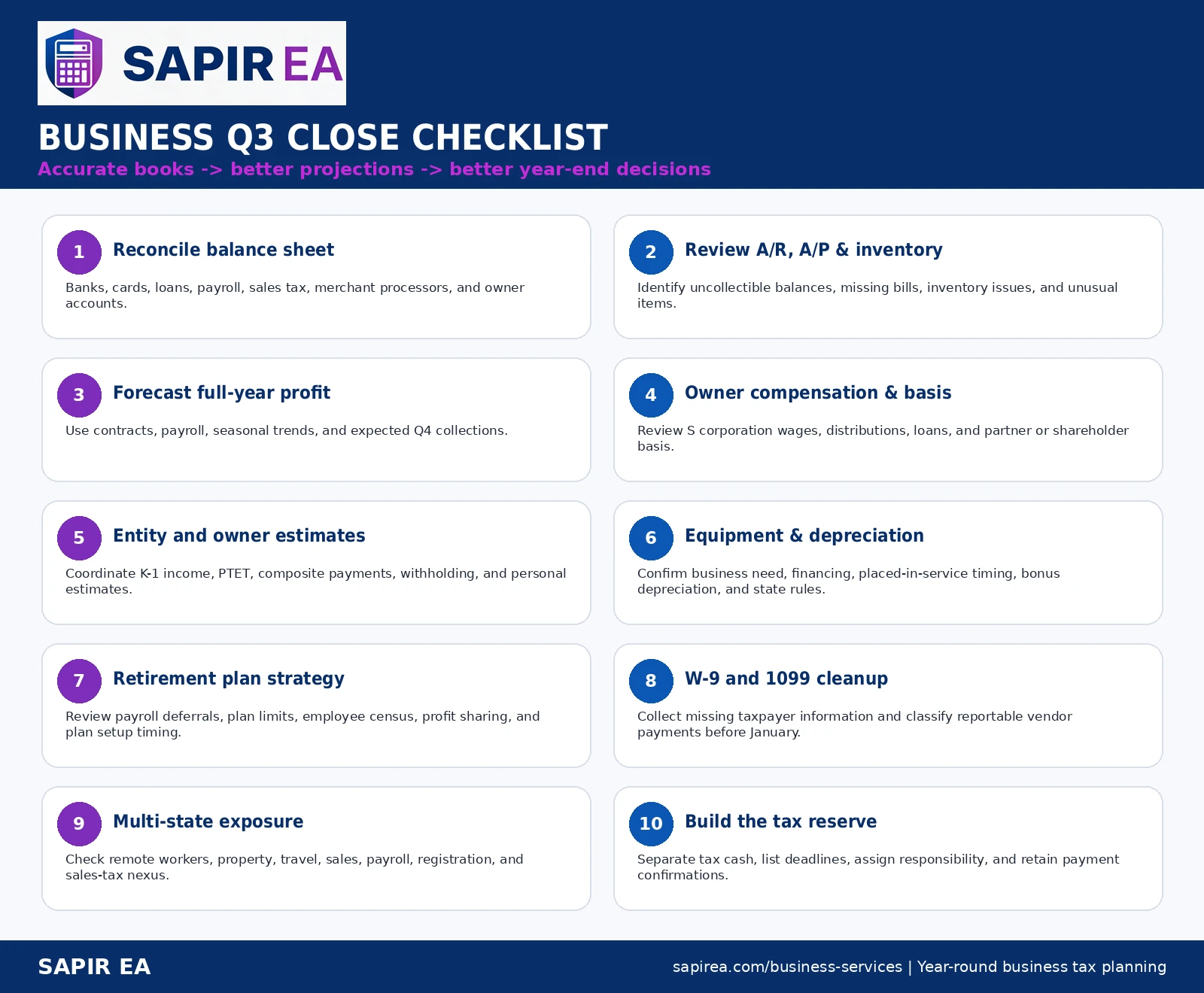
1. Reconcile every balance-sheet account
A reliable tax projection starts with reliable books. Reconcile bank accounts, credit cards, merchant processors, payroll liabilities, sales tax, loans, lines of credit, and owner accounts through September 30.
Do not limit the close to the profit-and-loss statement. Duplicated feeds, unreconciled cards, loans recorded as income, and distributions posted as expenses can distort the projection.
SAPIR EA's virtual bookkeeping and accounting services help businesses maintain tax-ready records throughout the year.
2. Review receivables, payables, inventory, and work in progress
Ask whether receivables are collectible, vendor bills are complete, inventory counts are reasonable, and deferred revenue or work in progress is recorded correctly. Cash-basis and accrual-basis taxpayers may have different timing results, but both need accurate source data.
Identify unusual items separately, including insurance proceeds, debt forgiveness, owner-paid expenses, asset sales, grants, and one-time contracts.
3. Update the full-year profit forecast
Project October through December using signed contracts, recurring revenue, payroll schedules, known purchases, seasonal patterns, and realistic collection assumptions. A projection based only on nine-month profit multiplied by 12/9 can be misleading for a seasonal business.
Compare an expected result with downside and high-profit cases so estimated-tax and cash-reserve decisions remain useful if conditions change.
4. Review owner compensation, distributions, and basis
S corporation shareholder-employees should review reasonable compensation before the final payrolls of the year. Partnerships and S corporations should also review distributions, shareholder or partner loans, capital accounts, and basis limitations.
A profitable entity can still create a taxable distribution if basis is insufficient. Any owner loan should have genuine documentation, repayment terms, and consistent bookkeeping.
5. Coordinate entity payments with owner estimates
Partnership and S corporation income generally passes through to owners, who may owe individual estimated taxes. PTET payments, composite payments, nonresident withholding, and K-1 projections should be analyzed together.
After a PTET election, recalculate owner-level estimates. PTET may not cover wages, spouse income, investments, or income from other entities.
For a preliminary projection, clients can use SAPIR EA's estimated tax payment calculator, followed by a professional review for complex facts.
6. Evaluate capital expenditures before ordering equipment
Current law generally allows permanent 100% bonus depreciation for eligible property acquired after January 19, 2025, subject to the applicable rules. Section 179 may also be available.
Do not make an unnecessary purchase for a deduction. Review business need, financing, placed-in-service timing, state conformity, taxable income, and future-year deductions.
7. Finalize retirement-plan strategy early enough
The 2026 employee deferral limit for many 401(k), 403(b), and governmental 457 plans is $24,500, before applicable catch-up contributions. The defined-contribution annual additions limit is generally $72,000.
September is a good time to review employee census data, owner compensation, plan testing, payroll elections, profit-sharing contributions, and whether a cash balance or other defined-benefit plan should be evaluated. Some actions require setup or notices before year-end; others allow later funding but still depend on timely plan establishment and accurate payroll.
8. Clean up W-9 and 1099 records now
Do not wait until January to locate contractor names, taxpayer identification numbers, addresses, and payment totals. Review vendors for potential Form 1099-NEC or Form 1099-MISC reporting, obtain missing Forms W-9, and separate payments made by credit card or third-party networks when the processor has the reporting responsibility.
It is easier to prevent information-return and backup-withholding problems than correct them.
9. Check multi-state activity
Remote employees, traveling owners, inventory, contractors, property, and customers in new states can create income tax, payroll, sales tax, or registration obligations. Q3 is the right time to identify new nexus before year-end filings are due.
SAPIR EA's business tax consulting services connect entity planning, estimated taxes, multi-state issues, and annual return compliance.
10. Build a tax reserve and year-end calendar
Separate projected tax cash from operating cash. List every remaining federal, state, payroll, PTET, retirement, and filing deadline. Assign responsibility for each payment and retain confirmation records.
Q3 Planning Checklist for Individual Clients
Recalculate withholding and estimated taxes
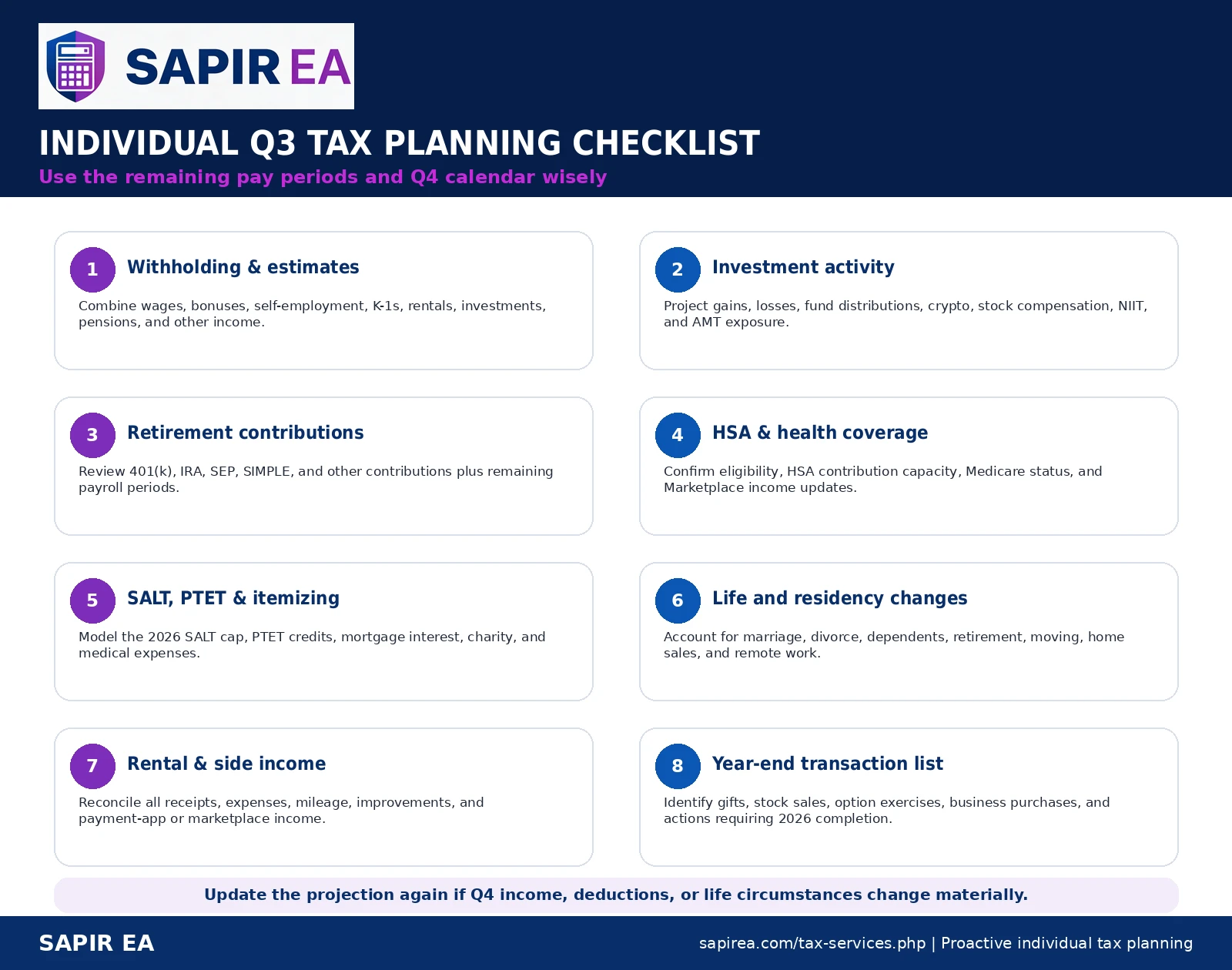
Combine wages, bonuses, self-employment income, K-1 income, rentals, pensions, Social Security, interest, dividends, capital gains, stock compensation, and other income. Compare that projection with withholding and estimated payments already made.
The IRS Tax Withholding Estimator reflects current 2026 law, including deductions related to qualified tips, overtime, qualifying car-loan interest, the enhanced senior deduction, and updated family, homeownership, and charitable provisions. Employees and retirees can use it to prepare a new Form W-4 or Form W-4P.
Review investment activity before year-end
Estimate realized gains and losses, mutual-fund distributions, cryptocurrency transactions, installment-sale income, and concentrated stock exposure. Tax-loss harvesting requires attention to wash sales, investment objectives, holding periods, state tax, and net investment income tax.
Clients with equity compensation should review restricted stock vesting, option exercises, withholding, estimated taxes, alternative minimum tax exposure, and sale timing before exercising or selling.
Revisit retirement and HSA contributions
For 2026, the IRA contribution limit is $7,500, with a $1,100 catch-up for eligible individuals age 50 or older. HSA limits are $4,400 for self-only coverage and $8,750 for family coverage, with a separate $1,000 catch-up for eligible individuals age 55 or older.
Eligibility, phaseouts, workplace coverage, Medicare, and deadlines matter. Determine now whether payroll deferrals must increase during the remaining pay periods.
Plan charitable gifts and itemized deductions
Review cash gifts, appreciated securities, donor-advised funds, qualified charitable distributions, mortgage interest, medical expenses, property taxes, and state income taxes. The corrected 2026 individual SALT deduction limit is $40,400, or $20,200 for married filing separately. It phases down above $505,000 of modified adjusted gross income, or $252,500 for married filing separately, but not below $10,000 or $5,000, respectively.
Business owners should analyze the SALT deduction together with PTET. The higher individual cap does not automatically eliminate the entity-level benefit.
Update Marketplace health-insurance income
Taxpayers receiving advance premium tax credits should update the Marketplace when household income or family size changes. A material income increase can produce a significant repayment when the return is filed.
Account for life and residency changes
Marriage, divorce, a new dependent, retirement, a move, a home sale, a new job, a business launch, or remote work in another state can change filing status, withholding, residency, credits, and state filing obligations. Update the projection before the change becomes a surprise on the return.
Organize rental and side-business records
Reconcile income from payment apps, marketplaces, cash, checks, and direct deposits. All taxable income must be reported even when no Form 1099 is issued. Separate repairs from improvements, track business mileage at the correct split-year rate, and retain receipts and contemporaneous records.
Current 2026 Tax Updates to Review in September
Business mileage increased on July 1
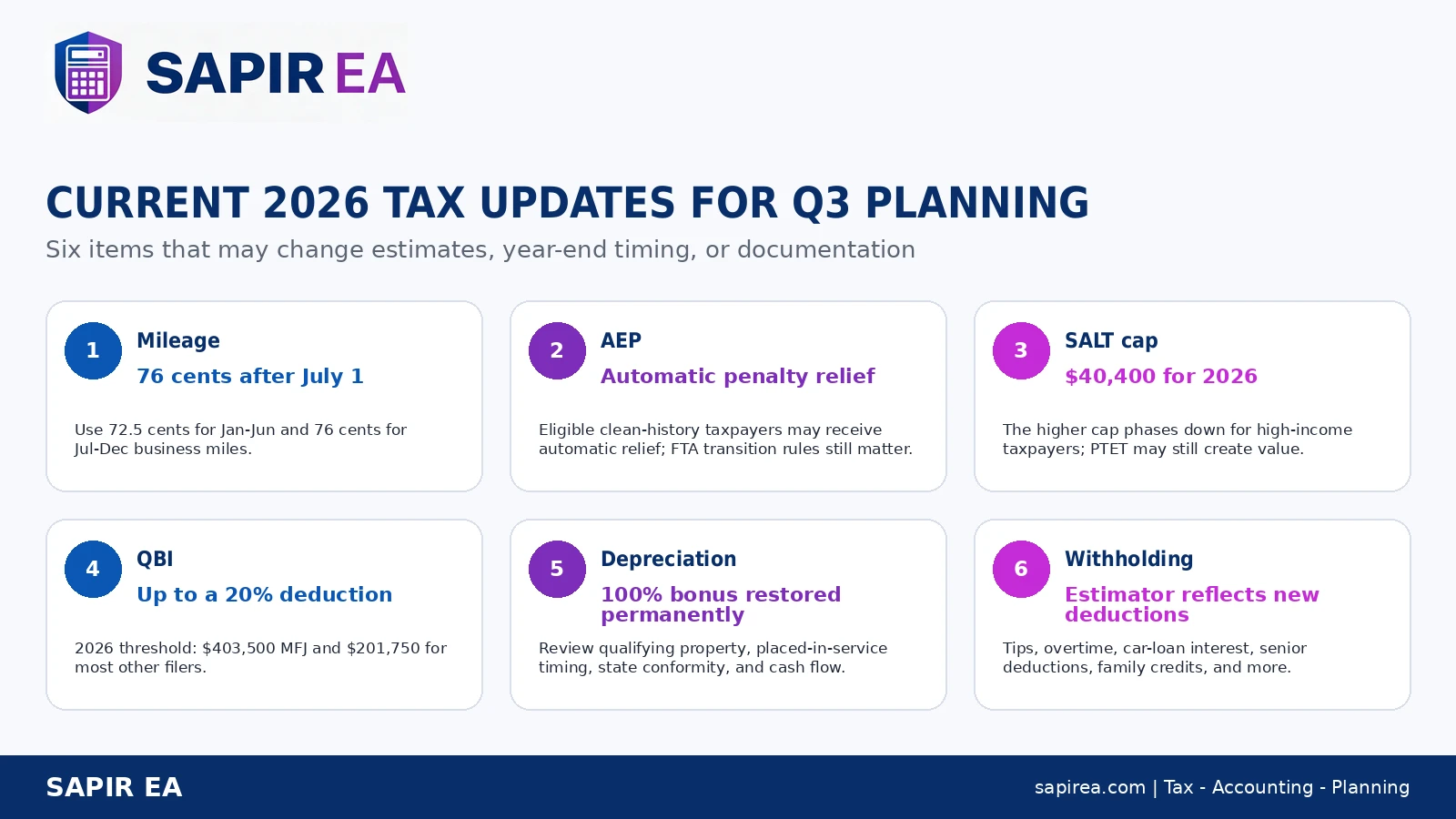
The 2026 standard business mileage rate is 72.5 cents per mile for January 1 through June 30 and 76 cents per mile for July 1 through December 31. Mileage logs and reimbursement systems must use the rate that applies to the date driven.
Automatic Exemption from Penalty is rolling out
Beginning in summer 2026, the IRS started implementing Automatic Exemption from Penalty, or AEP. Eligible taxpayers with a clean three-year history, or 12 consecutive quarters for quarterly filers, may automatically avoid certain failure-to-file, failure-to-pay, and failure-to-deposit penalties during original-return processing.
During the transition, some eligible 2025 annual and 2026 quarterly returns may still receive a penalty notice and require a First Time Abate request. AEP is not permission to file or pay late. Tax and interest remain due, and many returns and penalties are excluded.
The SALT cap is higher, but planning is still required
The corrected 2026 SALT limit is $40,400 for most filers and $20,200 for married filing separately. The higher cap phases down for higher-income taxpayers. High-income clients should model itemized deductions, PTET, charitable gifts, and year-end income together.
QBI and depreciation remain major business-planning areas
The Qualified Business Income deduction can provide up to a 20% deduction for eligible business income, subject to taxable-income, business-type, wage, and property limitations. For 2026, the principal threshold is $403,500 for married filing jointly and $201,750 for most other filers.
Businesses should also review permanent 100% bonus depreciation for eligible property and the interaction with Section 179, state conformity, basis, business income, and future deductions.
New individual deductions can change withholding
Current law includes deductions for certain qualified tips, qualified overtime compensation, qualifying personal vehicle loan interest, and an enhanced deduction for eligible seniors. Each has definitions, documentation rules, income limits, and filing requirements.
Do not assume a new deduction will eliminate tax. Update withholding or estimates using current income and verified eligibility.
Leveraged businesses should review Section 163(j)
The IRS updated its business-interest limitation FAQs on August 19, 2026. Businesses with significant interest expense, carryforwards, real estate elections, or average annual gross receipts near the 2026 $32 million small-business threshold should include Section 163(j) in the Q3 projection.
What Needs Action Now, and What Can Wait?
| Timing | Priority actions |
|---|---|
| Before September 15 | Complete estimated-tax projections, submit federal and state estimates, file extended Forms 1065 and 1120-S, issue final K-1/K-3 packages, and confirm specialized September filings |
| By September 30 | Reconcile Q3 books, close payroll and owner accounts, update forecasts, finish extended Form 1041 when applicable, and identify year-end transactions |
| October through early November | File extended individual and C corporation returns by October 15, file Q3 payroll returns, finalize 1099 vendor records, and complete retirement-plan design work |
| Before December 31 | Complete transactions requiring payment, payroll, election, purchase, placement in service, charitable transfer, or entity action during 2026 |
| By January 15, 2027 | Make the fourth individual estimated tax payment when required and confirm state deadlines |
Timing changes the result. Deductions may depend on payment, assets on placed-in-service dates, employee deferrals on payroll, and PTET on when the state receives the payment.
Common Q3 Tax Planning Mistakes
- Using unreconciled books to calculate estimated taxes.
- Paying the September estimate based only on last year's voucher when income changed substantially.
- Assuming an extension also extended the time to pay.
- Ignoring state, city, PTET, payroll, or nonresident payments.
- Treating the safe harbor as the projected final tax bill.
- Waiting until December to design a retirement plan or compensation strategy.
- Buying equipment solely for a deduction without considering cash flow.
- Continuing owner estimates after PTET without coordinating the credit.
- Creating a year-end mileage log from memory instead of maintaining contemporaneous records.
- Missing disaster-relief rules that change an otherwise standard deadline.
A Practical Q3 Action Plan
Start with accurate books and complete income records. Prepare federal and state projections, compare them with safe-harbor targets, identify the September 15 payment, and list actions due by September 30, October 15, November 2, and December 31.
Coordinate entity and owner projections, include every income source, retain payment confirmations, and update the analysis if Q4 changes materially.
For year-round support, SAPIR EA provides tax preparation and proactive tax planning, business tax consulting, virtual bookkeeping, and IRS representation. Review the firm's 2026 tax deadline calendar for additional dates.
Is Your 2026 Tax Plan Still on Track?
Use the Q3 close to connect current income, accurate books, estimated payments, and year-end decisions. SAPIR EA provides coordinated planning for individuals and closely held businesses nationwide.
Schedule a Q3 Tax Strategy ReviewFrequently Asked Questions
When is the third 2026 estimated tax payment due?
The general federal deadline is September 15, 2026. State and local deadlines may differ, and qualifying disaster-area taxpayers may have postponed deadlines.
Does the September payment cover September income?
Not under the standard individual payment periods. The third period generally covers June 1 through August 31. September through December generally falls in the fourth period due January 15, 2027.
What is the estimated-tax safe harbor for higher-income taxpayers?
The prior-year safe harbor is generally 110% of prior-year tax when prior-year adjusted gross income exceeded $150,000, or $75,000 for married filing separately. The prior return generally must cover 12 months.
Can additional December withholding help an earlier estimated-tax shortfall?
Potentially. Federal withholding is generally treated as paid evenly across the year for penalty purposes, which can make late-year withholding useful. The result should be calculated for the taxpayer's facts.
What if income was earned unevenly during the year?
The annualized income installment method may reduce or eliminate a penalty by matching required installments to when income was earned. It generally requires Form 2210 Schedule AI and detailed period records.
Are extended partnership and S corporation returns due September 15?
Yes, for most calendar-year entities that timely requested a six-month extension. Final K-1s and applicable K-3s are generally due at the same time.
Should a business buy equipment before year-end for the deduction?
Only when the purchase makes business and cash-flow sense. Bonus depreciation and Section 179 can accelerate deductions, but the asset must qualify and satisfy placed-in-service and other rules.
What 2026 mileage rate applies after July 1?
The standard business mileage rate is 76 cents per mile for July 1 through December 31, 2026. The January through June rate was 72.5 cents.
Does the higher 2026 SALT cap eliminate the need for PTET?
No. High-income phase-downs, property taxes, state income taxes, itemization, QBI effects, state credits, and timing can still make PTET valuable or unfavorable depending on the facts.
What is AEP, and should I rely on it?
Automatic Exemption from Penalty may prevent certain penalties for eligible taxpayers with a strong compliance history. Taxpayers should still file, pay, and deposit on time because AEP does not cover every return, taxpayer, or penalty.
What is the most important Q3 planning step?
Prepare a realistic full-year federal and state projection using reconciled books, complete income information, and all payments already made. Most other decisions depend on that calculation.
Work With SAPIR EA Before Year-End
A strong Q3 close gives you time to act while the calendar still allows it. SAPIR EA helps individuals, S corporations, partnerships, LLCs, and closely held businesses connect accurate bookkeeping, estimated taxes, entity planning, and year-end strategy.
Schedule a Q3 Tax Strategy Review: Contact SAPIR EA
This article is for general educational purposes and does not constitute individualized tax, legal, investment, payroll, or retirement-plan advice. Federal and state law can change, and deadlines may be modified by weekends, holidays, or disaster relief. Consult a qualified professional regarding your specific facts.
Official Sources
- IRS Publication 509, Tax Calendars
- IRS Form 1040-ES for 2026
- IRS Estimated Tax Guidance
- IRS Publication 505, Tax Withholding and Estimated Tax
- IRS Third Quarter Tax Calendar
- IRS Standard Mileage Rates
- IRS Automatic Exemption from Penalty
- IRS Correction to the 2026 SALT Deduction Amounts
- IRS 2026 Retirement Plan Limits
- IRS 2026 HSA Limits
- IRS Guidance on Permanent 100% Bonus Depreciation
- IRS Updated Tax Withholding Estimator
- IRS Section 163(j) FAQ Update