Pass-Through Entity Tax (PTET): 2026 Guide

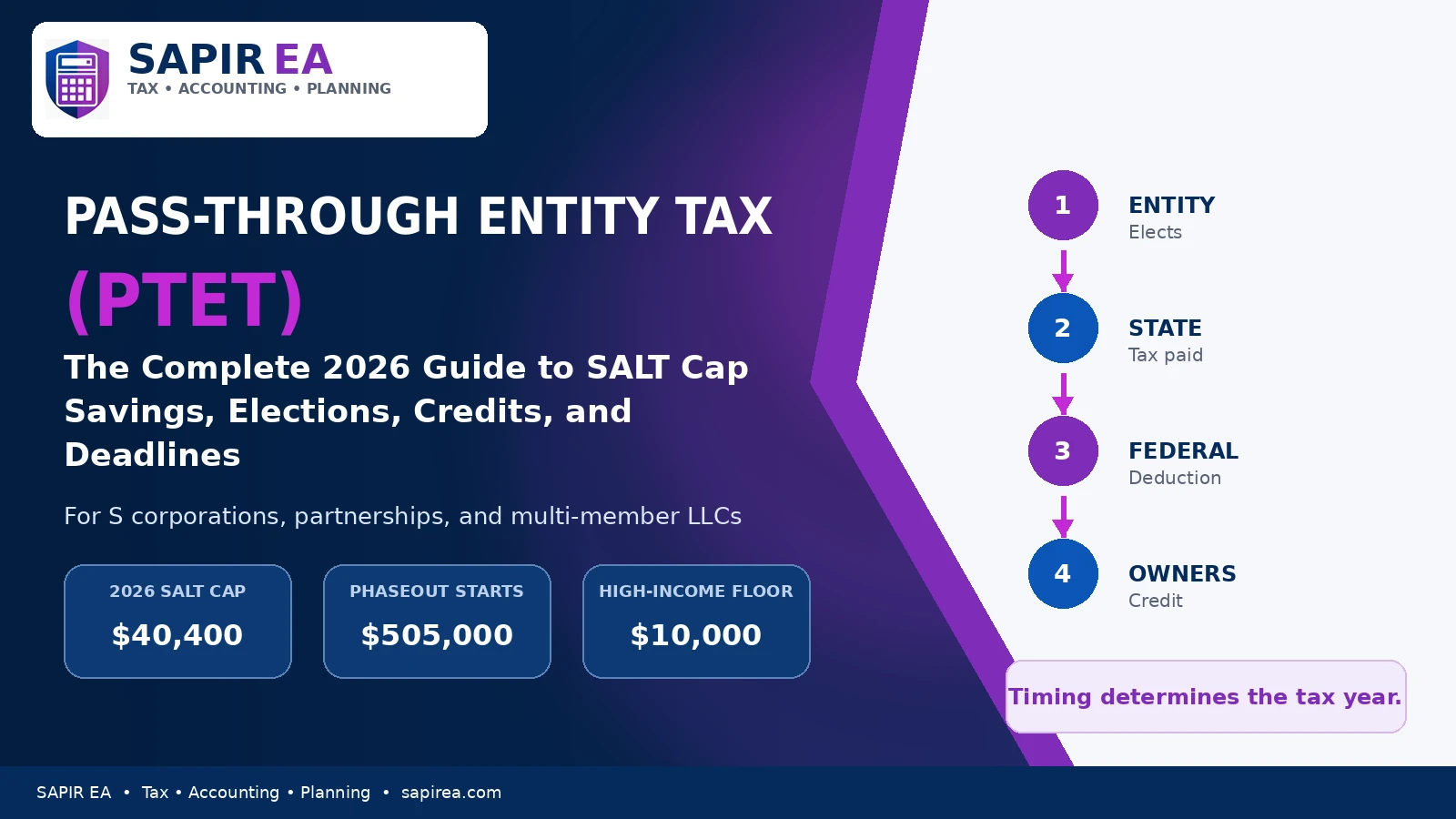
Pass-Through Entity Tax (PTET): The Complete 2026 Guide to SALT Cap Savings, Elections, Credits, and Deadlines
The Pass-Through Entity Tax—usually called PTE tax or PTET—can create a valuable federal deduction for owners of profitable S corporations, partnerships, and multi-member LLCs. But the election is not automatic, and it is not equally beneficial for every owner or state.
A sound PTET strategy must coordinate entity and owner eligibility, the state credit, multi-state residency, the Qualified Business Income deduction, estimated taxes, cash flow, and—most importantly—election and payment timing. This guide explains how PTET works in 2026, how it interacts with the federal SALT deduction limit, where the savings come from, and when the election can backfire.
Quick answer: An eligible pass-through entity pays state income tax at the entity level and may deduct the qualifying payment when computing federal income. Eligible owners generally receive a state credit or similar offset. Under IRS Notice 2020-75, the entity-level payment is not counted against the owner’s individual SALT deduction limit. State rules and deadlines vary substantially.
PTET at a Glance
| Question | Practical answer |
|---|---|
| What is PTET? | A state income tax imposed on, or elected by, a qualifying pass-through entity. |
| Who may qualify? | Commonly partnerships, S corporations, and multi-member LLCs taxed as one of those entities. |
| Where is the federal benefit? | The entity-level tax deduction reduces pass-through income before it reaches the owners. |
| Does PTET eliminate state tax? | No. It changes who pays the tax and may change who receives the federal deduction. |
| Does the owner receive a state benefit? | Usually, but the benefit may be a refundable credit, nonrefundable credit, deduction, exclusion, or other adjustment. |
| Is the election always beneficial? | No. State-credit limitations, QBI effects, losses, owner mix, residency, and cash flow can reduce or eliminate the benefit. |
| Why does timing matter? | State election deadlines and federal payment timing are separate. A late payment may move the federal deduction into the following year. |
What Is a Pass-Through Entity Tax?
A pass-through entity generally reports taxable income to its owners on Schedule K-1 rather than paying federal income tax as a C corporation. PTET changes the state-tax payment mechanism.
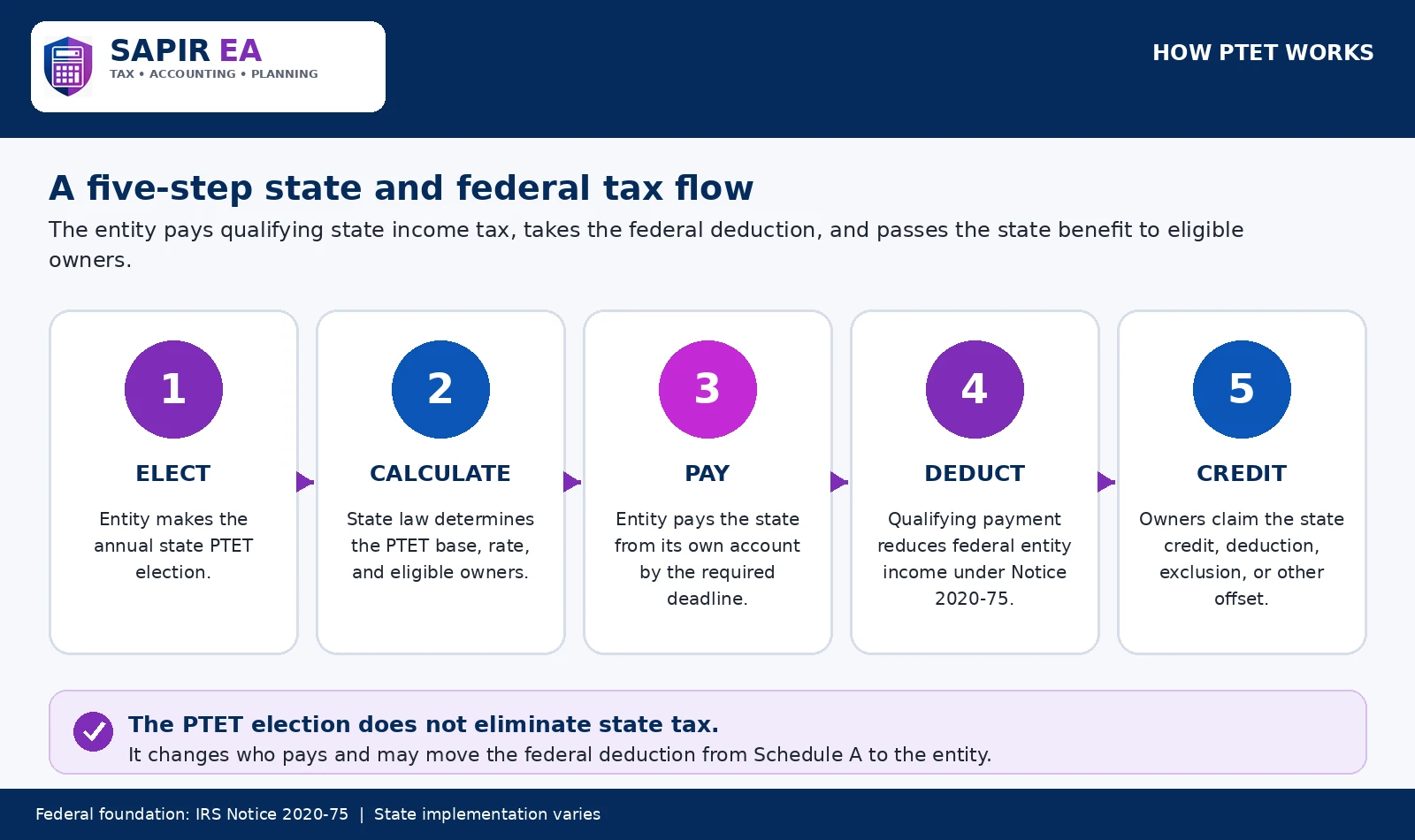
Under a typical elective regime, the entity elects, calculates and pays state tax, deducts the qualifying payment in federal entity income, and allocates a state credit or similar benefit to eligible owners. The state details matter: resident income, state-source income, guaranteed payments, trusts, tiered partnerships, and credit refundability are treated differently across jurisdictions.
Why PTET Exists
The federal SALT limit created a mismatch: state income tax paid personally was an itemized deduction subject to a cap, while qualifying state income tax paid by a business could reduce business income.
IRS Notice 2020-75 states that qualifying state and local income taxes imposed on and paid by partnerships or S corporations are deductible in computing non-separately stated income or loss. Those entity-level payments are not counted when applying an owner’s individual SALT limit.
PTET is therefore more than a year-end journal entry. It is a state tax regime with elections, payments, returns, owner-credit rules, penalties, and cash-flow consequences.
The 2026 SALT Cap and Why PTET Still Matters
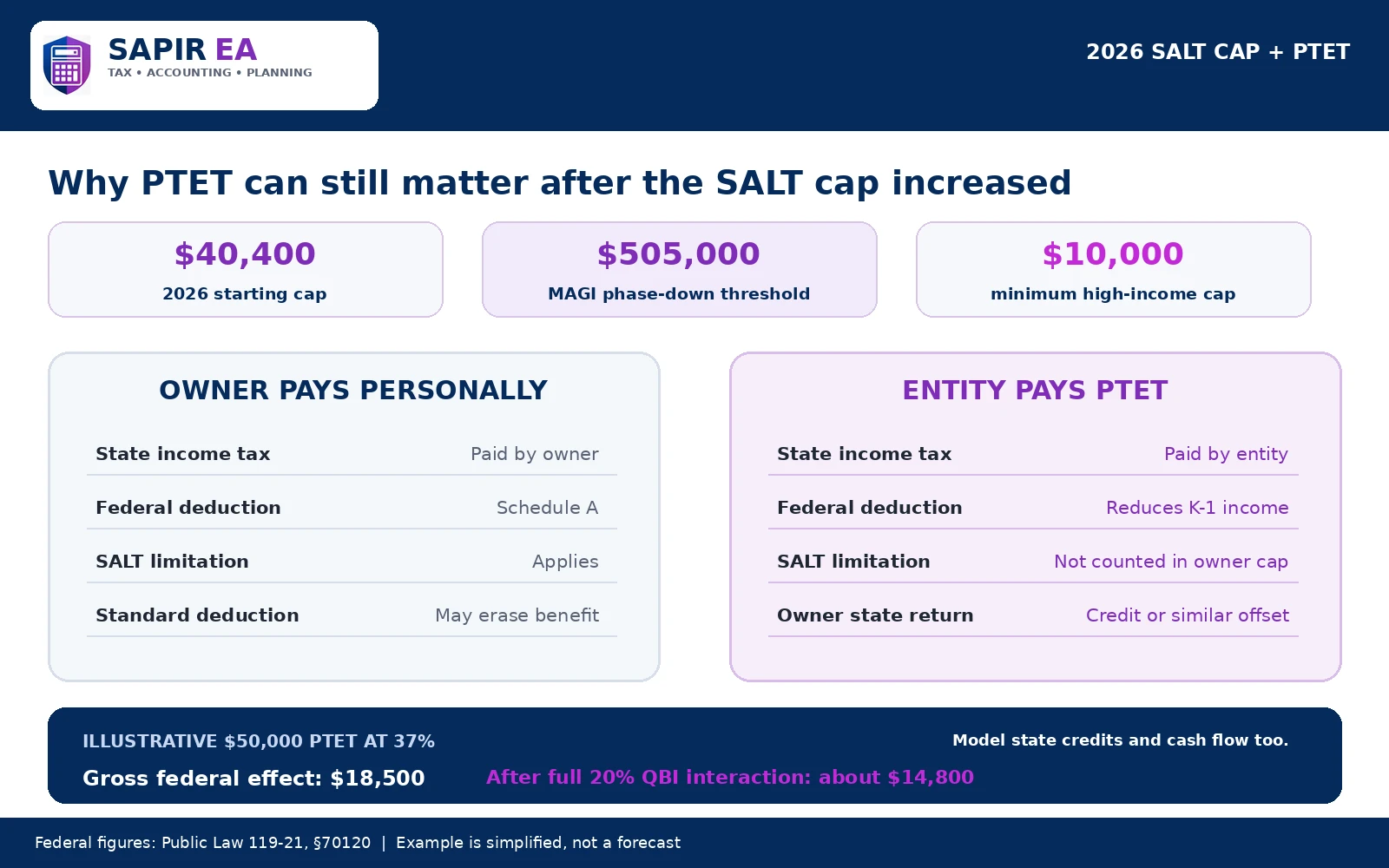
For 2026, the individual SALT deduction limit is $40,400, or $20,200 for married filing separately. It begins to phase down when modified adjusted gross income exceeds $505,000, or half that amount for married filing separately. The reduction is 30% of the excess over the threshold, but the deduction cannot fall below $10,000, or $5,000 for married filing separately.
Under Public Law 119-21, the cap and threshold increase 1% annually for 2027 through 2029, then the cap returns to $10,000 after 2029 unless the law changes.
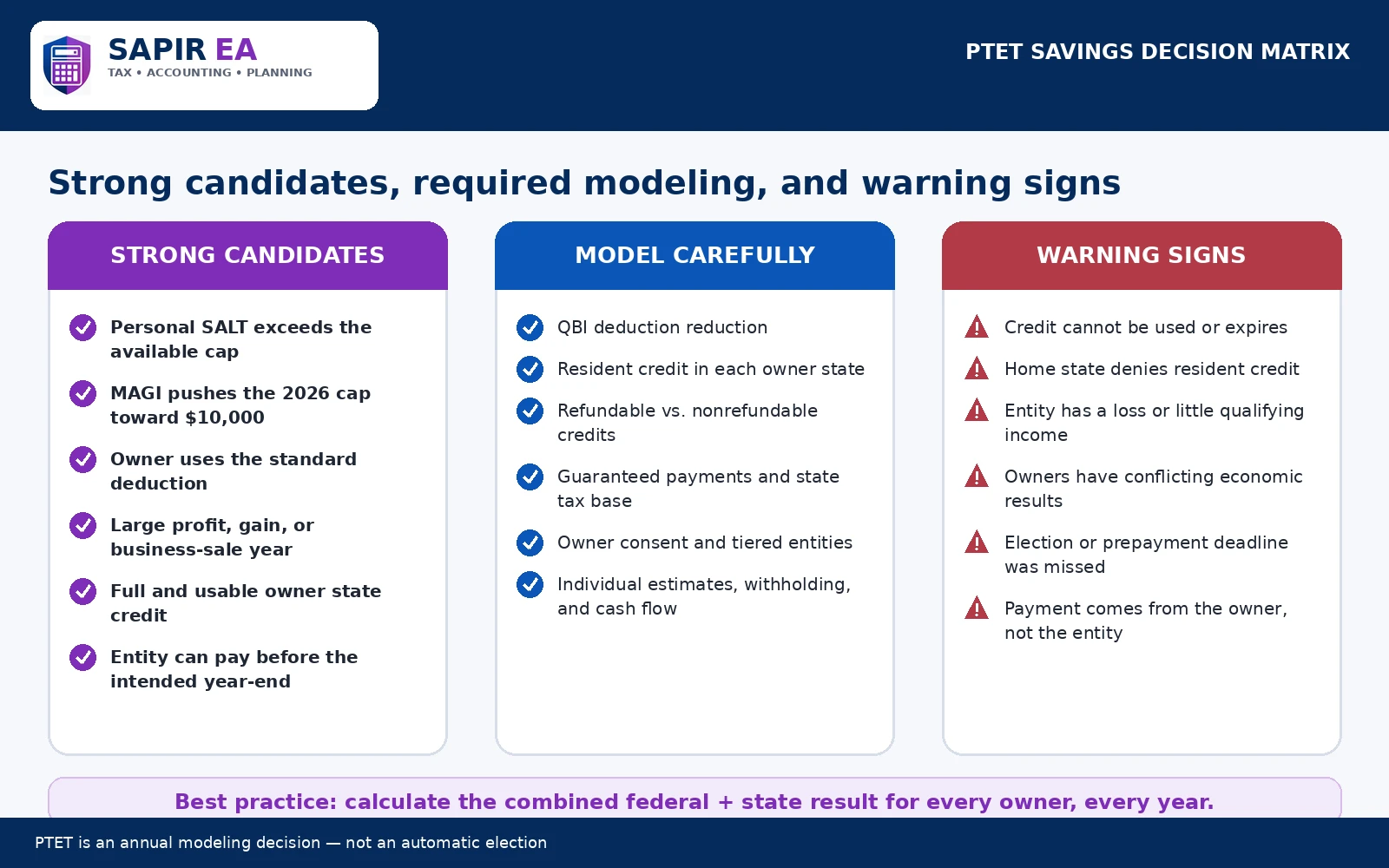
The higher temporary cap reduces PTET’s value for some taxpayers, but PTET may still help when personal income and property taxes exceed the available cap, income pushes the cap toward $10,000, the owner uses the standard deduction, or a sale or unusually profitable year creates substantial state tax.
2026 SALT Cap Example
A married couple has $90,000 of SALT and $700,000 of modified adjusted gross income. The $40,400 starting cap is reduced by 30% of the $195,000 excess over $505,000, so the $10,000 floor applies. If an eligible business pays $45,000 of qualifying PTET, that payment may reduce federal pass-through income without entering the owners’ individual SALT-cap calculation. The state credit, QBI effect, and other limitations still must be modeled.
PTET Versus Paying State Tax Personally
| Issue | Owner pays state tax personally | Entity elects and pays PTET |
|---|---|---|
| Federal deduction location | Schedule A itemized deduction | Deduction in entity-level federal income |
| Individual SALT limit | Applies | Qualifying PTET payment is not counted against it |
| Standard deduction taxpayer | May receive no federal benefit | May still benefit through lower K-1 income |
| State relief mechanism | Normal individual payment | State credit, deduction, exclusion, or other offset |
| QBI interaction | Personal SALT generally does not reduce QBI | Entity deduction may reduce QBI |
| Timing | Individual cash payment rules | State election rules plus entity payment timing |
| Cash flow | Owner funds individual estimates | Entity needs cash for PTET estimates and balance due |
| Complexity | Lower | Higher: separate election, estimates, return, allocations, and owner reporting |
Who Can Elect PTET?
Eligibility depends on state law, but common eligible entities include:
- partnerships filing Form 1065;
- S corporations filing Form 1120-S;
- multi-member LLCs taxed as partnerships;
- LLCs taxed as S corporations;
- and, in some states, certain limited liability partnerships or professional entities.
Common exclusions include sole proprietorships, disregarded single-member LLCs, C corporations, publicly traded partnerships, and entities with disqualified owners. Some states permit trusts, estates, or corporate owners; others limit the credit to individual owners. California, for example, generally requires qualifying owners to consent and excludes partnerships from being qualified taxpayers, while New Jersey and New York use different owner and sourcing rules.
An LLC label alone does not determine eligibility. The relevant question is how the entity is classified for federal and state income-tax purposes and whether the owners meet that state’s requirements.
The Main PTET Savings Opportunities
1. Recovering a Deduction Lost to the SALT Cap
When personal SALT already exceeds the available Schedule A limit, entity-level PTET can convert an otherwise nondeductible state payment into a federal business deduction. The benefit is the net taxable-income reduction multiplied by the owner’s marginal rate—not the PTET amount itself.
2. Protecting High Earners From the Phase-Down
In 2026 the cap can fall from $40,400 to $10,000 once modified adjusted gross income exceeds the phaseout range. Qualifying PTET remains outside that individual calculation.
3. Helping Standard-Deduction Taxpayers
A taxpayer who does not itemize receives no separate federal deduction for personally paid state income tax. PTET can still reduce K-1 income before the standard-versus-itemized decision.
4. Planning for a Sale or Unusually Profitable Year
A large contract, asset sale, practice sale, or partner buyout can generate significant state tax. PTET may create a same-year federal deduction if the gain enters the state PTET base and all deadlines are met. States differ on sourcing, sale-of-interest gains, entity asset sales, and resident-owner income, so model the transaction before closing.
5. Coordinating Multi-State Taxes
PTET may cover nonresident state-source income and interact with composite returns or withholding. The home state must recognize the other state’s entity tax for a useful resident credit; otherwise the election can create double taxation.
6. Using Payment Timing Deliberately
An election does not by itself create a federal deduction. For a calendar-year entity seeking a 2026 deduction, review how much qualifying PTET was actually paid by December 31 and whether the state permits a supplemental payment. A January 2027 payment may satisfy the state but shift the federal deduction to 2027.
7. Coordinating Owner Estimates and Cash Flow
After electing, owners should not automatically continue full individual state estimates, nor should they eliminate them. PTET may not cover wages, investments, spouse income, non-electing entities, or income outside the state base. Model entity PTET, withholding, composite payments, credits, and remaining owner tax together. SAPIR EA’s 2026 estimated tax calculator can provide a starting point for the owner-level projection.
The QBI Tradeoff: Why Gross Savings Are Not Net Savings
The Qualified Business Income deduction may equal up to 20% of eligible QBI. Because a deductible PTET payment generally reduces pass-through business income, it may also reduce QBI and the related Section 199A deduction.
Assume an S corporation pays $50,000 of PTET and its owner is in the 37% federal bracket.
- Ignoring QBI, the gross federal tax reduction could be $18,500.
- If the owner receives a full 20% QBI deduction and no other limitation applies, the $50,000 PTET deduction could reduce the QBI deduction by $10,000.
- The net reduction in federal taxable income would then be approximately $40,000, producing about $14,800 of federal tax savings at 37%.
That is still meaningful, but it is not $18,500. Conversely, an owner who receives no QBI deduction because of income or specified-service-business limitations may preserve more of the gross PTET benefit. Every model should calculate the actual Section 199A effect rather than applying a federal tax rate to the PTET payment alone.
How to Estimate the Net PTET Benefit
A useful PTET projection starts with four numbers: the entity-level tax payment, the owner’s federal marginal rate, the federal deduction the owner would otherwise receive on Schedule A, and the value of any QBI deduction that is lost. Then add state-specific effects such as credit haircut, addback, carryforward, or resident-credit limitation.
A simplified formula is:
Estimated federal PTET benefit = federal tax saved from the entity deduction − federal benefit otherwise available for the same state tax − tax cost of any lost QBI deduction.
Assume a business pays $50,000 of PTET for an owner in the 37% federal bracket. The owner is already limited to a $10,000 SALT deduction and would receive no additional Schedule A benefit from paying the $50,000 personally. If the owner has no QBI deduction, the preliminary federal benefit is $18,500. If the payment reduces an otherwise available QBI deduction by $10,000, the net federal taxable-income reduction is closer to $40,000, and the preliminary benefit becomes $14,800.
The model is not finished until the state side is tested. A full refundable owner credit may preserve most of the result. A 90% credit, a nonrefundable credit that sits unused, or denial of a resident credit can erase part or all of the federal savings. Administrative costs and the time value of cash should also be considered for smaller elections.
This is why PTET should be evaluated as a combined federal-and-state transaction, not simply as “tax paid × federal bracket.”
When PTET May Not Save Money
PTET may be neutral or unfavorable if the owner already receives a full personal SALT deduction, cannot use a nonrefundable state credit, is ineligible for the credit, or loses a resident credit in the home state. It can also disappoint when the entity has a loss, the election includes owners who do not benefit, the state base or rate is unfavorable, or the entity lacks cash for estimates.
A current federal deduction is not enough by itself. Credit carryforwards, QBI reduction, state addbacks, owner residency, and the date cash is paid can materially change the net result.
Timing: The Most Important PTET Planning Issue
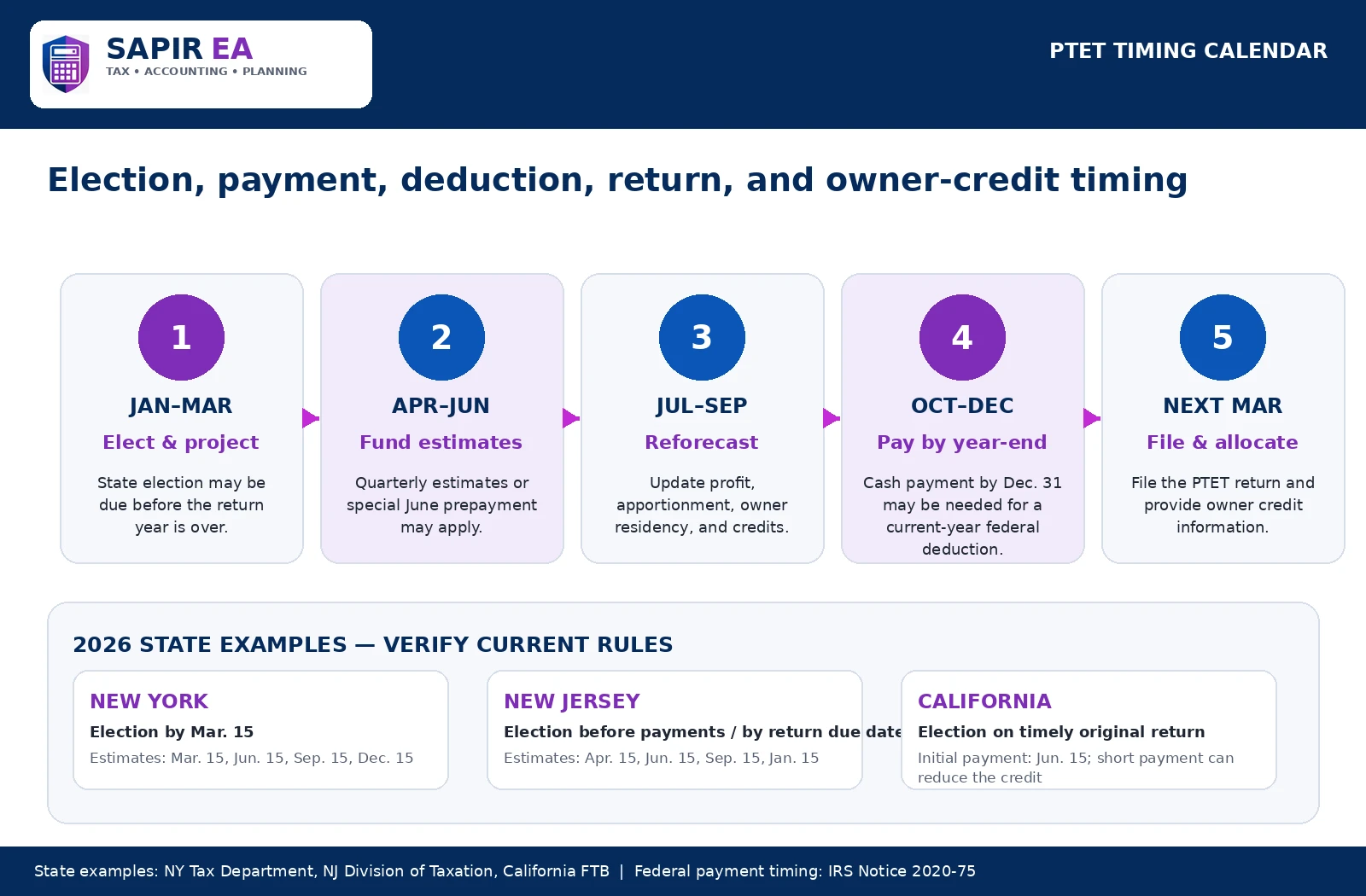
PTET has separate deadlines for the election, estimated payments, year-end cash payment, return, and owner credit. An extension to file may not extend an early election or prepayment deadline.
Illustrative 2026 State Timing Examples
| State program | Election timing | Payment timing for calendar-year entities | Return/credit notes |
|---|---|---|---|
| New York PTET | Annual online election January 1 through March 15; irrevocable | Estimates generally March 15, June 15, September 15, and December 15 | Annual PTET return generally due March 15; credit allocated to eligible owners |
| New Jersey BAIT | Annual election; must be made before payments are accepted and generally by the original return due date | Estimates generally April 15, June 15, September 15, and January 15 | PTE-100 generally due March 15; eligible members may receive refundable credits |
| California PTE elective tax | Annual irrevocable election on a timely filed original return | June 15 initial payment generally equals the greater of 50% of prior-year elective tax or $1,000; balance by original return due date | For 2026, a short June payment can reduce owner credits by 12.5% of the unpaid required amount |
State rules can change, and fiscal years, short years, disaster relief, weekends, and tiered entities can alter dates. Federal deduction timing also depends on when the entity makes the qualifying payment. Review SAPIR EA’s 2026 tax due-date calendar alongside the state-specific PTET calendar.
Multi-State PTET and Resident-Credit Traps
A resident owner can be taxed by the home state on all income and by another state on income sourced there. PTET complicates the usual resident credit because the legal taxpayer may be the entity.
Confirm whether the home state recognizes the other state’s PTET, how it limits the credit, whether local PTET qualifies, and whether trusts or tiered entities can pass the benefit through. New York recognizes certain substantially similar PTETs; Pennsylvania uses separate resident-credit and out-of-state entity-tax rules. A mismatch can turn a federal deduction into state double tax. SAPIR EA serves multi-state business owners nationwide through its virtual tax and accounting practice.
Partnership, S Corporation, and LLC Differences
Partnerships may have special allocations, guaranteed payments, tiered owners, and residents of several states. PTET allocation must fit the state law, partnership agreement, and federal economic arrangement.
S corporations generally allocate income, deductions, and credits pro rata by stock ownership. PTET cannot ordinarily be used to shift a disproportionate benefit to one shareholder.
LLCs qualify according to tax classification. A disregarded LLC, partnership-taxed LLC, S-corporation LLC, and C-corporation LLC can have different outcomes even though each is legally an LLC.
Bookkeeping and Return Reporting
Track PTET separately by state, tax year, and payment date. Do not combine it with owner distributions, personal estimates, nonresident withholding, sales tax, or franchise fees.
Retain the election, payment confirmations, owner consents, tax-base calculation, apportionment, credit allocations, state return, K-1 support, resident-credit analysis, and general-ledger reconciliation. SAPIR EA’s virtual bookkeeping services can keep the records tax-ready.
Common PTET Mistakes
- Missing an election or prepayment deadline.
- Paying from an owner’s personal account instead of the entity.
- Waiting until return filing and losing the intended federal year.
- Assuming every entity owner qualifies for the state credit.
- Ignoring the reduction in the QBI deduction.
- Failing to test resident credits and multi-state sourcing.
- Duplicating PTET, individual estimates, withholding, or composite payments.
- Using the wrong state tax base or overlooking required owner consent.
- Treating a nonrefundable credit as immediately usable cash.
- Repeating last year’s election without a new projection.
Three PTET Planning Examples
| Situation | Key opportunity | Main caution |
|---|---|---|
| High-income S corporation owner with $700,000 of MAGI and $80,000 of SALT | The individual cap may be at the $10,000 floor, so qualifying PTET can create an incremental federal deduction | Model QBI, state credit, addbacks, and actual payment date |
| Partnership owner who uses the standard deduction | PTET can reduce K-1 income even though personally paid state tax would not create a separate federal deduction | Credit must be fully usable and the entity must qualify |
| Multi-state partnership with owners in three states | Source-state PTET may simplify some nonresident payments and produce a federal deduction | A home state that denies resident credit can create double tax |
These examples illustrate the framework only. Actual savings depend on state law, owner facts, tax rates, QBI, and credit limitations.
A Practical PTET Decision Process
Before electing, confirm entity and owner eligibility, project income by state and owner, calculate the state credit, compare the individual SALT deduction with and without PTET, model QBI, test resident credits, and identify every election and payment deadline. Then confirm cash flow, adjust owner estimates, make the intended year-end payment, and reconcile the return and K-1 reporting.
Repeat the analysis annually. For coordinated projections, see SAPIR EA’s business tax consulting and year-round tax planning.
Year-End PTET Checklist
- Confirm the election and owner consents.
- Update income, gains, apportionment, and owner credits.
- Test resident credits and the QBI effect.
- Verify estimated-payment safe harbors.
- Determine whether another payment is permitted before December 31.
- Pay from the correct entity account and tax period.
- Update owner estimates and preserve all confirmations.
- Schedule the PTET return, K-1, and next-year election review.
Frequently Asked Questions
Is PTE tax the same as PTET?
Yes. Both terms generally refer to state taxes imposed on or elected by qualifying pass-through entities.
Is PTET mandatory?
Usually it is elective, but some entity-level pass-through taxes are mandatory. Check each filing state.
Does PTET eliminate state income tax?
No. It changes who pays and where the federal deduction may arise. Owners generally receive a state credit or similar offset.
Does PTET still matter after the SALT cap increased?
Yes. The 2026 cap is $40,400 but can phase down to $10,000 above the income threshold. PTET may also help taxpayers who use the standard deduction.
Can a sole proprietor or single-member LLC elect?
Usually not while the business is disregarded. Eligibility generally requires partnership or S corporation tax status, subject to state law.
Can an S corporation or partnership elect for only some owners?
It depends. Some states use owner consent or qualifying-owner rules; others apply the election more broadly. S corporation allocations also must remain pro rata.
When is the federal deduction allowed?
Notice 2020-75 ties the deduction to a qualifying payment made by the entity. Election and payment dates are separate.
Does a December 31 election guarantee the current-year deduction?
No. If the entity pays in the following year, the federal deduction may also move to that year.
Does PTET reduce QBI?
It can. A PTET deduction that reduces qualified business income can also reduce the Section 199A deduction.
What if the owner’s state credit is larger than the tax due?
Refundability and carryforward rules vary. A credit that cannot be used promptly can create a significant cash-flow cost.
Can PTET replace individual estimated taxes?
Only partly. Owners may still owe tax on wages, investments, spouse income, other entities, and income outside the PTET base.
Should the entity elect every year?
Not automatically. Recalculate the result when income, ownership, residency, state rules, QBI, or SALT exposure changes.
How SAPIR EA Helps With PTET Planning
PTET works best when federal tax, state credits, residency, QBI, estimates, bookkeeping, and cash flow are modeled together.
SAPIR EA helps S corporations, partnerships, and LLCs evaluate elections, calculate owner-by-owner benefits, coordinate multi-state credits, track deadlines, adjust estimates, and reconcile payments with K-1 reporting.
Schedule a Tax Strategy Review before the applicable election or payment deadline. Many PTET mistakes are timing mistakes that cannot be repaired after the year closes.
This article is for general education and is not individualized tax, legal, accounting, or investment advice. PTET laws change frequently. Confirm current state rules, forms, and deadlines before making an election or payment.
Should Your Business Elect PTET?
SAPIR EA can model the federal deduction, state credit, QBI interaction, multi-state rules, and payment timing before the deadline.
Schedule a Tax Strategy Review