What Is an LLC? How LLCs Work and How They Are Taxed
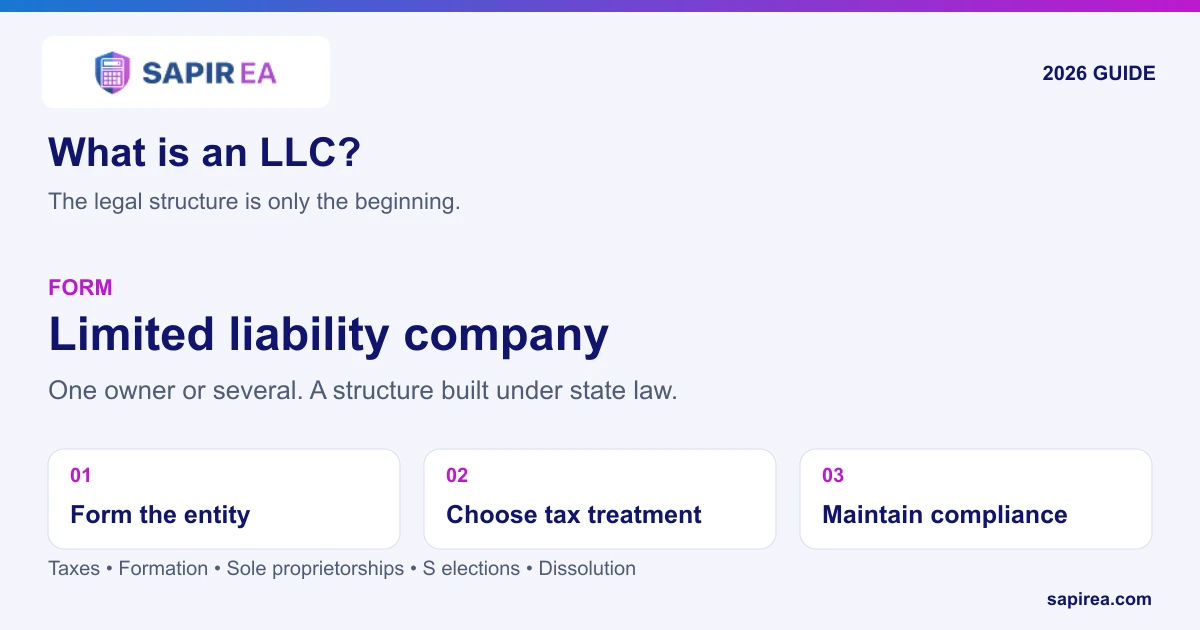
An LLC, or limited liability company, is a business entity created under state law. It can help separate business obligations from an owner’s personal affairs, while offering several federal tax classifications. Forming an LLC does not automatically reduce taxes, create deductible expenses, or make its owner an employee.
This guide is for freelancers, consultants, contractors, family businesses, and growing companies deciding how to organize and pay taxes. It covers federal fundamentals and Pennsylvania requirements, with practical examples that connect entity choice to bookkeeping, payroll, and an eventual business closure.
What does an LLC mean for your business?
The owners of an LLC are called members. An LLC may have one member or several, and its operating agreement can establish management authority, voting, profit allocations, and procedures for an owner’s departure. State law and the agreement determine many rights that a tax return cannot resolve.
Limited liability generally protects a member from being personally responsible for company debts solely because of membership. It is not absolute protection. Personal guarantees, an owner’s own misconduct, certain tax liabilities, and failures to respect the entity can create personal exposure. Professional-liability rules also vary.
Separate bank accounts, accurate records, appropriate contracts, and insurance support a sound business structure. An attorney should address formation documents, ownership agreements, and legal-protection questions. SAPIR EA’s business tax consulting services address the tax consequences and ongoing reporting.
How is an LLC taxed?
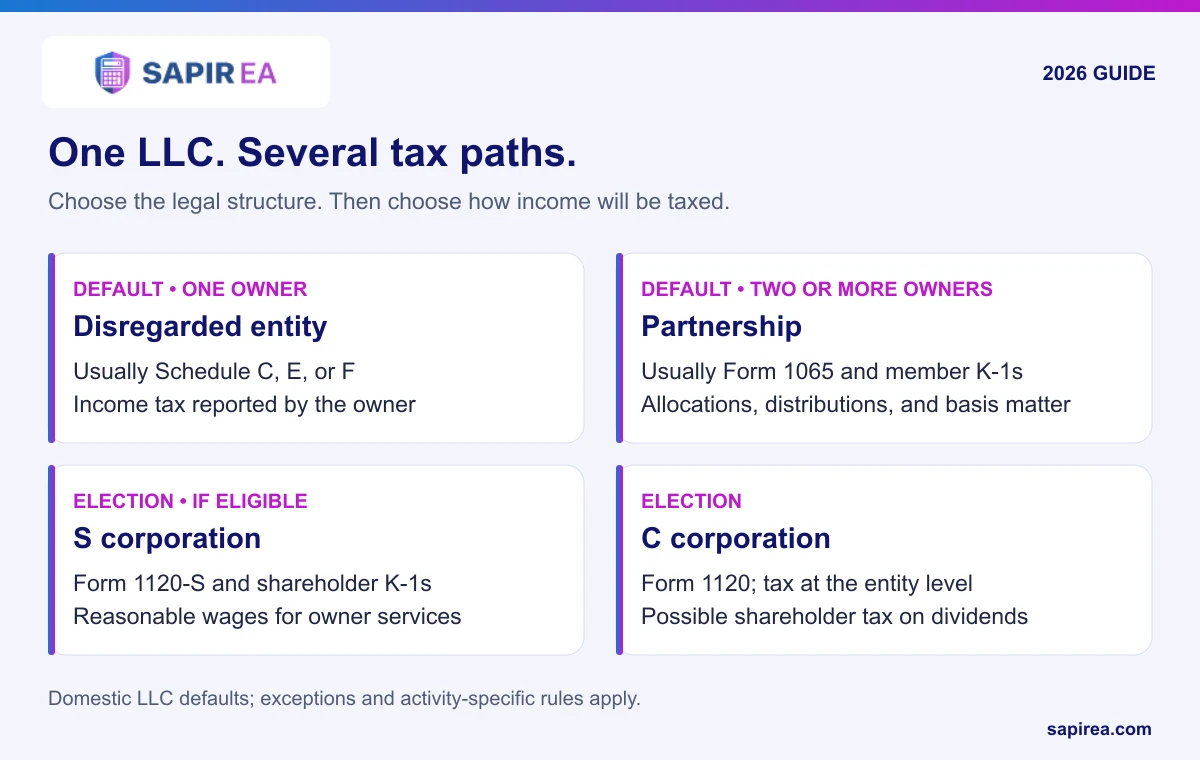
The IRS generally looks at the number of owners and any valid tax election. A domestic single-member LLC normally is disregarded for federal income tax; a domestic LLC with two or more members normally is a partnership. An eligible LLC may elect corporate treatment. The IRS LLC overview explains these default classifications.
Single-member LLC taxes
For an individual owner, an operating business usually reports income and expenses on Schedule C attached to Form 1040. Rental activity may belong on Schedule E; farming may belong on Schedule F. Disregarded does not mean invisible: employment taxes, certain excise taxes, and some information-reporting obligations treat the entity separately.
A Schedule C owner generally owes income tax and self-employment tax on net earnings, even if cash stays in the business. Owner draws do not reduce taxable profit. The owner ordinarily does not issue themselves a W-2 under this default treatment.
Multi-member LLC taxes
A partnership-classified LLC generally files Form 1065 and provides Schedule K-1 to each member. Members report their allocated tax items, potentially even without a cash distribution. Members performing services generally are self-employed rather than employees of the partnership. Guaranteed payments and profit allocations require careful accounting.
Self-employment tax treatment can depend on the member’s role and the character of income. Do not assume that every LLC member qualifies for the limited-partner exception. Adding an owner can change classification and create contribution, basis, allocation, and filing issues.
| Tax treatment | Typical federal reporting | Owner payment | Key consideration |
|---|---|---|---|
| Single-member default | Owner’s Schedule C, E, or F | Draws | Business activity determines tax character |
| Multi-member default | Form 1065; member K-1s | Distributions; guaranteed payments | Allocations and basis matter |
| S-corporation election | Form 1120-S; shareholder K-1s | Wages for services; distributions | Eligibility and reasonable compensation |
| C-corporation election | Form 1120 | Wages; possible dividends | Corporate tax plus possible shareholder tax |
When C-corporation treatment deserves a separate review
A corporate-classified LLC can be taxed as a C corporation rather than an S corporation. The corporation generally pays federal income tax on its own taxable income. Distributing after-tax earnings as dividends can create another tax layer for shareholders. Keeping profits in the company does not make future distributions tax-free.
Outside investment, owner eligibility, employee benefits, and the planned sale can influence this choice. Moving appreciated property into or out of corporate treatment may create tax costs. Before changing classification, model the current year and the eventual exit, including whether debt exceeds tax basis. Tax elections can have consequences even when no cash changes hands.
Does an LLC save taxes in 2026?
Formation alone usually does not change a sole proprietor’s federal income or self-employment tax. Legitimate business deductions depend on the expenditure and applicable law, not the letters LLC. A corporate election can change the result, but also changes compliance, benefits, and exit planning.
The 20% qualified business income deduction under section 199A was made permanent by Public Law 119-21. For 2026, limitations begin above taxable income of $403,500 for joint returns, $201,775 for married filing separately, and $201,750 for other returns. Wage, property, and specified-service-business restrictions can then matter.
A new $400 minimum deduction applies in 2026 when qualifying active-business QBI reaches $1,000 and the statutory material-participation requirements are met. This is not a universal LLC credit. See Revenue Procedure 2025-32, section 4.26, and the IRS QBI explanation. Owner wages and certain other payments are excluded from QBI.
Sole proprietorship versus LLC: what changes?
A sole proprietorship generally arises when one person operates an unincorporated business without creating a separate entity. An assumed business name does not itself create an LLC. Both a sole proprietor and an individually owned, default-taxed LLC may file Schedule C for the same operating activity.
The meaningful difference is the state-law entity and its associated obligations. An LLC brings formation costs, state filings, and legal administration. A small, low-risk venture might reasonably begin as a sole proprietorship; contracts, employees, premises, partners, or meaningful liability exposure can justify earlier legal review.
| Question | Sole proprietorship | Default single-member LLC |
|---|---|---|
| Separate state-law entity? | No | Yes, once properly formed |
| Liability separation? | Generally no entity shield | Generally available, with exceptions |
| Operating-business income tax? | Usually Schedule C | Usually Schedule C |
| Automatic self-employment tax savings? | No | No |
| State entity maintenance? | Licenses and registrations may apply | Entity filings plus applicable registrations |
For example, a consultant earning $70,000 after ordinary business expenses generally does not erase self-employment tax by moving the same activity into a default single-member LLC. The entity decision may still make legal sense. The tax decision needs its own analysis.
How to start an LLC with the tax foundation in place
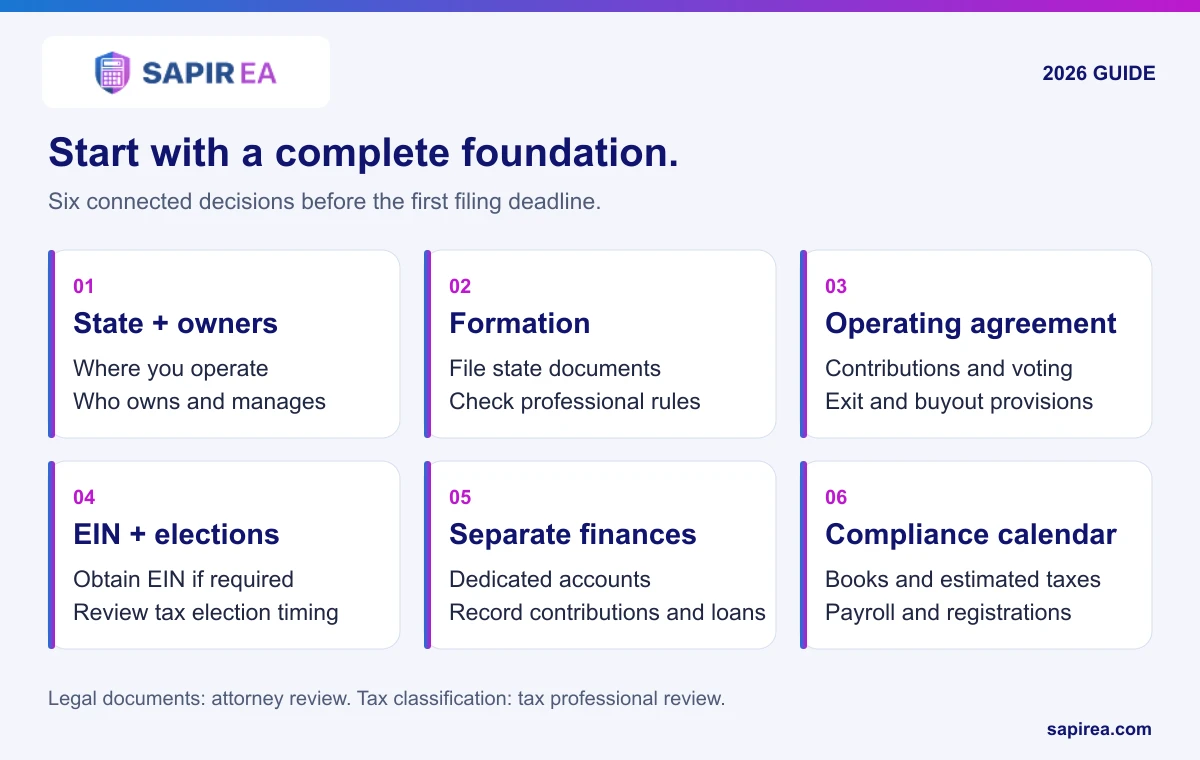
Begin with the owners, activity, location, financing, and expected profit. A formation service can submit paperwork, but it cannot resolve every ownership or tax question. Organize these steps before revenue, hiring, or major asset transfers make corrections expensive.
- Choose the jurisdiction and name. Review where you actually operate and whether registration elsewhere will be required. Forming out of state does not eliminate home-state obligations.
- File the state formation documents. Pennsylvania uses a Certificate of Organization and docketing statement. The standard Certificate of Organization filing fee is $125; specialized entities may have additional requirements.
- Document ownership and management. Address contributions, authority, profit sharing, buyouts, death, disability, and disputes in an operating agreement with legal counsel.
- Obtain an EIN when required. Form the entity before applying. An EIN application is not an S election. Banks may request an EIN even when a disregarded entity has no separate federal income-tax filing obligation.
- Open dedicated financial accounts. Record startup costs, owner contributions, loans, and transferred assets separately. Keep receipts and contracts from the beginning.
- Set the tax and filing calendar. Decide classification, review election deadlines, register applicable tax accounts, and arrange bookkeeping before the first payroll or sales-tax collection.
The Pennsylvania LLC formation guidance and official fee schedule provide the state filing starting point. Professional businesses should check restricted-professional-company requirements.
Can an LLC elect S-corporation status?
Yes, if it satisfies the eligibility rules. An S election changes federal taxation while the business can remain an LLC under state law. Requirements generally include no more than 100 shareholders, eligible owners, one class of stock, and shareholder consent. Nonresident-alien shareholders generally are prohibited.
An eligible LLC normally files Form 2553. A timely, valid S election can also provide the deemed corporate-classification election, so a separate Form 8832 is not always needed. Review the actual ownership agreement: distribution and liquidation rights can create eligibility problems.
Consider liquidity as well as taxes. An S corporation must fund payroll deposits and operating bills even when customers pay late. Salary planning should also account for retirement-plan contributions and special treatment of benefits for more-than-2% shareholders. The lowest apparent payroll-tax bill may produce a worse overall result after those items are included.
Election timing and owner payroll
Generally, Form 2553 is due within two months and 15 days after the beginning of the intended tax year, or during the preceding tax year. For an existing calendar-year business seeking January 1, 2026 effectiveness, the ordinary deadline was March 16, 2026 because March 15 fell on Sunday. New businesses can have a different starting date.
That ordinary 2026 deadline has passed. Late-election relief may be available under Revenue Procedure 2013-30 when its conditions are satisfied; it is not automatic. Keep submission evidence and the IRS acceptance notice. The Form 2553 instructions explain timing, consent, and relief procedures.
A shareholder who works in the business generally must receive reasonable compensation for services before non-wage distributions. There is no approved universal salary percentage. Duties, hours, training, experience, and comparable pay support the amount. Read SAPIR EA’s reasonable compensation guide alongside the IRS compensation guidance.
A limited example of the employment-tax comparison
Assume $120,000 of profit before owner salary and employer payroll tax, no other wages, and a factually supportable $70,000 salary. Default Schedule C treatment produces approximately $16,955 of self-employment tax: $120,000 × 92.35% × 15.3%. The combined employer and employee Social Security and Medicare tax on $70,000 of wages is $10,710.
The difference is approximately $6,245 before unemployment taxes, payroll service, additional return preparation, state taxes, benefits, and income-tax effects. Employer FICA of $5,355 also leaves only $44,645 of corporate profit before other added costs. Calling the entire remaining $50,000 a distribution would overlook that employer expense.
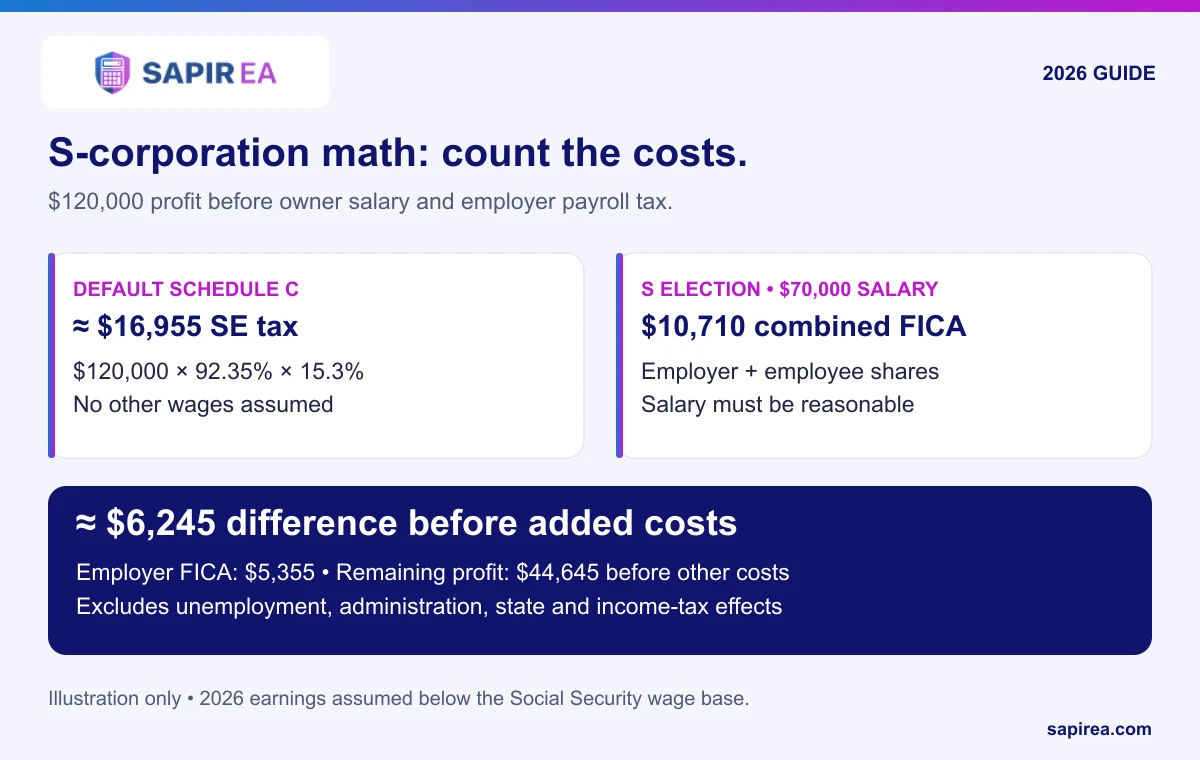
The calculation assumes earnings below the 2026 Social Security wage base of $184,500. Other wages, Additional Medicare Tax, QBI, retirement contributions, and state treatment can change the comparison. Use the LLC versus S-corporation article for further context. The entity comparison calculator currently labels its estimates as tax year 2025; confirm 2026 assumptions separately.
Ongoing LLC responsibilities: books, taxes, and owner payments
Reconcile bank and credit-card accounts monthly. Classify revenue, expenses, assets, liabilities, owner contributions, loans, and distributions correctly. A withdrawal is not automatically a deductible expense; a loan payment can include both principal and interest. Reliable books support tax planning and defend the return.
Plan for estimated income and self-employment taxes when withholding is insufficient. Quarterly payment dates do not follow four equal calendar quarters. Use SAPIR EA’s estimated tax calculator as a starting point, then coordinate federal, state, local, and household obligations.
Partnerships and S corporations also need owner-basis records. Loss deductions can be restricted by basis, at-risk, passive-activity, and other rules. A K-1 loss is not automatically deductible. Payroll, contractor information returns, sales tax, business licenses, and additional-state registrations may create separate deadlines.
A practical monthly and annual review
Each month, reconcile accounts, review unpaid invoices and bills, set aside tax money, and identify personal charges that need correction. If you use payroll, compare payroll reports with the books and confirm deposits. Track member loans and capital activity separately rather than leaving them in a miscellaneous expense account.
Before year-end, update the profit forecast, review owner compensation, request missing contractor information, and discuss retirement contributions or major purchases before committing. Confirm next year’s filing calendar and who owns each task. An extension to file an income-tax return generally does not extend the time to pay the tax.
For implementation help, explore virtual bookkeeping services, the owner draws, distributions, and payroll guide, and the year-end business tax checklist. Review the structure again when ownership, profit, employees, or operating states change.
Pennsylvania LLC annual reports and 2026 BOI rules
Pennsylvania annual reports
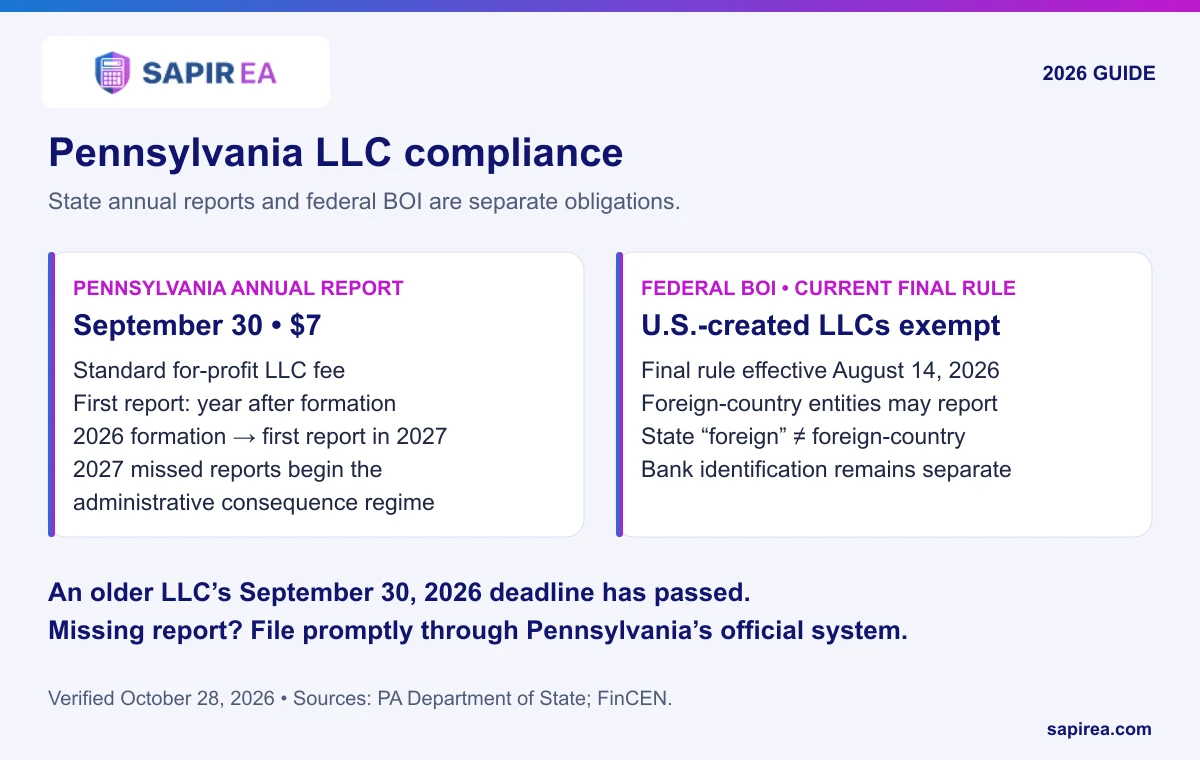
Pennsylvania’s annual-report system began in 2025. Domestic and registered foreign LLCs generally file by September 30 each year. The standard fee is $7; LLCs with a not-for-profit purpose have no fee. The first report is due in the year after formation or initial Pennsylvania registration.
An LLC formed in 2026 ordinarily files its first report by September 30, 2027. An older LLC’s 2026 deadline was September 30, 2026, which has already passed as of this guide’s review date. If yours is missing, file promptly through the state’s official system.
The state’s administrative dissolution, cancellation, or termination consequences begin with reports not filed in 2027. The transition period does not eliminate 2025 or 2026 filing obligations. The Department of State annual-report page explains filing, fees, and the transition. This report is separate from income-tax returns.
Federal BOI reporting changed again in 2026
FinCEN’s final rule, effective August 14, 2026, made permanent the exemption for U.S.-created entities. A Pennsylvania-created LLC therefore is exempt from federal Corporate Transparency Act BOI reporting under the current rule, even if foreign-owned. This updates the March 2025 interim rule.
Entities formed under foreign-country law and registered in the United States may still have reporting duties unless exempt. A Delaware LLC registered in Pennsylvania is “foreign” for state registration but remains U.S.-created for this federal distinction. Check FinCEN’s current BOI guidance and the 2026 final rule. Bank identification requirements remain separate.
Do not infer pass-through entity tax election eligibility from the federal entity label. State PTET programs have separate rules for eligible entities, owners, elections, payments, and credits. An owner working across state lines needs a jurisdiction-specific analysis; a program available in one state does not automatically exist in another.
Pennsylvania generally recognizes federal S status unless the business elects out. Owner pass-through income generally faces Pennsylvania personal income tax at 3.07%, with state-specific adjustments. Local earned-income, business privilege, or Philadelphia business taxes may also apply. See the Pennsylvania pass-through entity guidance.
How to dissolve an LLC and close its tax accounts
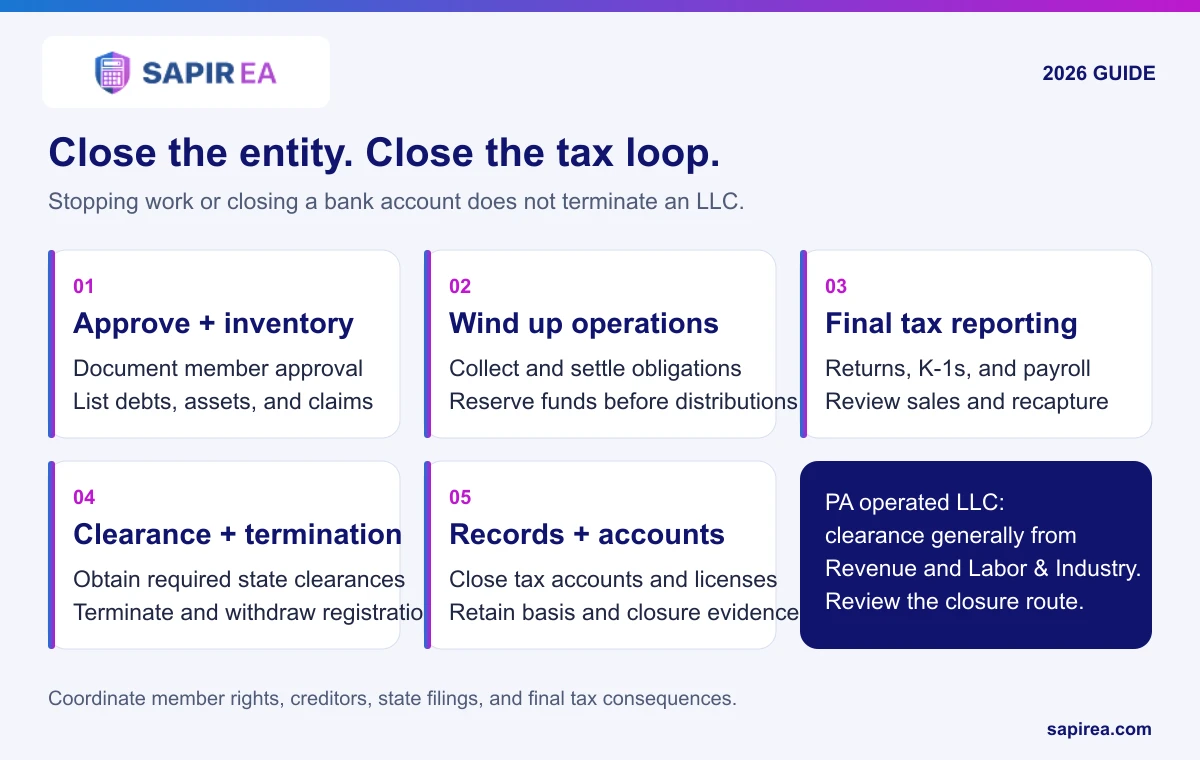
Stopping work does not automatically terminate the entity. Dissolution starts the closing process; winding up addresses assets and obligations; termination completes the state-law entity closure. Follow the operating agreement and state requirements, document member approval, and obtain legal guidance for unresolved claims or insolvency.
- Inventory obligations. Identify debts, contracts, leases, employees, customer deposits, receivables, and outstanding taxes.
- Wind up operations. Collect money, settle liabilities, address creditor rights, and preserve sufficient funds before distributing remaining assets.
- Prepare final filings. Mark final returns and K-1s where applicable; complete payroll, information returns, and tax deposits. Review asset sales, depreciation recapture, debt cancellation, and liquidating distributions.
- Complete state termination and withdrawals. Close registrations in every relevant jurisdiction and cancel licenses or tax accounts through the proper agencies.
- Retain records. Keep returns, ownership records, payroll files, asset-basis support, and closure evidence for the applicable retention periods.
For a Pennsylvania domestic LLC that conducted business, termination generally requires tax-clearance certificates from both the Department of Revenue and Department of Labor and Industry. A never-operated entity may qualify for a different voluntary-closure route. Consult the state tax-clearance guidance and IRS closing-a-business checklist. An EIN remains permanently assigned even when its business account is closed.
Common LLC mistakes to avoid
Do not confuse formation, an EIN, and an S election. They are distinct actions. Avoid mixing personal spending with business expenses, treating every distribution as tax-free, or assuming an LLC shelters your own negligence. Keep the operating agreement consistent with the tax classification.
Foreign owners need specialized review: a foreign-owned U.S. disregarded entity can have Form 5472 and pro forma Form 1120 obligations for reportable related-party transactions despite the domestic BOI exemption. Rental businesses, spouses sharing ownership, and professional practices also deserve advice before applying general rules.
For a two-owner startup, agree on tax distributions before profits arise. Owners may owe tax on allocated income that the business retains for expansion. Without a cash-distribution policy, one member may have an unexpected personal bill despite receiving no money. Ask how capital contributions, services, loans, and ownership changes will be recorded and reported.
Bring current books, prior returns, ownership documents, payroll records, and expected changes to an entity review. SAPIR EA serves business owners nationwide, with appointments in Jamison, Pennsylvania. Request a business tax consultation to connect your structure with a workable tax and accounting plan.
Frequently asked questions about LLCs
Is an LLC a corporation?
An LLC is a state-law entity distinct from a corporation. For federal tax purposes, an eligible LLC can elect corporate treatment, including S-corporation treatment when eligible.
Does a single-member LLC need a separate tax return?
Usually not for federal income tax when it is disregarded and owned by an individual. Employment, excise, state, or foreign-owner information reporting may still require separate filings.
Can I pay myself a salary from my LLC?
A default sole-proprietor owner normally takes draws, and partnership members generally are not employees. An LLC taxed as a corporation can pay owner wages; working S-corporation shareholders must address reasonable compensation.
Is there a profit level where every LLC should elect S status?
No. Compare supportable salary, employment taxes, QBI, state taxes, benefits, payroll administration, and return costs using the business’s actual facts.
When is a Pennsylvania LLC annual report due?
Generally September 30, beginning in the year after formation or initial Pennsylvania registration. The standard fee is $7, with no fee for LLCs with a not-for-profit purpose.
Does a U.S.-created LLC need to file a federal BOI report in 2026?
No under FinCEN’s final rule effective August 14, 2026. Foreign-country-created entities registered in the United States may still need to report unless exempt.
Does closing my bank account dissolve my LLC?
No. Complete the state closure process, final tax reporting, required clearances, and account cancellations. Settle obligations before distributing remaining assets.
Do I need an EIN before forming an LLC?
Form the state-law entity first, then apply for an EIN when required. The IRS issues EINs without an application fee. An EIN identifies the business; it does not establish legal formation or elect S-corporation treatment.
Can an inactive LLC still have filing obligations?
Yes. State entity maintenance and some federal or state returns can remain due even without revenue. Review the classification, transactions, registrations, and formal closure status before assuming nothing must be filed.
Can an LLC deduct personal expenses?
No. Creating an LLC does not convert personal spending into deductible business expenses. Each deduction must satisfy the applicable tax rules and have supporting records.
General educational information as of October 28, 2026. Tax and legal outcomes depend on facts and jurisdiction. SAPIR EA provides tax and accounting guidance; consult legal counsel for entity documents, liability protection, and dissolution rights.