LLC vs S-Corp: When an S-Corp Election Actually Saves Taxes (2026)
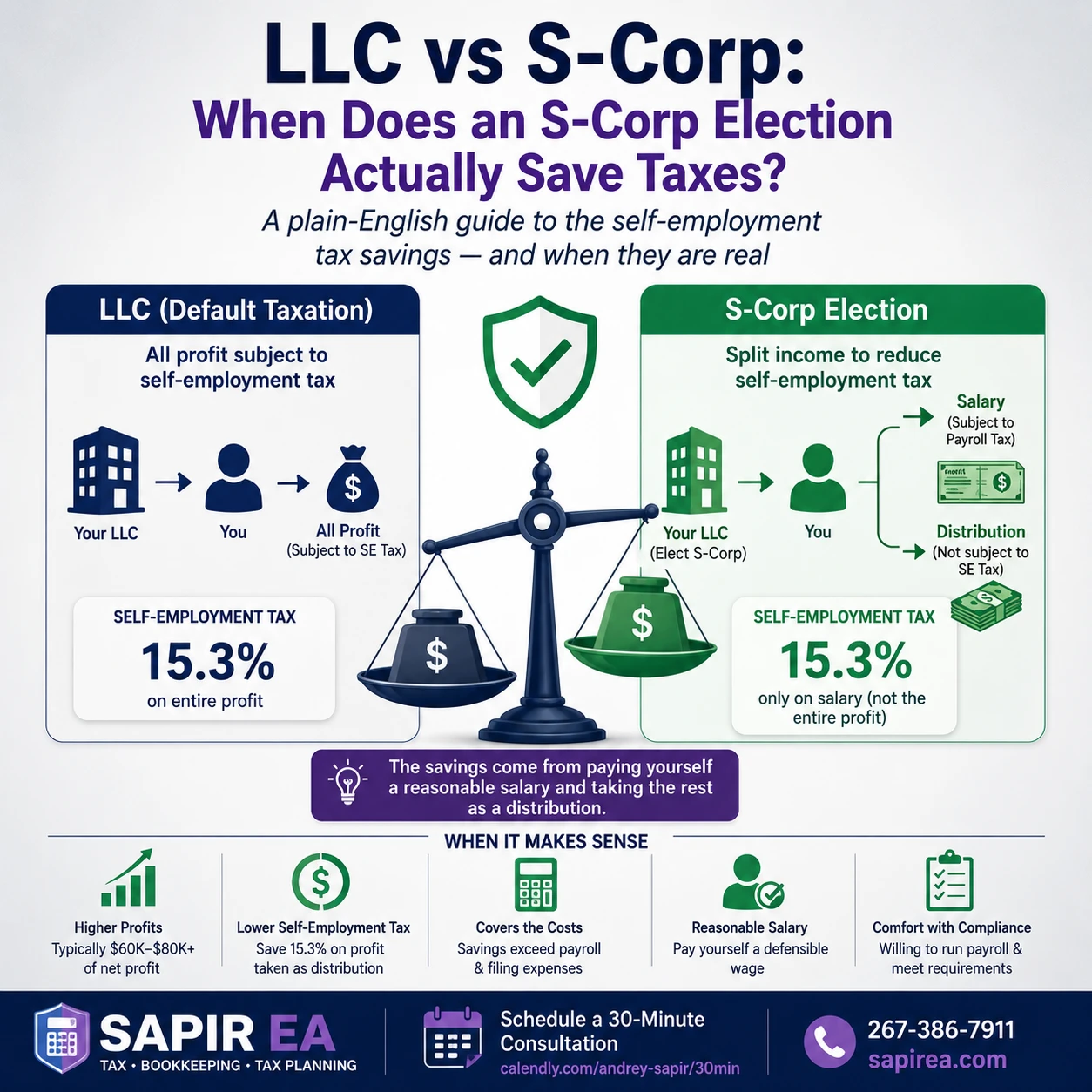
LLC vs S-Corp: When Does an S-Corp Election Actually Save Taxes?
The short version: an S-Corp election can lower your
self-employment tax once your profit is high enough to justify the extra
payroll and paperwork. Below that point, it is usually not worth it.
First, What an S-Corp Actually Is
This trips up a lot of owners: an S-Corp is not a type of
company. It is a tax election. You still have your LLC. You simply file a form
telling the IRS to tax that LLC under the S-Corporation rules instead of the
default rules. Your legal entity does not change — only the way the profit is
taxed does.
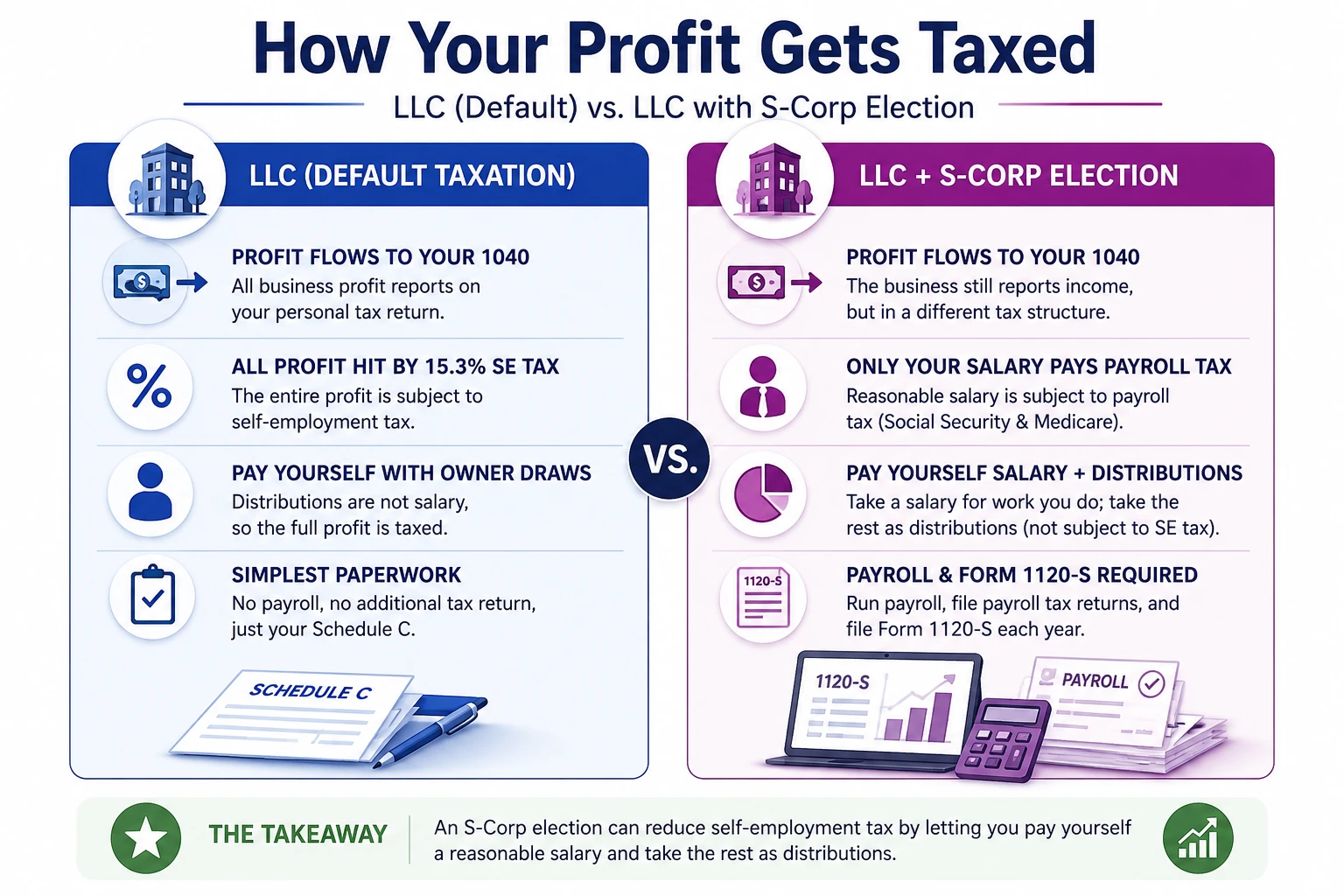
By default, a single-member LLC is taxed like a sole
proprietorship and a multi-member LLC like a partnership. In both cases, all of
the net profit lands on your personal return and is subject to self-employment
tax.
Where the Savings Come From: Self-Employment Tax
On top of regular income tax, self-employed owners pay a
15.3% self-employment tax (Social Security and Medicare) on their business
profit. That is the cost an S-Corp election targets.
When your LLC is taxed as an S-Corp, you split your pay into
two buckets: a reasonable salary that runs through payroll, and the remaining
profit taken as a distribution. The salary is subject to payroll taxes — but
the distribution is not. That is the core of the savings.
A Simple Example
Say your LLC earns $120,000 in profit. As a default LLC,
roughly the entire amount is exposed to the 15.3% self-employment tax. As an
S-Corp, you might pay yourself a $70,000 reasonable salary and take the
remaining $50,000 as a distribution. Only the $70,000 salary carries payroll
tax; the $50,000 distribution does not.
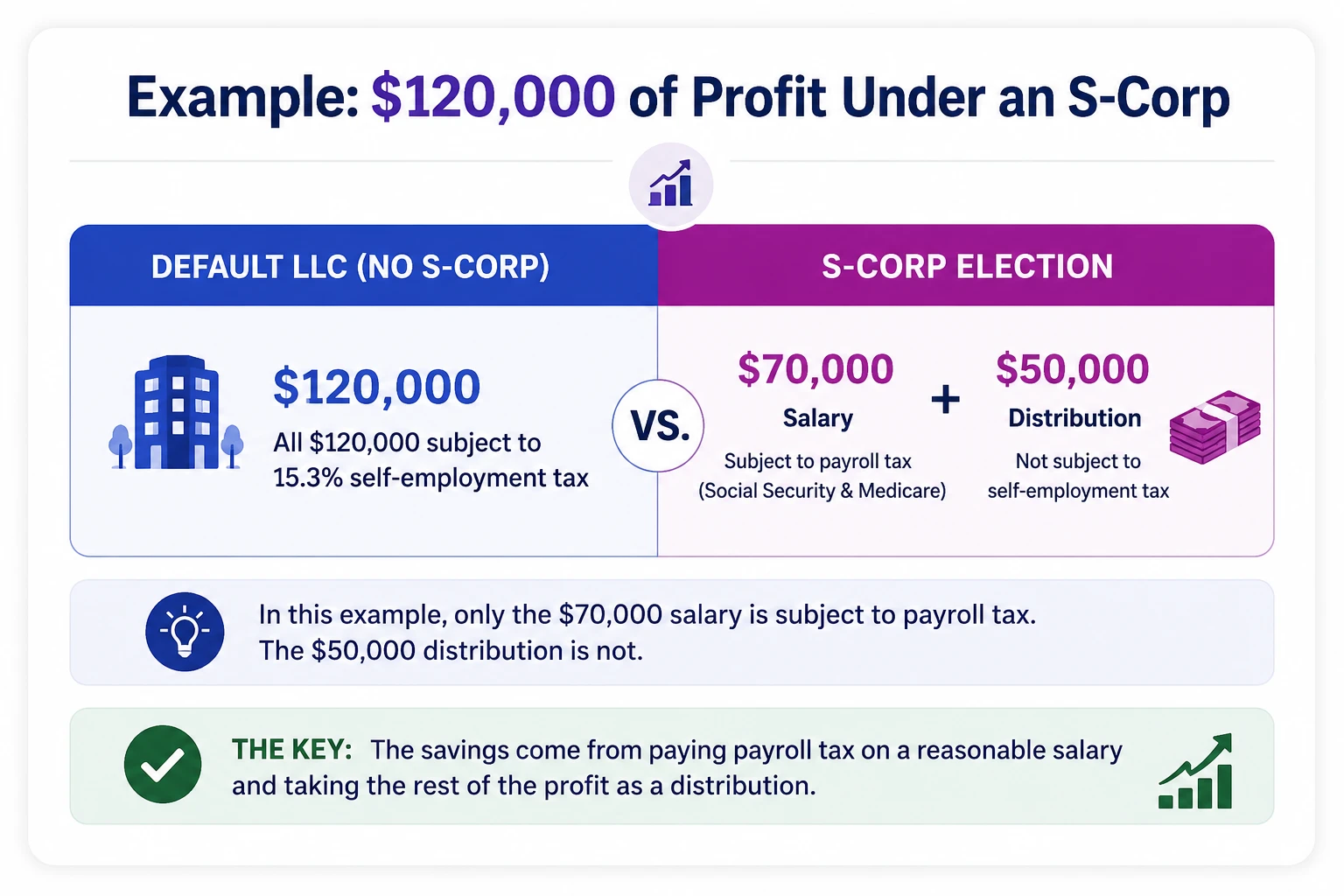
That gap is where the savings live. But notice the salary
has to be reasonable — you cannot pay yourself $10,000 and call the other
$110,000 a distribution. The IRS requires S-Corp owners who work in the
business to take reasonable compensation, and lowballing it is one of the most
audited S-Corp issues.
When the Election Actually Pays Off
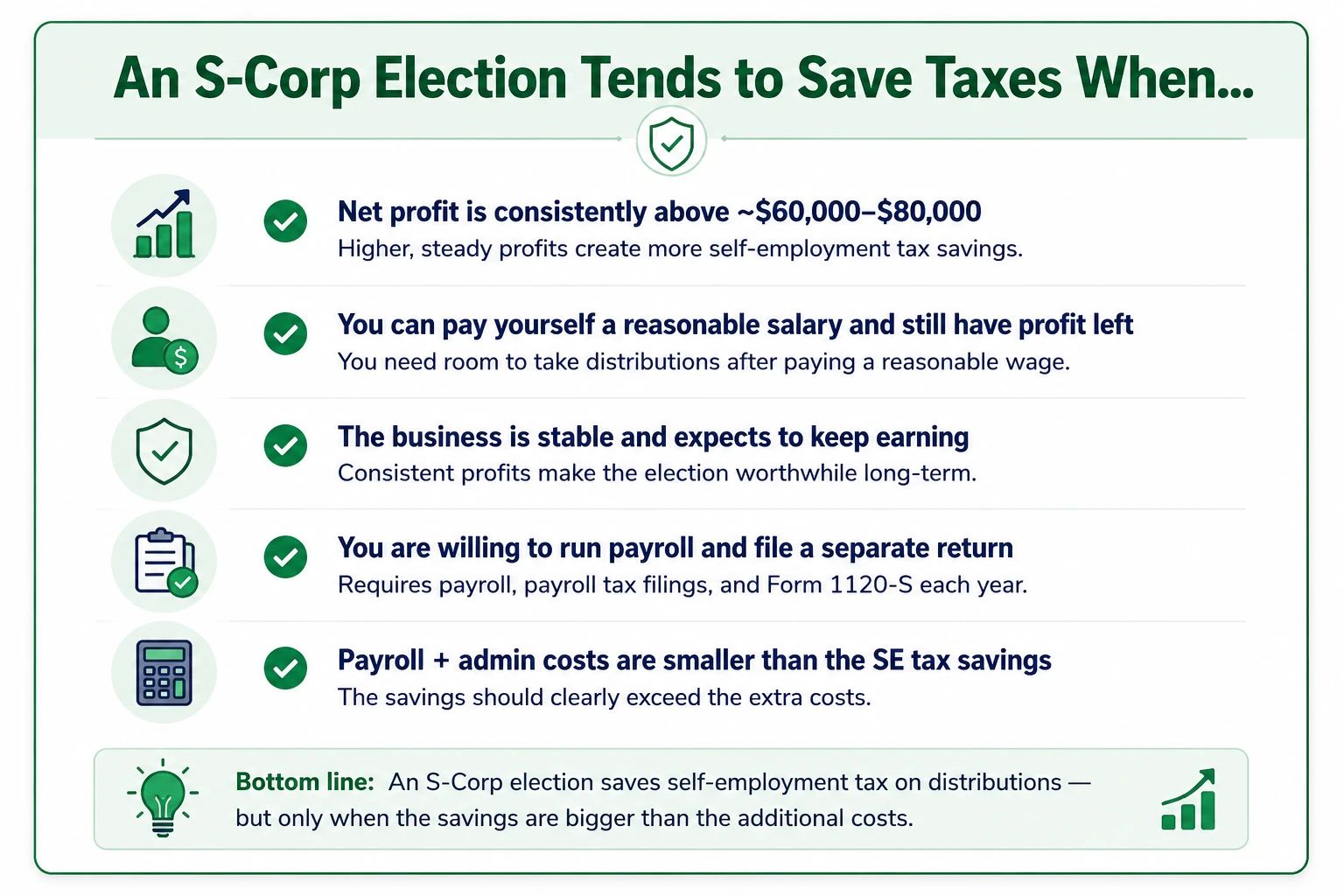
An S-Corp election makes the most sense once your profit is
high enough that the self-employment tax savings clearly beat the new costs. As
a rough guide, owners often start to benefit somewhere around $60,000 to
$80,000 of net profit, but the right threshold depends on your salary, your
state, and your situation.
The Costs and Trade-Offs
The savings are real, but so are the obligations. Before
electing, weigh these:
·
Payroll. You
must run real payroll, withhold taxes, and file payroll returns — usually
through a payroll provider.
·
A
separate tax return. The S-Corp files its own Form 1120-S, which typically
means higher preparation fees.
·
Reasonable
salary. You have to pay yourself a defensible wage, which reduces how much
you can take as a distribution.
·
State
rules and fees. Some states impose extra taxes or fees on S-Corps, which
can shrink the benefit.
|
Key takeaway: An S-Corp election saves money by
reducing self-employment tax on the portion of profit you take as a
distribution. It usually pays off once profit is high enough to cover payroll
and filing costs — and only if you pay yourself a reasonable salary. |
The Bottom Line
LLC versus S-Corp is not about which is better in the
abstract — it is about your numbers. If your business is consistently
profitable and you can pay yourself a reasonable salary with room to spare, an
S-Corp election can be a smart, legitimate way to keep more of what you earn.
If your profit is modest or unpredictable, the default LLC is often simpler and
cheaper. Running the actual math for your situation is the only way to know.
|
Work with Sapir EA Have questions about your situation?
Schedule a 30-minute consultation at calendly.com/andrey-sapir/30min, call
267-386-7911, or visit sapirea.com. We help business owners and individuals
nationwide with tax preparation, planning, and bookkeeping. |
Disclaimer:
This article is general educational information, not individualized tax, legal,
or financial advice. Tax rules change and depend on your specific facts. Please
consult a qualified professional before acting. Sapir EA • 2370 York Road,
Suite G1 #357, Jamison, PA 18929 • 267-386-7911.