Rental Real Estate Tax Guide 2026
Rental Real Estate Tax Guide for 2026: Short-Term Rentals, Passive Losses, Depreciation, Cost Segregation, and More
A practical 2026 guide for long-term landlords, Airbnb and VRBO hosts, real estate professionals, and investors building a rental portfolio.
Rental real estate can produce income, appreciation, leverage, and meaningful deductions. It can also create some of the most misunderstood rules on an individual return. The result depends on lease length, personal use, owner participation, financing, entity structure, state law, and depreciation choices.
This guide explains the 2026 federal framework for long-term and short-term rentals, material participation, real estate professional status, passive losses, depreciation, cost segregation, bonus depreciation, QBI, property sales, and Section 1031 exchanges.
Quick answer: Rental income is generally taxable and ordinary rental expenses may be deductible, but losses can be limited even when they are economically real. The key questions are how the activity is classified, whether the owner participates enough to change the passive-loss result, which costs must be capitalized, and what happens on sale.
Educational notice: This article provides general federal tax information, not individualized tax, legal, investment, or real-estate advice. State and local rules and property-specific facts can change the result.
Rental Real Estate at a Glance
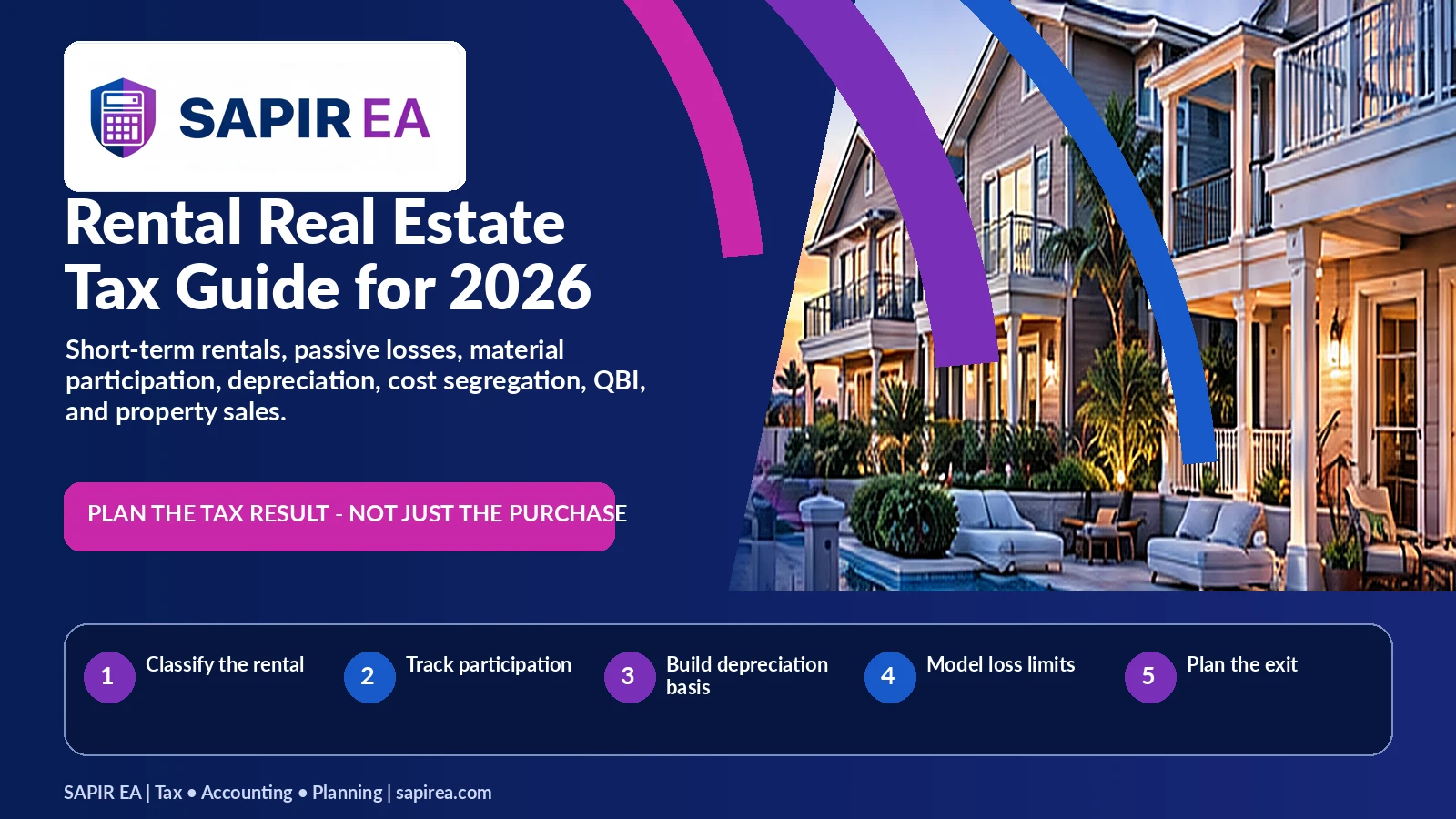
Start by identifying the activity:
- Long-term rental: A traditional residential or commercial lease. Losses are generally passive unless an exception applies.
- Short-term rental: Often operated through Airbnb or VRBO. An average customer stay of seven days or less is not a rental activity for passive-loss purposes, making material participation important.
- Vacation or mixed-use home: Personal-use days can limit deductions and require expense allocation.
- Trade or business: A rental may qualify as a trade or business for QBI or net investment income tax, but one classification does not control every rule.
- Dealer activity: Property held primarily for sale to customers is not investment real estate and generally is ineligible for Section 1031.
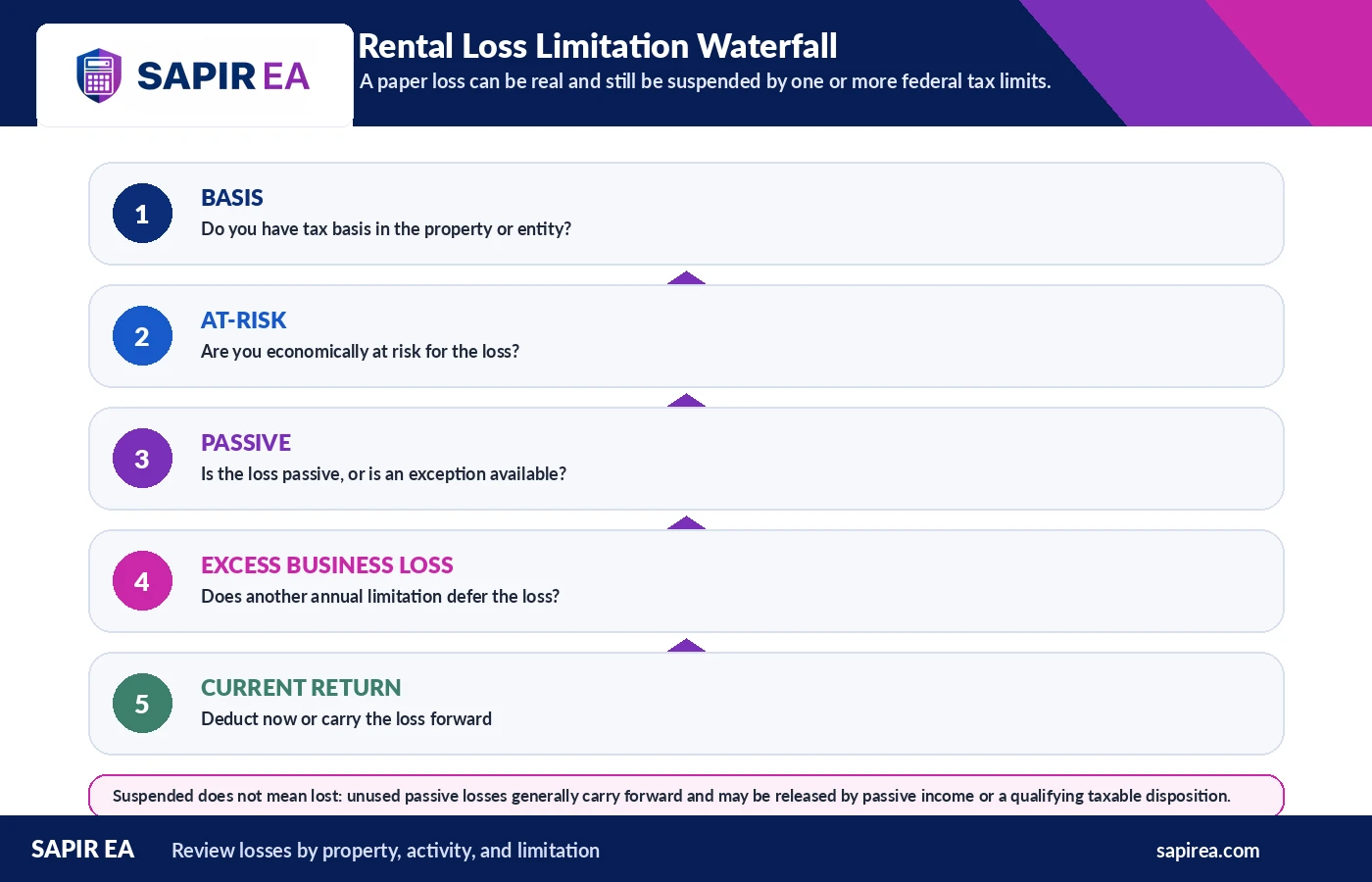
Loss rules apply in layers. Basis and depreciation are calculated first, the at-risk rules apply next, and passive-activity limits follow. Large noncorporate business losses may face another limitation. A depreciation deduction therefore may be suspended rather than currently usable.
Short-Term Rentals vs. Long-Term Rentals
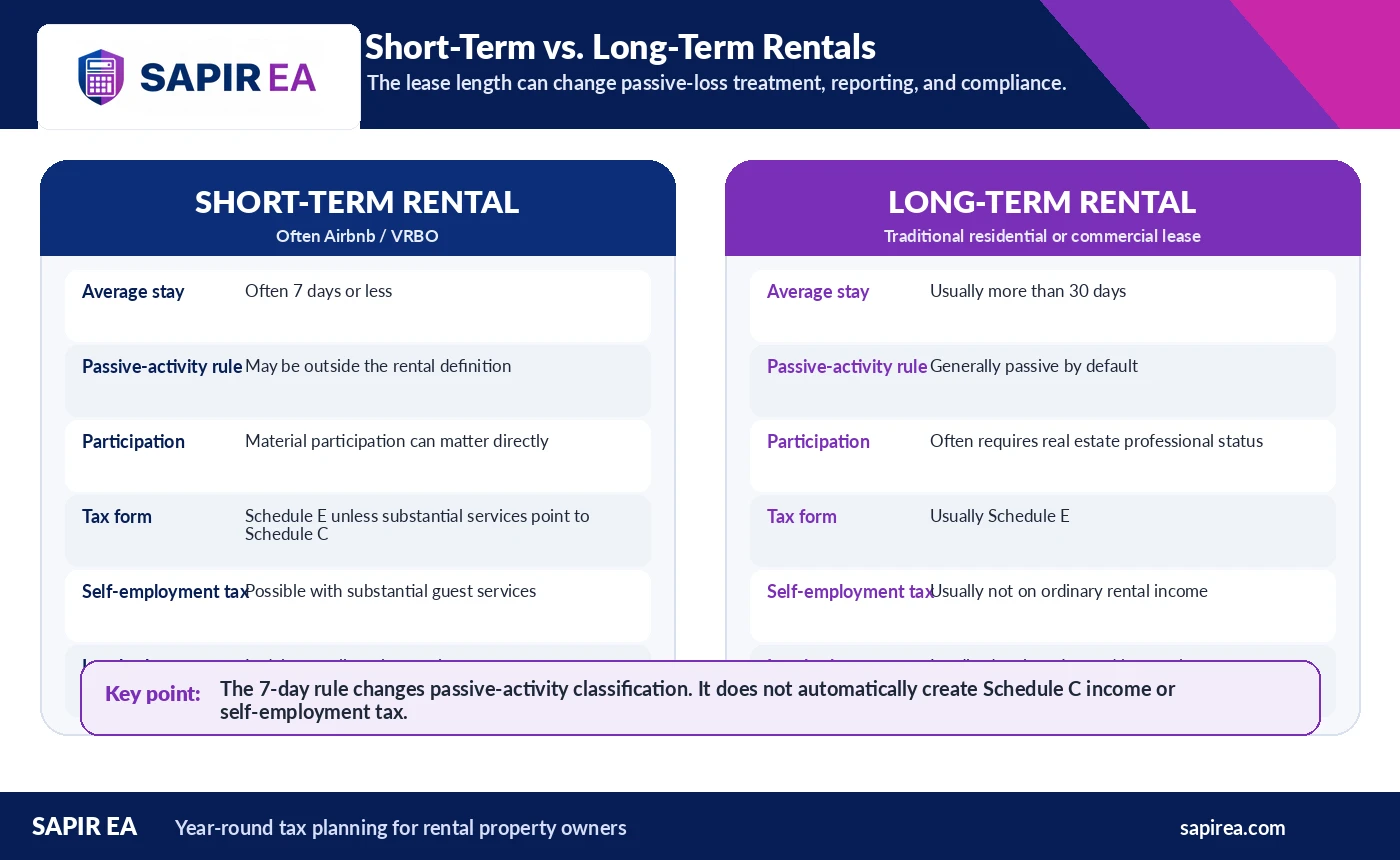
A short-term rental is not merely a long-term rental with more tenants. Average stay and guest services can change both passive-loss treatment and reporting.
| Issue | Short-Term Rental | Long-Term Rental |
|---|---|---|
| Typical stay | Often seven days or less | Usually more than 30 days |
| Passive classification | May be a nonrental trade or business activity | Generally passive by default |
| Material participation | Can make a qualifying activity nonpassive | Usually requires real estate professional status as well |
| Reporting | Often Schedule E; Schedule C may apply with substantial services | Usually Schedule E |
| Self-employment tax | May apply with substantial guest services | Usually does not apply to ordinary rent |
| Local compliance | Lodging tax, registration, zoning, and licensing | Landlord registration and lease-law requirements |
Under the passive-activity rules, an activity is not a rental activity when the average customer-use period is seven days or less. The same may apply when the average stay is 30 days or less and significant personal services are provided. If the activity is outside the rental definition, the ordinary material-participation tests determine whether it is passive.
This creates a planning opportunity: a materially participating owner may be able to use a qualifying short-term-rental loss without meeting the real estate professional tests. It is not automatic. The owner must substantiate participation, have sufficient basis and amount at risk, and account for personal use and the excess-business-loss rules.
The seven-day rule also does not automatically require Schedule C or self-employment tax. Those results depend mainly on services. Meals, regular in-stay cleaning, transportation, concierge services, or similar guest conveniences point toward Schedule C. Cleaning between guests, routine repairs, and common-area maintenance generally do not.
Reporting Rental Income and Deductible Expenses
Rental income generally includes rent, advance rent, lease-cancellation payments, and amounts a tenant pays on the owner's behalf. A refundable security deposit usually is not income when received; it becomes income if applied to rent or retained.
Common deductions include advertising and platform fees, cleaning, ordinary repairs, management fees, insurance, properly traced interest, property taxes, utilities, professional fees, supplies, documented travel, association fees, occupancy taxes borne by the owner, and depreciation.
Mortgage principal is not an expense. Refinance interest follows the use of the proceeds: cash used personally does not become rental interest merely because rental property secures the loan.
Repairs vs. Improvements
A repair keeps property in ordinarily efficient condition. An improvement must generally be capitalized when it creates a betterment, restores the property, or adapts it to a new use. Repainting between tenants may be a repair; a complete renovation is generally capitalized.
The tangible-property regulations include elections and safe harbors. For taxpayers without an applicable financial statement, the de minimis safe harbor can generally cover qualifying items costing up to $2,500 per invoice or item when the annual election and recordkeeping requirements are met. It does not turn a major building improvement into a repair.
Rental Property Depreciation Rules
Depreciation allocates the cost of income-producing property over its recovery period. Property is placed in service when it is ready and available for rent, not necessarily when the first tenant moves in.
Depreciable basis usually begins with purchase price plus capitalized acquisition costs, allocated between land and depreciable property. Land is not depreciable. Improvements increase basis, while depreciation, casualty adjustments, and certain reimbursements reduce it. For a former residence converted to rental use, depreciation basis is generally the lower of adjusted basis or fair market value on the conversion date.
| Asset | Typical federal recovery period | Examples |
|---|---|---|
| Residential rental building | 27.5 years | Single-family rental, apartment, residential portion of mixed-use property |
| Nonresidential real property | 39 years | Office, retail, warehouse, commercial building |
| Furniture and appliances | 5 years | Beds, refrigerators, movable furniture, certain carpeting |
| Certain equipment | 5 or 7 years | Computers, tools, security and office equipment |
| Land improvements | 15 years | Certain parking, fencing, landscaping, and site work |
| Land | Not depreciable | Purchase-price allocation to land |
Buildings generally use straight-line depreciation and the mid-month convention. Shorter-life property may use accelerated methods. Depreciation is usually allowed or allowable: failing to claim it generally does not preserve basis, so omitted depreciation should be corrected rather than ignored.
Cost Segregation and 100% Bonus Depreciation
A cost segregation study separates a building's cost into asset classes with different recovery periods. A defensible study may identify five-year, seven-year, and fifteen-year components such as certain finishes, dedicated electrical systems, specialty equipment, landscaping, parking, and site improvements. The building and structural components remain longer-life Section 1250 property, and land remains nondepreciable.
Current federal law generally provides permanent 100% bonus depreciation for eligible property acquired after January 19, 2025. Properly identified components with recovery periods of 20 years or less may therefore be deductible in the placed-in-service year. States may require an addback or different schedule.
Cost segregation can be valuable when the property has a meaningful basis, the owner expects to use accelerated losses, and the tax benefit exceeds the study cost and future recapture. An older property may also qualify for a study. Form 3115 and a Section 481(a) adjustment may permit a catch-up deduction without amending every prior return.
Cost segregation is primarily a timing strategy. Accelerated deductions reduce adjusted basis. On sale, shorter-life Section 1245 property can produce ordinary-income recapture, while gain attributable to building depreciation may be taxed as unrecaptured Section 1250 gain at up to 25% federally.
Model loss usability before ordering a study. A large deduction suspended under the passive rules may still have value, but not the same immediate cash-flow benefit as a currently deductible loss.
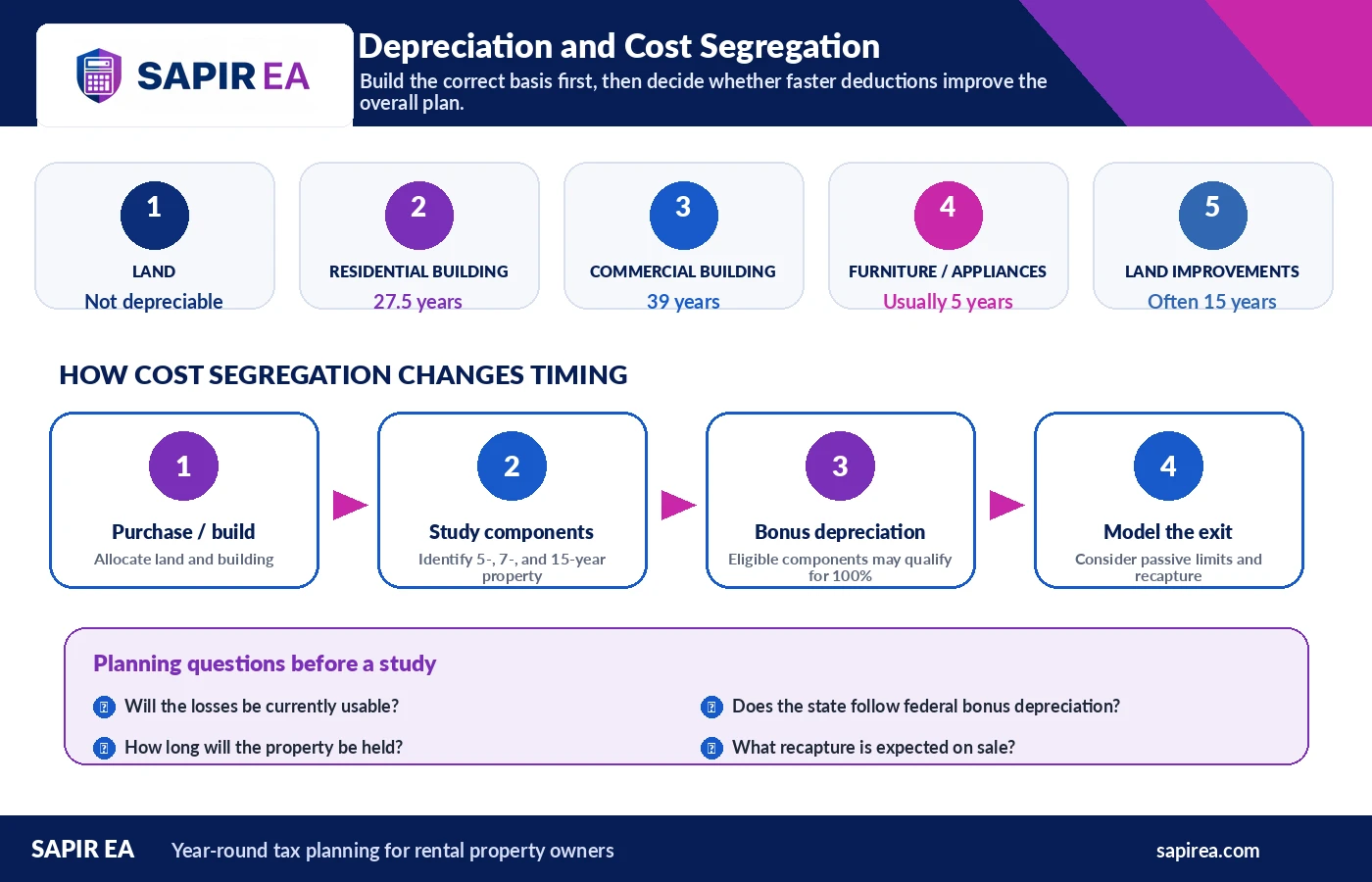 Cost segregation changes the timing and character of depreciation; it does not eliminate future recapture.
Passive Loss Rules, Active Participation, and Material Participation
Rental real estate losses are generally passive. Passive losses normally offset passive income, not wages, portfolio income, or active business income. Unused losses carry forward until passive income is available or the entire activity is sold in a fully taxable transaction to an unrelated person.
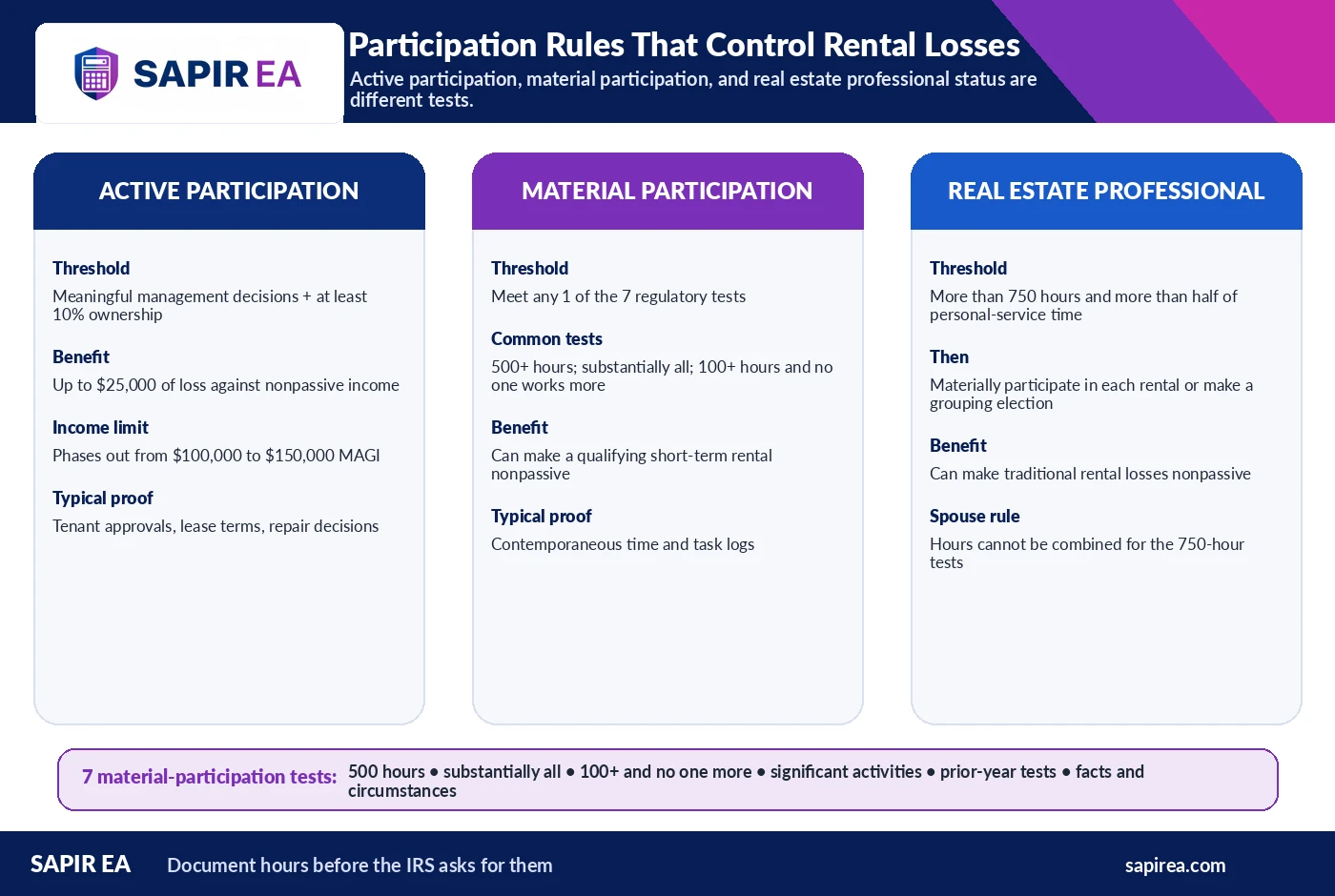
| Standard | General requirement | Why it matters |
|---|---|---|
| Active participation | Management decisions plus at least 10% ownership | May allow up to $25,000 of rental loss, subject to income phaseout |
| Material participation | One of seven regulatory tests | Can make a qualifying nonrental activity, including some short-term rentals, nonpassive |
| Real estate professional | More than 750 hours and more than half of personal-service time in qualifying real-property businesses, plus material participation | Can make rental real estate nonpassive |
The $25,000 Special Allowance
An owner who actively participates may deduct up to $25,000 of rental loss against nonpassive income. The allowance generally phases out by 50 cents per dollar of modified adjusted gross income above $100,000 and is generally unavailable at $150,000. Active participation is a relatively low standard: approving tenants, setting terms, and authorizing repairs can qualify when the taxpayer owns at least 10%.
The Seven Material-Participation Tests
A taxpayer materially participates by meeting at least one test:
- More than 500 hours.
- Substantially all participation.
- More than 100 hours and at least as much as any other person.
- More than 500 combined hours in significant-participation activities, each over 100 hours.
- Material participation in any five of the prior ten years.
- Material participation in a personal-service activity for any three prior years.
- Regular, continuous, and substantial participation under all facts and circumstances, generally with more than 100 hours and additional restrictions.
Investor-type monitoring may not count. Owners should keep contemporaneous logs showing date, task, property, and time.
Real Estate Professional Status
For traditional rentals, material participation alone generally is insufficient. The owner must first qualify as a real estate professional and then materially participate in the rentals.
The taxpayer generally must perform more than 750 hours in real-property trades or businesses in which the taxpayer materially participates, and those hours must exceed half of all personal-service time. Employee hours usually count only when the taxpayer owns more than 5% of the employer.
Spouses cannot combine hours for the 750-hour and more-than-half tests, but a spouse's participation can count for material participation in a specific activity. Each rental is normally separate unless the taxpayer elects to group all rental real estate interests. Grouping can help satisfy participation but may delay release of suspended losses when only one property is sold.
The at-risk rules apply before passive limits. A taxpayer generally cannot deduct more than the amount economically at risk, although qualified nonrecourse real-estate financing may count. Large losses can then face the excess-business-loss rules.
Vacation Homes, Personal Use, and the 14-Day Rule
Personal use can change the result even when the property is listed for rent.
A dwelling is generally treated as a residence if personal use exceeds the greater of 14 days or 10% of the days rented at a fair rental price. Expenses must be allocated between rental and personal use, and rental deductions may be limited to rental income. Personal use includes use by the owner, certain family members, people using the property under a reciprocal arrangement, and anyone paying less than fair rental value.
A separate rule applies when a residence is rented for fewer than 15 days during the year. The rental income generally is not reported, and rental expenses are not deducted. This rule is sometimes called the Augusta rule, but it is not a blanket exemption for a full-time short-term-rental business.
Track rental days, personal days, maintenance days, and days the property is available but vacant. A maintenance day is not automatically personal when the principal purpose is full-time repair or maintenance, but the work performed should be documented.
QBI, Net Investment Income Tax, and Entity Structure
Rental real estate may qualify for the Section 199A QBI deduction when it rises to a trade or business. Revenue Procedure 2019-38 offers a safe harbor that generally requires separate books, qualifying rental-service hours, contemporaneous records, and an annual statement. Triple-net leases are excluded from the safe harbor, although general trade-or-business principles may still apply.
The 3.8% Net Investment Income Tax can apply to rental income and gains above statutory income thresholds. Income from a nonpassive trade or business may be excluded, but the real-estate-professional, material-participation, and trade-or-business tests must be analyzed together.
An LLC can provide legal separation without automatically changing federal tax treatment. Partnership-taxed LLCs often provide flexibility for property contributions, debt allocations, and distributions. Holding appreciating property in an S corporation can create gain when property is distributed and reduce flexibility. Coordinate ownership with legal counsel and a tax professional before transferring title.
Buying, Refinancing, Selling, and Section 1031 Exchanges
At acquisition, preserve the settlement statement, appraisal, loan documents, renovation invoices, and allocation among land, building, and personal property. Acquisition costs may be capitalized, deducted, or amortized depending on their nature.
Refinancing generally is not taxable, but interest follows the use of proceeds. Cash used for personal purposes may create nondeductible personal interest even when rental property secures the loan.
On sale, gain is generally selling price less selling costs and adjusted basis. Adjusted basis reflects improvements and depreciation allowed or allowable. The sale may produce Section 1231 gain, unrecaptured Section 1250 gain, and ordinary Section 1245 recapture from cost-segregated property. Suspended passive losses generally release on a fully taxable sale of the entire activity to an unrelated buyer.
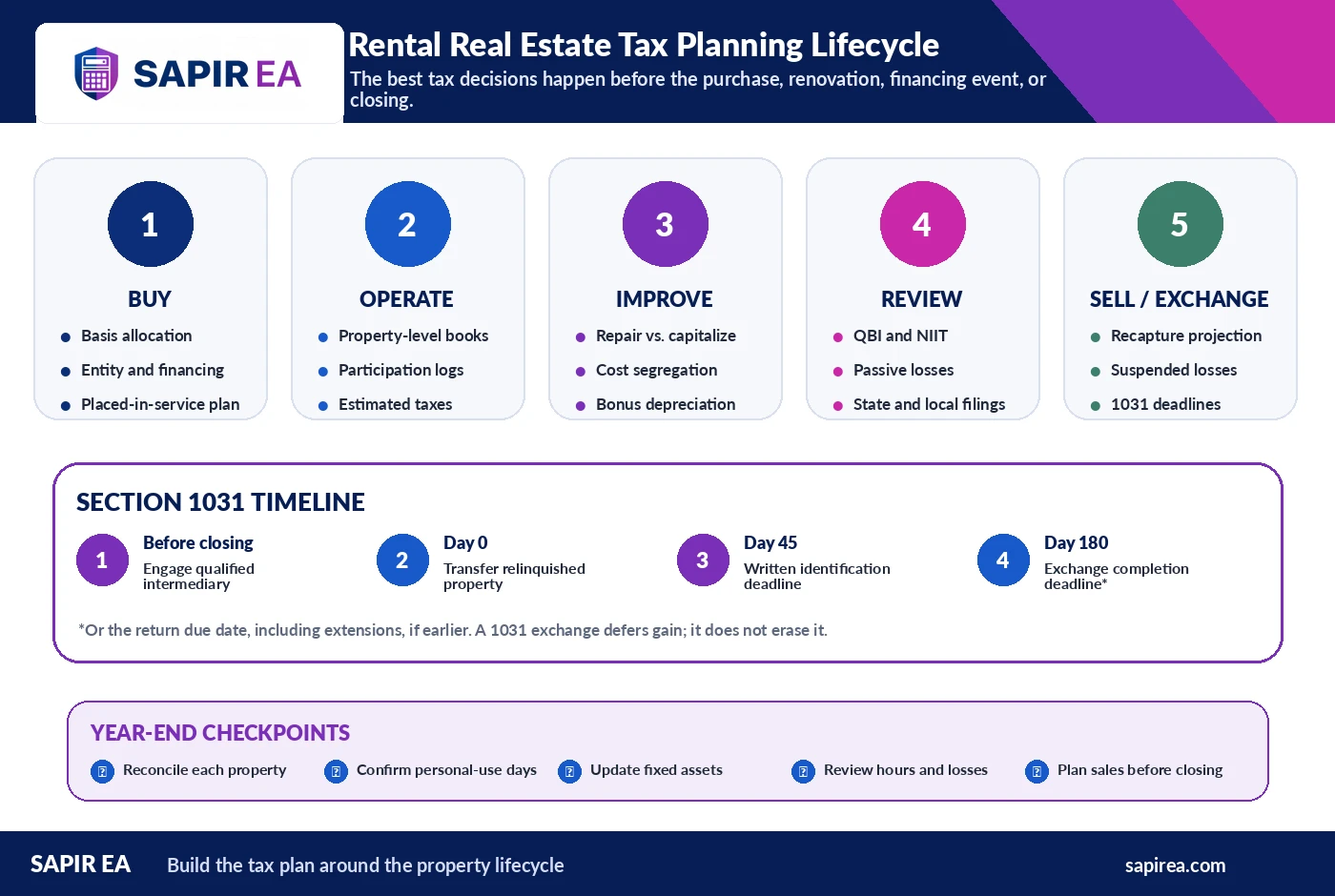
A Section 1031 exchange can defer gain when investment or business real property is exchanged for qualifying like-kind U.S. real property. It does not erase gain; the deferred amount generally carries into the replacement basis. Replacement property usually must be identified in writing within 45 days and received by the earlier of 180 days after transfer or the return due date, including extensions. Engage a qualified intermediary before closing because receiving or controlling the proceeds can disqualify the exchange.
Dealer property and property held primarily for personal use generally do not qualify.
State, Local, and Multi-State Rules
Federal treatment is only part of the analysis. A state may require a nonresident return because rental property is located there. Short-term rentals may be subject to state sales tax, hotel tax, municipal occupancy tax, registration, zoning, and business-license rules. Platforms sometimes collect some taxes but not every tax or filing obligation.
States may decouple from federal bonus depreciation, use different passive-loss adjustments, impose entity-level taxes, or require withholding for nonresident owners. Partnerships and multi-member LLCs should also evaluate composite returns and Pass-Through Entity Tax elections. Review each state's treatment before assuming the federal deduction produces the same state result.
Year-End Rental Real Estate Checklist
Before December 31 and before the return is filed, review:
- property-by-property income, expenses, and security deposits;
- bank, credit-card, mortgage, and platform reconciliations;
- repair versus improvement classification;
- placed-in-service dates and personal-use days;
- fixed-asset additions, disposals, and depreciation schedules;
- cost-segregation opportunities and whether accelerated losses are usable;
- active-participation, material-participation, and real-estate-professional hour logs;
- estimated federal, state, local, and occupancy taxes;
- Forms W-9 and information-return obligations for contractors;
- QBI safe-harbor records;
- state filing and local licensing requirements;
- suspended passive losses and at-risk basis;
- expected property sales, 1031 exchange planning, and recapture exposure; and
- whether ownership and liability structure still fit the portfolio.
Clean property-level bookkeeping is essential. A single combined profit-and-loss statement can hide which property generated the loss, whether a security deposit was misclassified, and which renovation should be capitalized. SAPIR EA provides virtual bookkeeping and QuickBooks support that can keep property records ready for planning and tax preparation.
Common Rental Real Estate Tax Mistakes
The most frequent problems include depreciating land, using the purchase date instead of the placed-in-service date, expensing improvements as repairs, assuming every short-term-rental loss is nonpassive, failing to document participation hours, overlooking personal-use limits, ignoring state lodging taxes, claiming a cost-segregation deduction without modeling passive-loss limits, and beginning a Section 1031 exchange after the sale has already closed.
Another common error is treating one rule as if it controls every issue. A property can be a nonrental activity for Section 469, still be reported on Schedule E, qualify or fail to qualify for QBI under a different test, and have a separate net-investment-income-tax analysis. Classification must be addressed rule by rule.
How SAPIR EA Helps Rental Property Owners
SAPIR EA provides tax preparation, virtual bookkeeping, and year-round tax planning for real estate investors, landlords, short-term-rental hosts, partnerships, and multi-state property owners. Services may include depreciation review, passive-loss analysis, material-participation planning, cost-segregation coordination, estimated taxes, entity and PTET considerations, 1031 reporting, and sale projections.
Learn more about tax services and year-round planning, tax preparation for real estate investors and agents, business tax consulting, Pass-Through Entity Tax planning, multi-state tax filings, and the 2026 year-end tax planning checklist.
Need a rental real estate tax review? A coordinated review can determine how the activity should be reported, whether losses are currently usable, whether a cost segregation study makes economic sense, and what should happen before a purchase, sale, or year-end deadline. Schedule a consultation with SAPIR EA.
Frequently Asked Questions About Rental Real Estate Taxes
Is rental income always taxable?
Usually. Rent, advance rent, lease-cancellation payments, and tenant-paid owner obligations are generally income. Refundable security deposits generally are not income until retained or applied to rent.
Is an Airbnb automatically reported on Schedule C?
No. Schedule C and self-employment tax generally depend on substantial guest services. Many short-term rentals without those services remain on Schedule E.
Can short-term-rental losses offset W-2 income?
Potentially. The activity may be nonpassive when average stays are seven days or less and the owner materially participates, but basis, at-risk, personal-use, and excess-business-loss limits still apply.
Do I need real estate professional status for a short-term rental?
Not always. A qualifying short-term rental may use the ordinary material-participation tests instead of the real estate professional rules.
Active participation vs. material participation: what is the difference?
Active participation is a lower standard used for the special rental allowance. Material participation requires one of seven regulatory tests and can determine whether a trade or business activity is passive.
How do I qualify as a real estate professional?
Generally, more than 750 hours and more than half of all personal-service time must be in qualifying real-property trades or businesses, followed by material participation in the rental activities.
How long is residential rental property depreciated?
The building is generally depreciated over 27.5 years using straight-line depreciation and the mid-month convention. Land is not depreciable; some furniture and land improvements use shorter lives.
What is cost segregation?
It identifies building components that properly qualify for shorter recovery periods. Eligible components may also qualify for 100% bonus depreciation under current federal law.
Can an older property receive a cost segregation study?
Often. Form 3115 may allow a catch-up Section 481(a) adjustment. Model study cost, passive-loss limits, state treatment, and future recapture first.
What if I forgot depreciation?
Basis generally must be reduced by depreciation allowed or allowable. Correcting the omission may require Form 3115 rather than simply claiming extra depreciation now.
Are travel costs to a rental deductible?
Ordinary and necessary travel may be deductible when the main purpose is managing or maintaining the property. Improvement-related travel is capitalized, and mixed personal travel must be allocated.
Does rental property qualify for QBI?
It may if it is a trade or business or meets the rental-real-estate safe harbor. Separate books, service-hour records, and the required annual statement are important.
What happens to suspended losses when I sell?
They generally release on a fully taxable disposition of the entire activity to an unrelated person. A tax-deferred Section 1031 exchange usually does not produce the same release.
Can a vacation home qualify for a 1031 exchange?
Only when the facts show investment or business use. Property held primarily for personal use does not qualify.
Should rental property be held in an S corporation?
Often not. Appreciated-property distributions can trigger gain, and partnership-taxed LLCs usually offer more flexibility. Review legal and tax consequences before transferring title.
Primary IRS Resources
- IRS Publication 527, Residential Rental Property
- IRS Publication 925, Passive Activity and At-Risk Rules
- IRS Publication 946, How To Depreciate Property
- IRS Cost Segregation Audit Techniques Guide
- IRS 2026 Guidance on Permanent 100% Bonus Depreciation
- IRS Revenue Procedure 2019-38, Rental Real Estate QBI Safe Harbor
- IRS Like-Kind Exchange Guidance
- IRS Tangible Property Regulations
- IRS Topic No. 415, Renting Residential and Vacation Property
This article is general educational information and does not constitute individualized tax, legal, accounting, investment, or real-estate advice. Federal, state, and local rules change and depend on the taxpayer's complete facts.