Who Can I Claim as a Dependent? 2026 Guide

Claiming a dependent can affect filing status, the Child Tax Credit, education credits, child-care benefits, the Earned Income Tax Credit, medical deductions, and paycheck withholding. Yet dependent has a precise tax meaning: paying someone’s expenses does not automatically qualify that person.
Federal law uses two rule sets—qualifying child and qualifying relative. A person can earn income, attend college, live away from home, or receive Social Security and still qualify in some situations. This guide explains the 2026 rules for children, students, parents, unmarried partners, shared-custody families, and relatives whose support is divided among several people.
2026 key number: A person who is not your qualifying child generally must have gross income below $5,300 to meet the qualifying-relative income test. The support and other dependency tests still apply.
Dependent Rules at a Glance
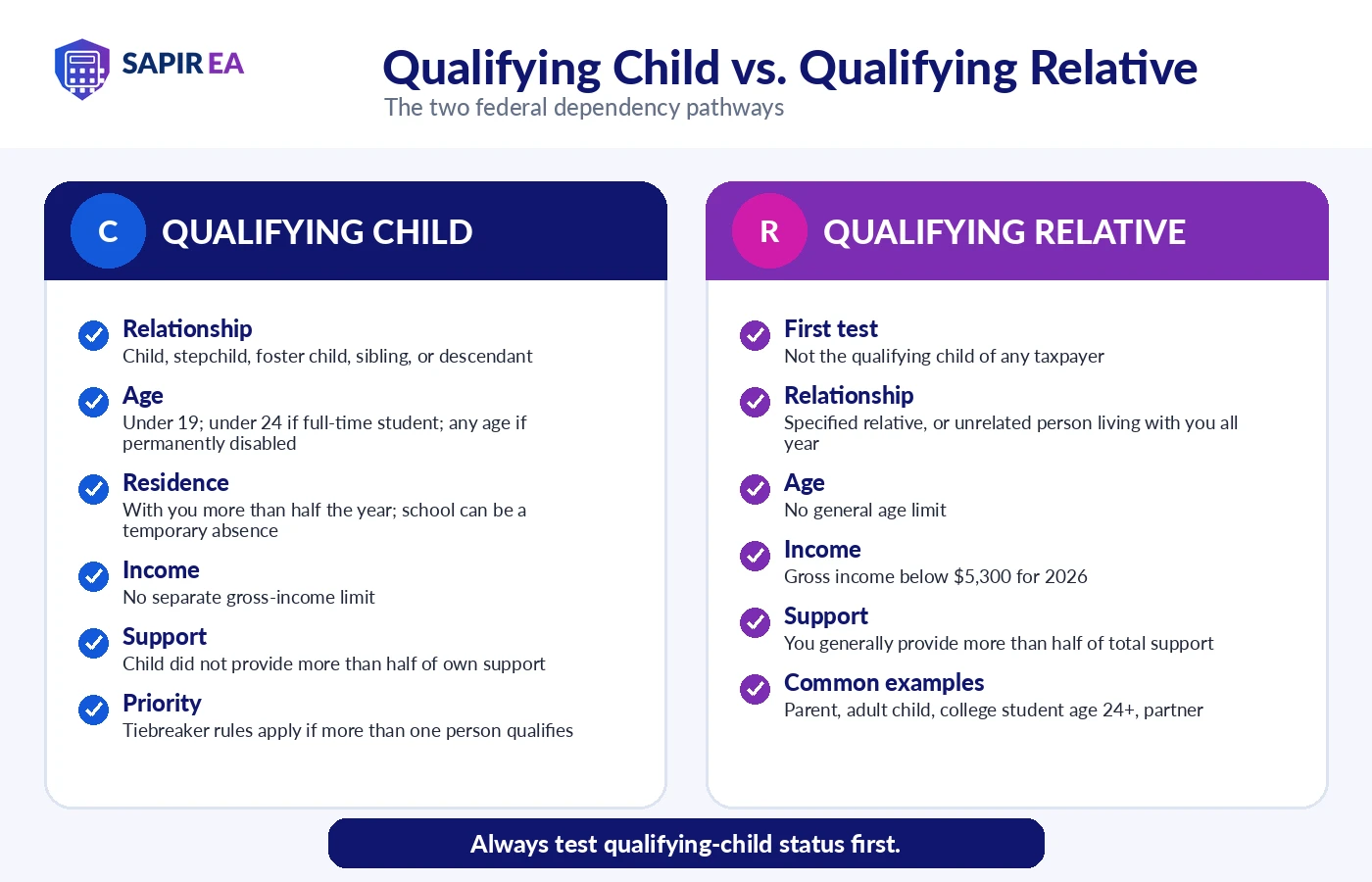
A dependent must generally be a qualifying child or qualifying relative. The labels are tax terms: a qualifying relative does not always have to be related to you, while a qualifying child can include certain siblings, grandchildren, nieces, nephews, adopted children, and eligible foster children.
| Question | Qualifying Child | Qualifying Relative |
|---|---|---|
| Relationship | Child, stepchild, foster child, sibling, stepsibling, half-sibling, or descendant | Specified relative, or an unrelated person living with you all year |
| Age | Usually under 19, or under 24 and a full-time student; no limit if permanently disabled | No general age limit |
| Residence | Usually with you more than half the year, including qualifying temporary absences | Specified relatives may live elsewhere; unrelated people generally must live with you all year |
| Income | No separate gross-income ceiling | Generally below $5,300 for 2026 |
| Support | The child did not provide more than half of personal support | You generally provided more than half of total support |
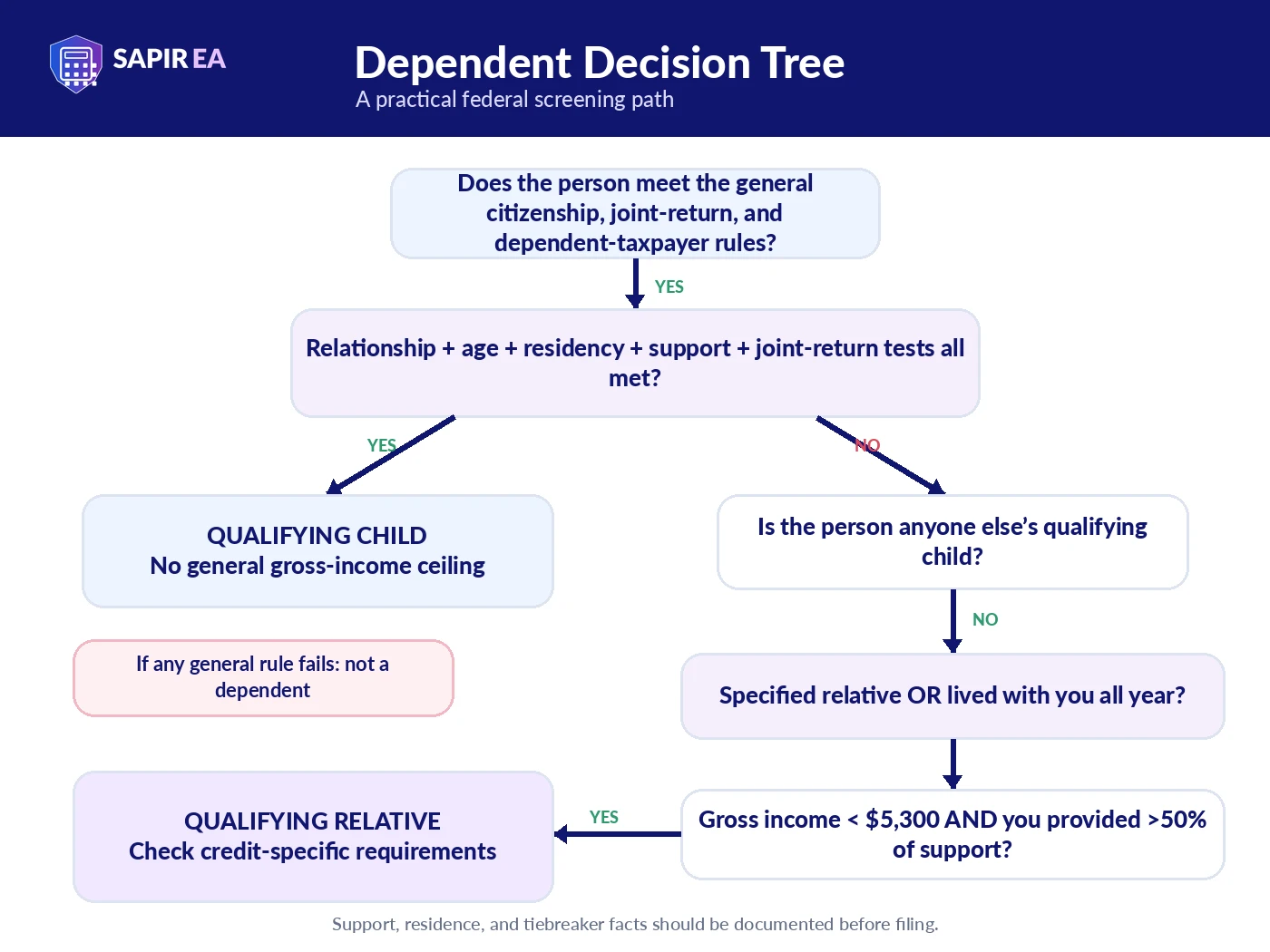
Rules common to both categories also matter. You generally cannot claim someone if you—or your spouse when filing jointly—can be claimed as another taxpayer’s dependent. A dependent usually cannot file a joint return with a spouse unless it is filed only to recover withheld or estimated tax. The person must meet the applicable citizen or resident test. You cannot claim your spouse, and one person generally cannot be claimed on two returns for the same year.
The Qualifying Child Tests
A qualifying child generally must satisfy each of these tests.
1. Relationship
The person must be your child, stepchild, eligible foster child, sibling, stepsibling, half-sibling, or a descendant of one of them. Adopted children are treated as children. Foster status requires authorized agency or court placement.
2. Age
At year-end, the child must generally be under 19, under 24 and a full-time student for at least five calendar months, or any age if permanently and totally disabled. The child must also generally be younger than you or your spouse when filing jointly.
3. Residency
The child must generally live with you more than half the year. Temporary absences for education, illness, vacation, military service, or similar circumstances can count as time at home when the child is expected to return and you continue maintaining the home.
4. Support
The question is whether the child provided more than half of personal support—not whether you alone paid more than half. Support includes housing, food, education, medical care, and transportation. Scholarships generally are excluded when measuring support provided by a student, while wages, savings, and student-responsible loans used for living costs may count.
5. Joint return
The child generally cannot file jointly with a spouse. A narrow exception can apply when the joint return is filed only to recover withheld or estimated tax and neither spouse otherwise owes tax.
6. Tiebreaker rules
When more than one taxpayer meets the tests, parents generally have priority. If both parents claim the child, the parent with more nights usually wins; equal nights generally favor the parent with the higher adjusted gross income.
The Qualifying Relative Tests
A qualifying relative must generally satisfy four core tests.
1. Not another taxpayer’s qualifying child
A person cannot be your qualifying relative if that person is the qualifying child of another taxpayer. This often matters when a grandparent supports a child who lives with the child’s parent.
2. Relationship or household membership
Parents, grandparents, children, siblings, aunts, uncles, nieces, nephews, and certain in-law or steprelationships need not live with you. An unrelated person—such as a partner or friend—generally must live with you all year as a household member. The relationship cannot violate local law.
3. Gross income below $5,300
For 2026, gross income generally must be less than $5,300. This means taxable income before many deductions, not take-home pay or adjusted gross income. Nontaxable Social Security is generally excluded, but taxable Social Security, pension income, investment income, and business or rental gross income may count.
4. More than half of support
You generally must provide more than half of total support, including fair rental value of housing, food, utilities, education, medical care, and transportation. Tax-exempt funds used by the person—including nontaxable Social Security—can count as support even when excluded from the gross-income test. This different treatment causes many errors.
How to Calculate Support Correctly
Support is often the deciding factor for parents, adult children, partners, and other qualifying relatives. Start by calculating the person’s total annual support, then identify who actually paid each item.
Include food, clothing, housing, education, medical and dental care, transportation, recreation, and similar necessities. For a person living in your home, use the fair rental value of the lodging rather than only cash costs such as mortgage principal. If the person lives in a care facility, separate support-related charges from expenses paid for someone else.
Funds matter only when used for support. Money sitting in a savings account generally is not support for that year, while savings withdrawn and spent on living costs can be. Borrowed funds are generally treated as support provided by the person responsible for repaying the loan. Public benefits, Social Security, and other tax-exempt income can count when spent on support.
Keep a worksheet showing each category, total cost, payer, and payment source. Avoid counting the same amount twice, and do not include items such as income taxes, Social Security and Medicare taxes, life-insurance premiums, or funeral costs in total support. For a qualifying child who is a student, scholarships generally are excluded from the support calculation used to decide whether the child provided more than half of personal support.
Claiming Children: Common Situations
A child born alive during the year can generally be treated as living with you all year if your home was the child’s home for the remainder of the year. Identification-number timing can affect the Child Tax Credit, so obtain the Social Security number before filing when possible.
Adopted children generally receive the same treatment as biological children. An adult child may remain a qualifying child at any age if permanently and totally disabled. Otherwise, an older child may qualify only as a qualifying relative under the income and support tests.
A job does not automatically disqualify a child. For qualifying-child status, determine whether the child paid more than half of personal support.
College Students: Dependency, Tuition, and Who Claims the Credit
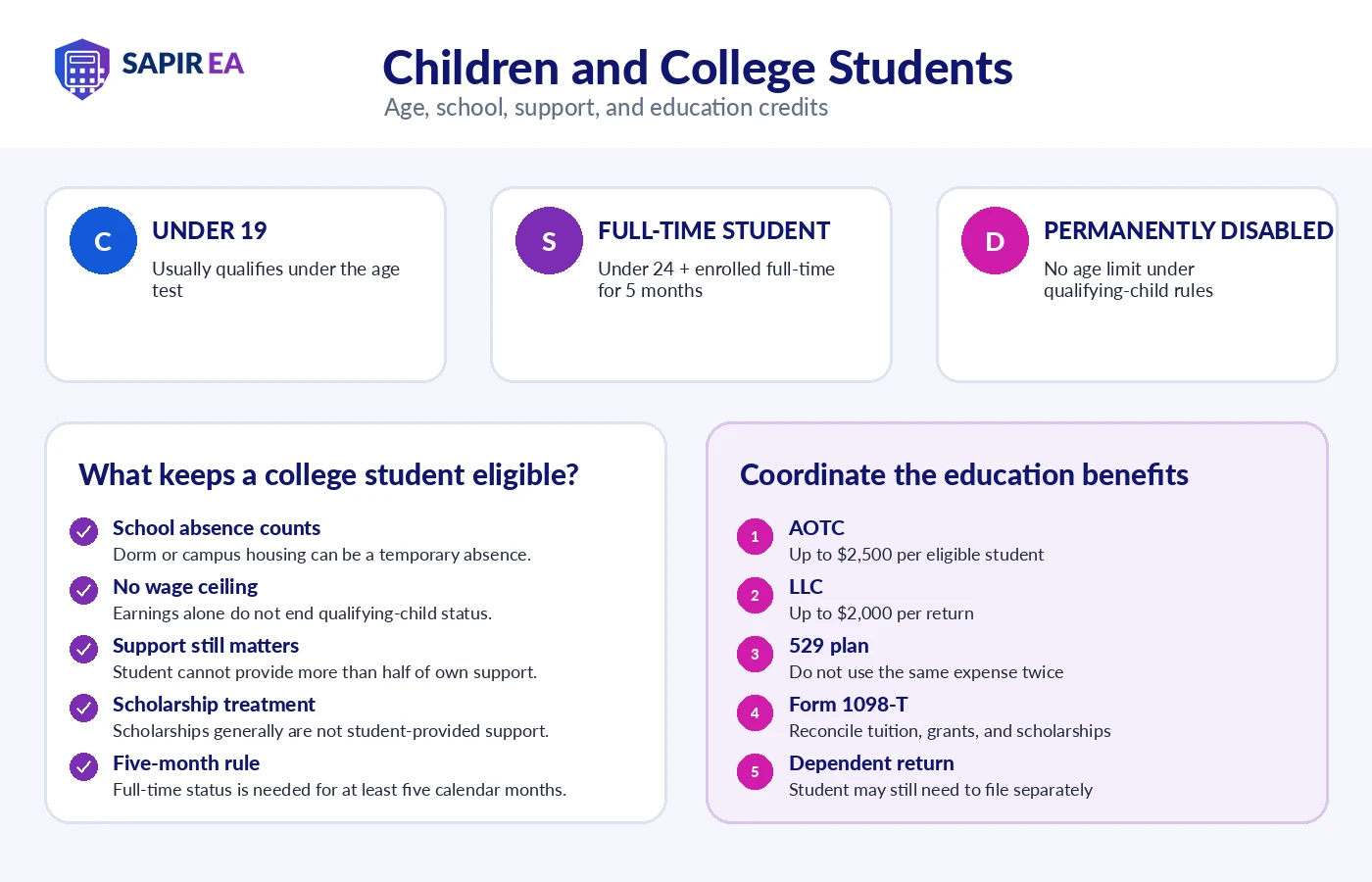
A student under age 24 at year-end can generally meet the qualifying-child age test if enrolled full-time for at least five calendar months and younger than the taxpayer claiming the student. Living in a dorm is usually a temporary absence, so the student may still meet the residency test.
Scholarships generally do not count as support provided by the student for this test. Wages, savings, loans for which the student is personally responsible, and other funds used for living expenses may matter. Families should calculate support rather than assume tuition decides the result.
If the student is claimed as a dependent, the taxpayer claiming the student generally evaluates the American Opportunity Tax Credit or Lifetime Learning Credit. For 2026, the AOTC can be worth up to $2,500 per eligible student and the LLC up to $2,000 per return. If the person entitled to claim the student does not do so, the student may be able to claim a credit, but that choice should be modeled.
Coordinate Form 1098-T, scholarships, grants, 529 distributions, tuition payments, and dependency status. The same expense cannot support both tax-free 529 treatment and an education credit.
Families with income-driven student loans should also review how filing status, adjusted gross income, and dependent counts affect repayment. See SAPIR EA’s income-driven student loan guide.
Claiming a Parent or Other Older Relative
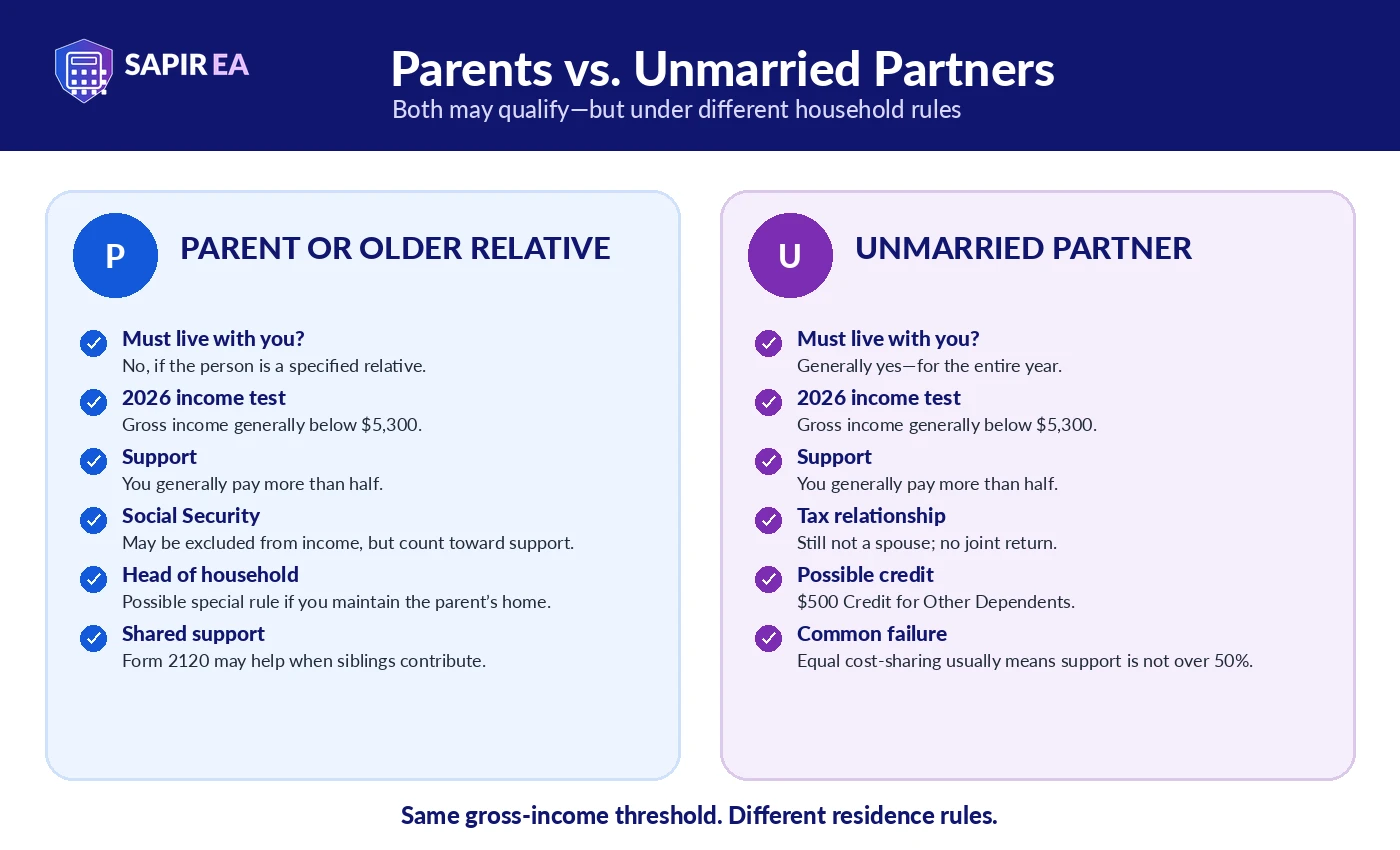
A parent does not have to live with you. The main issues are usually gross income and support.
For 2026, a parent’s gross income generally must be below $5,300. Nontaxable Social Security is usually excluded from that test, but benefits used for housing, food, or medical needs count in the support calculation. Taxable retirement income, interest, dividends, gains, and taxable Social Security can affect gross income.
Support includes fair rental value of lodging and amounts paid to assisted-living or nursing facilities. Keep statements showing what you and the parent paid.
If siblings jointly provide more than half of a parent’s support and no one provides more than half alone, a multiple support agreement may let one person who paid over 10% claim the parent. Other eligible contributors provide signed waivers, and Form 2120 is generally attached.
An unmarried taxpayer may qualify for head of household by paying more than half the cost of the parent’s main home, even when the parent lives elsewhere, if the other rules are met. Separate medical-expense rules can sometimes help when a parent fails only the income or joint-return dependency test.
Can You Claim an Unmarried Partner?
An unmarried partner can sometimes be a qualifying relative. The partner generally must live with you for the entire year, have gross income below $5,300, receive more than half of total support from you, not be another taxpayer’s qualifying child, and meet the citizen or resident and joint-return rules.
Claiming a partner does not permit a joint return or automatically create head of household status. The partner may support the $500 Credit for Other Dependents when all credit rules are met. A roommate who pays an equal share of rent and living costs usually fails the support test.
Divorced, Separated, or Never-Married Parents
The custodial parent is generally the parent with whom the child lived for more nights. Paying more child support does not by itself determine custody for tax purposes.
The custodial parent may release certain benefits to the noncustodial parent on Form 8332. Modern divorce decrees generally do not replace the form. The noncustodial parent may then claim the dependency claim and Child Tax Credit, Additional Child Tax Credit, or Credit for Other Dependents. The release does not transfer head of household, the Earned Income Tax Credit, the child and dependent care credit, or dependent-care benefit exclusion.
| Benefit | Can Form 8332 transfer it? |
|---|---|
| Dependency claim and Child Tax Credit / Credit for Other Dependents | Yes, when the special rules are met |
| Head of household | No |
| Earned Income Tax Credit | No |
| Child and dependent care credit or benefit exclusion | No |
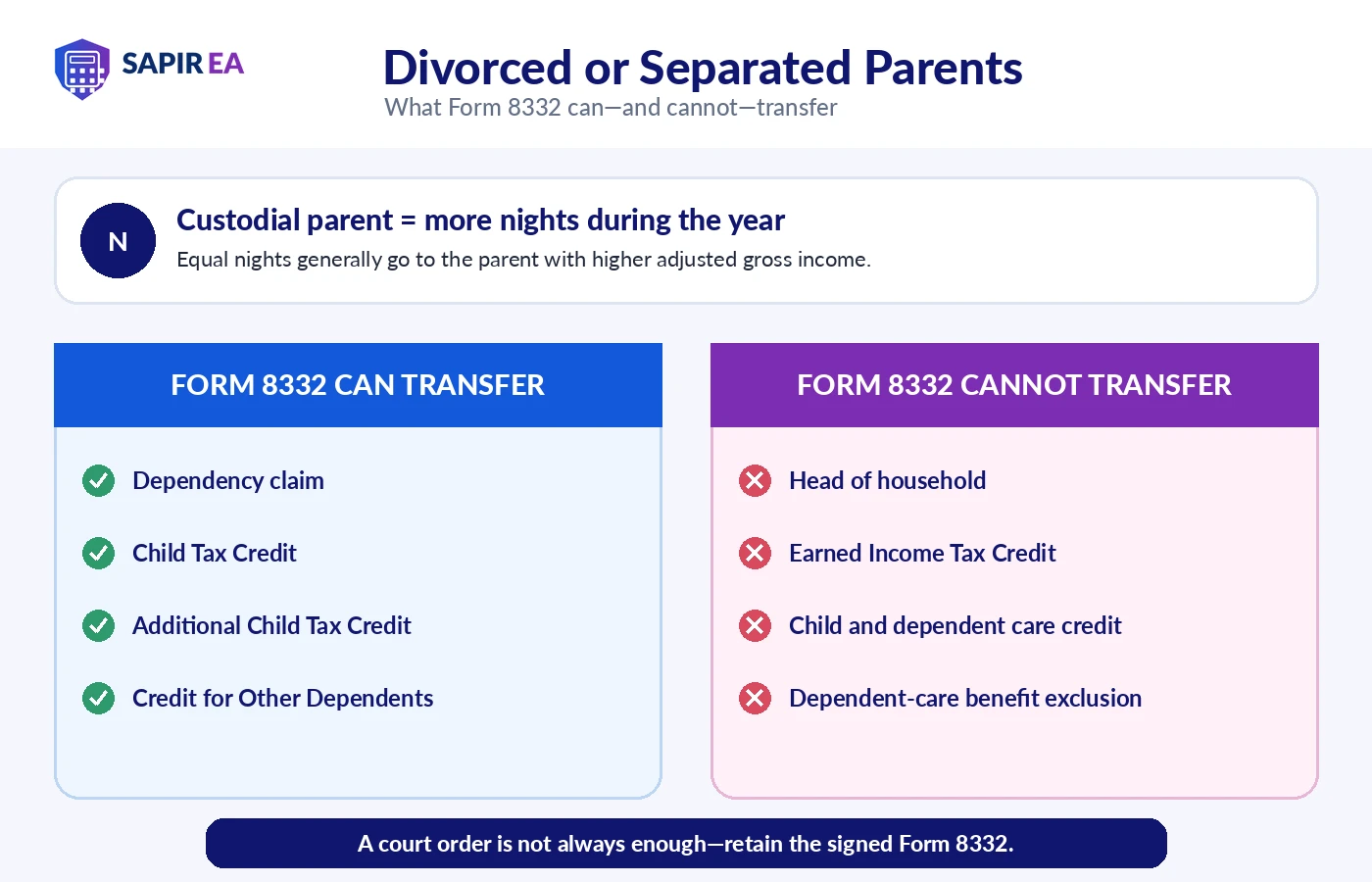
Equal nights generally favor the parent with higher AGI. Keep an overnight calendar, school records, and signed forms. A child cannot be split between two federal returns for different parts of the same year.
What Tax Benefits Can a Dependent Affect?
Dependency is often the gateway, but each benefit has separate rules.
| 2026 tax item | Potential value or rule | Common dependent |
|---|---|---|
| Child Tax Credit | Up to $2,200 per qualifying child under 17; phaseout and SSN rules apply | Young child |
| Additional Child Tax Credit | Potentially refundable up to $1,700 | Young child |
| Credit for Other Dependents | Up to $500, nonrefundable | Older child, student, parent, partner |
| Child and Dependent Care Credit | For 2026, up to $1,500 for one qualifying person or $3,000 for two or more | Child under 13 or incapable-of-self-care person |
| AOTC / Lifetime Learning Credit | Up to $2,500 per student / $2,000 per return | Eligible student |
| Head of household | Different brackets and a higher standard deduction than single filing | Qualifying child or dependent parent |
| Earned Income Tax Credit | Separate child and income rules apply | Qualifying child |
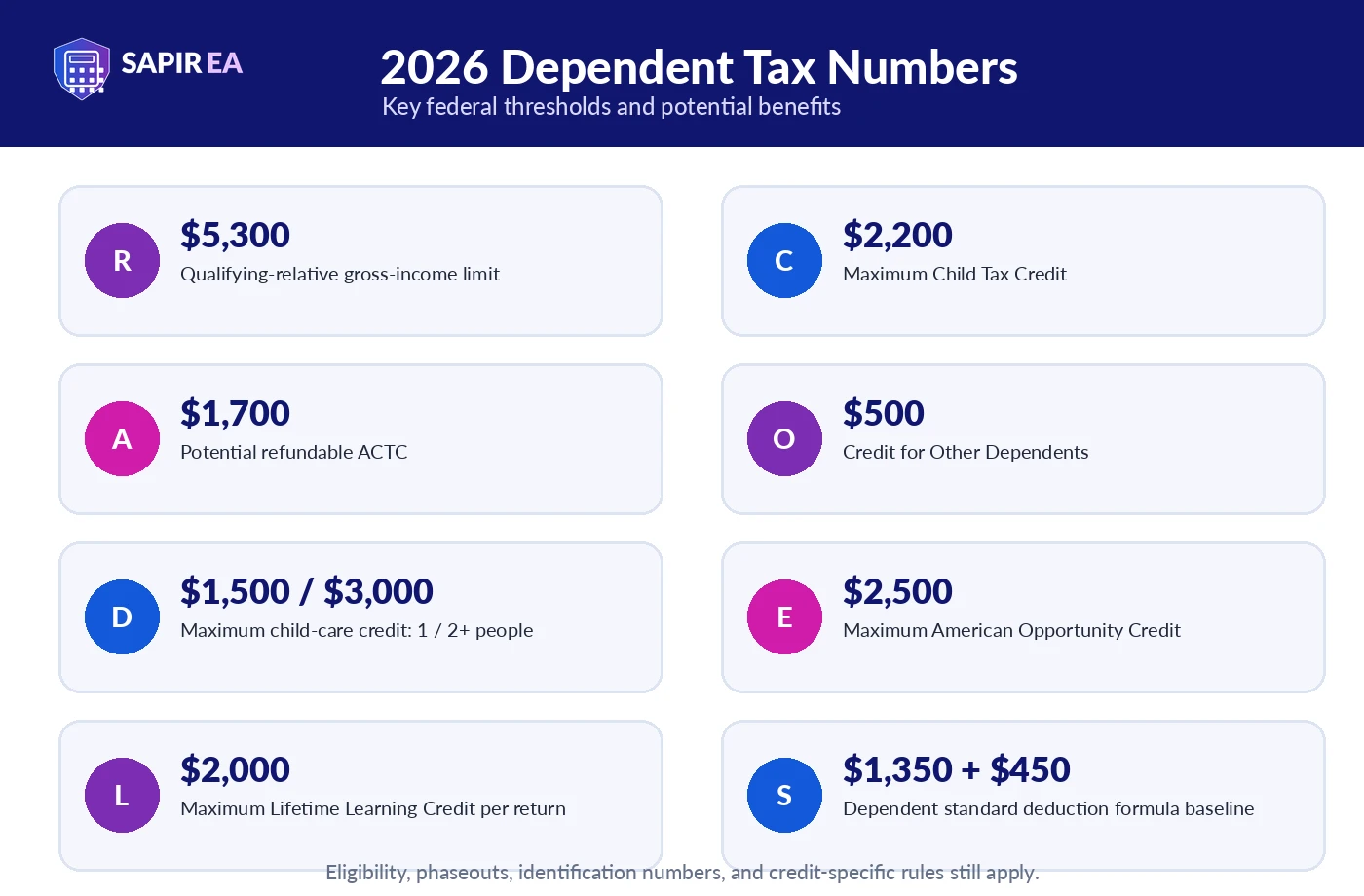
If a new dependent changes expected credits, review Form W-4 rather than waiting until filing season. Use SAPIR EA’s W-4 Withholding Planner or Estimated Tax Calculator.
Can a Dependent File a Tax Return?
Yes. A dependent may need to file because of wages, self-employment, investment income, taxable scholarships, or other income, and may file voluntarily to recover withholding.
For 2026, a dependent’s federal standard deduction generally cannot exceed the greater of $1,350 or earned income plus $450, capped at the regular deduction for the filing status. Unearned income may trigger kiddie-tax rules, and self-employment income can create a filing requirement even when income is modest.
A dependent who files only to recover withholding should still report the dependency status correctly. On the return, answer whether someone can claim the taxpayer based on law—not merely whether the other person already filed or chose not to claim them.
Records to Keep
Keep evidence of relationship, residency, and support: birth or placement records; school, medical, lease, and daycare records; an overnight calendar; tuition and 529 statements; Social Security and income records; proof of housing and care costs; a support worksheet; Form 8332; Form 2120 and waivers; and valid taxpayer identification numbers. Conflicting claims are resolved with facts and documents, not family assumptions.
Ten Common Dependent-Claim Mistakes
- Assuming the higher-income person always claims the child. Tiebreaker rules are more specific.
- Treating child support as decisive. Overnight residence usually identifies the custodial parent.
- Using the same support test for children and relatives. The tests are different.
- Mishandling Social Security. It may be excluded from gross income but included in support.
- Treating college as a change of residence. Education can be a temporary absence.
- Counting scholarships as student-provided support. They are generally excluded for this test.
- Claiming a partner who moved in midyear. An unrelated person generally must live with you all year.
- Believing Form 8332 transfers every child benefit. It does not.
- Ignoring the dependent’s own filing requirement. Dependents may still need a return.
- Filing without the required taxpayer identification number. Credit-specific timing rules can be strict.
Year-End Dependent Review Checklist
Before filing, confirm:
- Who lived in each household and for how many nights;
- Whether a student was full-time for five months;
- Each child’s age at year-end;
- Whether a child paid more than half of personal support;
- Whether a parent or partner had gross income below $5,300;
- Who paid housing, food, tuition, and medical costs;
- Whether siblings need Form 2120;
- Whether a custodial parent will sign Form 8332;
- Who should claim education credits and coordinate 529 withdrawals;
- Whether head of household is available;
- Whether withholding should change; and
- Whether the dependent must file a return.
SAPIR EA provides individual tax preparation and year-round planning for families, college households, caregivers, and shared-custody taxpayers. See the Tax and Accounting FAQ, 2026 tax figures, and IRS forms library.
DEPENDENCY QUESTIONS ARE FACT-SPECIFIC
Confirm the Claim Before the Returns Are Filed
Competing claims, education expenses, shared support, and custody arrangements can affect several benefits at once. SAPIR EA can review the facts and coordinate the related returns.
Frequently Asked Questions
Can I claim my child if the child earns income?
Possibly. A qualifying child has no general gross-income ceiling. The issue is whether the child provided more than half of personal support. The child may still need to file a return.
Can I claim my 22-year-old college student?
Potentially, if the student is under 24, younger than you or your spouse, full-time for five months, meets residency rules including school absences, and did not provide more than half of personal support.
Does a scholarship count as support provided by my student?
Generally no for the qualifying-child support test.
Can I claim my 25-year-old child?
Usually only as a qualifying relative unless the child is permanently and totally disabled. The $5,300 gross-income limit, support test, and other rules apply.
Can I claim my parent if the parent receives Social Security?
Possibly. Nontaxable benefits may be excluded from gross income but count toward support when used for the parent’s needs.
Does my parent have to live with me?
No. A parent is a specified relative, but the income, support, and other tests still apply.
Can I claim my unmarried partner?
Possibly, if the partner lived with you all year, had gross income below $5,300, received more than half of support from you, and met the remaining rules.
Can both parents claim the same child?
No. Custody and tiebreaker rules determine priority, and Form 8332 transfers only certain benefits.
Does Form 8332 transfer head of household status?
No. It does not transfer head of household, EITC, or dependent-care benefits.
Who claims an education credit for a dependent student?
Generally the taxpayer claiming the student. If the eligible taxpayer does not claim the student, the student may be able to claim the credit under separate rules.
Can a dependent file a tax return?
Yes. Filing does not automatically prevent dependency, but a disqualifying joint return can.
Can siblings take turns claiming a parent?
A multiple support agreement may allow it when the family meets the joint-support rules and files Form 2120.
Does paying medical bills make someone my dependent?
Not by itself, although separate medical-deduction rules may apply.
What happens if two returns claim the same dependent?
An e-filed return may be rejected, or the IRS may request records and apply tiebreaker rules.
When should I update Form W-4 after having a child?
Review it after birth or adoption and after household-income changes. Do not duplicate the same expected credit across several jobs.
Primary IRS Sources
- IRS Dependents overview
- Publication 501
- 2026 inflation adjustments, Rev. Proc. 2025-32
- Child Tax Credit
- Child and Dependent Care Credit
- Education credits
- Form 8332 and Form 2120
This article provides general educational information and is not individualized tax, legal, financial, or family-law advice. Results depend on complete facts, support calculations, identification numbers, and the rules for each credit.