Income-Driven Student Loan Repayment Plans: The Complete Tax Guide for Borrowers (2026)
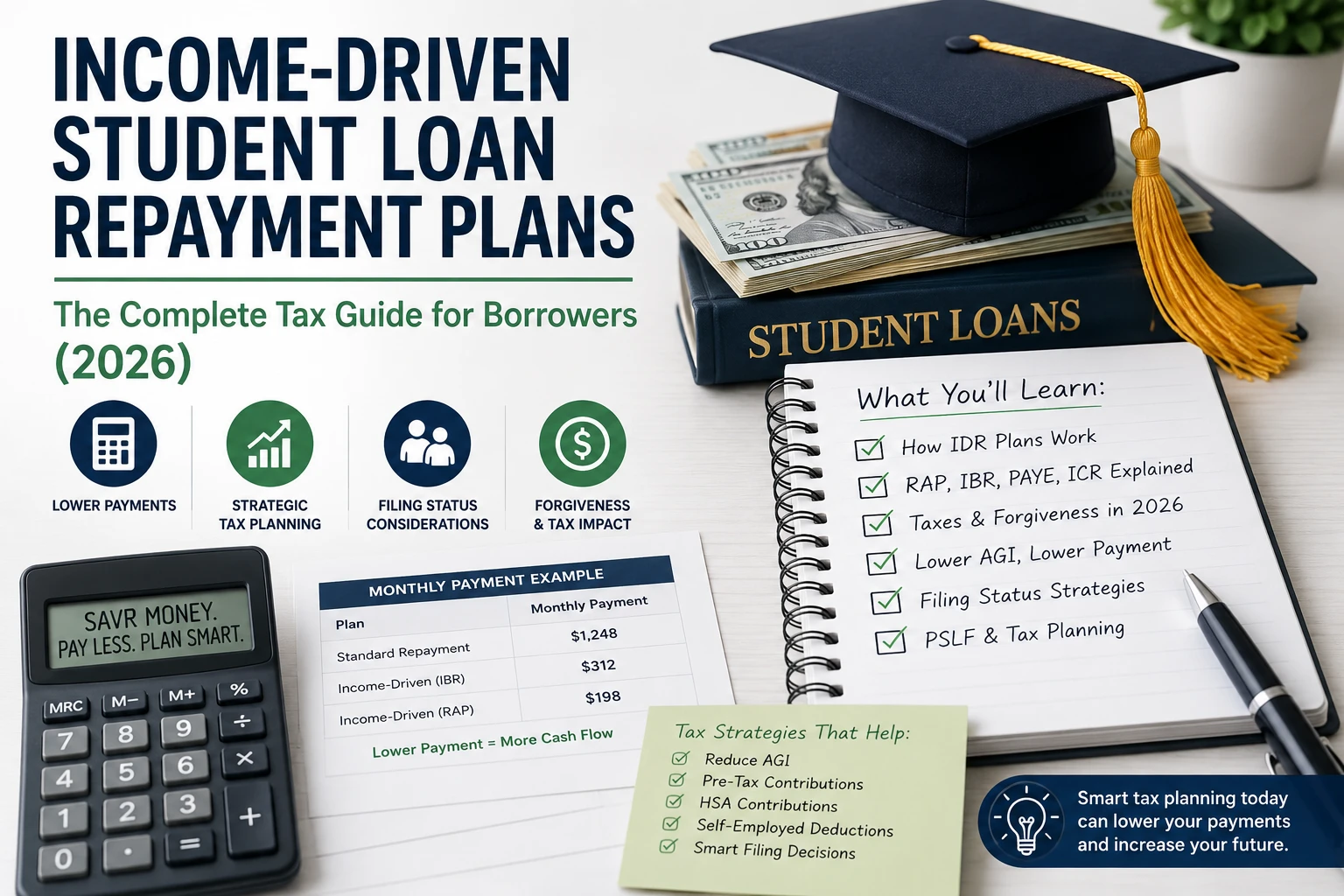
If you repay federal student loans on an income-driven repayment (IDR) plan, 2026 is the most consequential year you have faced since you signed your promissory note. The SAVE plan is gone. A brand-new plan called RAP launched on July 1. Two older plans are being phased out. And the biggest change of all is one most borrowers have not heard about yet: student loan forgiveness became federally taxable again on January 1, 2026.
Here is the theme that connects every one of those changes: your tax return now controls your student loan payment, and your student loans now shape your tax bill. The number your loan servicer uses to set your monthly payment is the adjusted gross income (AGI) on your Form 1040. Your filing status decides whether your spouse's income counts. And when your remaining balance is eventually forgiven, the IRS may treat that forgiven amount as income in a single tax year.
As an Enrolled Agent working with borrowers, families, and self-employed professionals nationwide, I spend a growing share of tax season answering one question: "How do I keep my loan payment low without creating a tax problem?" This guide is the long answer. It covers what changed in 2026, how IBR and RAP payments are actually calculated, when married filing separately makes sense, how to legally shrink the income your servicer sees, and how to prepare — years in advance — for the forgiveness "tax bomb."
- The 2026 IDR landscape: what survived, what didn't
- How IBR and RAP payments are calculated
- Why your tax return is now your loan payment application
- Married filing separately: the highest-stakes decision
- Lowering your AGI: the strategy that saves twice
- The forgiveness tax bomb is back
- PSLF, Parent PLUS, and special situations
- Your 2026 action checklist
- Frequently asked questions
1. The 2026 IDR Landscape: What Survived, What Didn't
Two forces reshaped income-driven repayment over the past eighteen months. First, federal courts blocked the Biden-era SAVE plan, and it was vacated by court order in early 2026. Second, Congress passed the One Big Beautiful Bill Act (OBBBA, P.L. 119-21), which rebuilt the entire repayment menu effective July 1, 2026.
Here is where each plan stands today:
- SAVE — eliminated. Vacated by the courts and repealed by statute. Borrowers parked in the SAVE litigation forbearance must choose a new plan; time in that forbearance generally has not counted toward forgiveness.
- PAYE and ICR — closing. These plans stopped accepting new enrollments on July 1, 2026, and sunset entirely by July 1, 2028. Borrowers still on them will be moved to IBR or RAP — by choice, or automatically by their servicer.
- IBR — permanent. Income-Based Repayment survives for loans disbursed before July 1, 2026, and OBBBA removed the old "partial financial hardship" entry requirement, so any borrower with eligible pre-2026 loans can now enroll regardless of income.
- RAP — the new default. The Repayment Assistance Plan launched July 1, 2026. For loans first disbursed on or after that date, RAP and a new tiered Standard plan are the only repayment options.
Existing borrowers (loans before July 1, 2026) will choose between IBR and RAP. New borrowers get RAP or the new Standard plan. Every other option is closing. The decision between IBR and RAP is partly a loan question — and very much a tax question.
2. How IBR and RAP Payments Are Calculated
The two surviving income-driven plans compute payments in fundamentally different ways, and the difference determines which tax strategies work for you.
IBR: 10% (or 15%) of discretionary income
IBR defines "discretionary income" as your AGI minus 150% of the federal poverty guideline for your family size. New borrowers (first loan on or after July 1, 2014) pay 10% of that figure, with forgiveness after 20 years. Borrowers with older loans pay 15%, with forgiveness after 25 years. Because of the poverty-line deduction, IBR is very sensitive to family size — every additional household member shields more income from the calculation.
RAP: 1%–10% of total AGI
RAP skips the discretionary income concept entirely. Your annual payment is a flat percentage of your total AGI, on a sliding bracket: borrowers with AGI of $10,000 or less pay a flat $10 per month, the rate starts at 1% for AGI between $10,001 and $20,000, and rises one percentage point per $10,000 of AGI until it caps at 10% for AGI above $100,000. Divide by 12, subtract $50 per dependent, and apply a $10 monthly floor.
RAP adds two sweeteners no prior plan offered together: if you pay on time, any unpaid monthly interest is waived (your balance never grows), and if your payment covers less than $50 of principal, the government matches principal reduction up to $50 per month. The trade-off is the longest forgiveness runway in the system: 30 years (360 qualifying payments).
| Feature | IBR | RAP | New Standard (tiered) |
|---|---|---|---|
| Who can use it | Loans disbursed before July 1, 2026 | All borrowers (only IDR option for new loans) | All borrowers |
| Payment formula | 10% of discretionary income (15% for pre-2014 borrowers) | 1%–10% of total AGI, minus $50/dependent; $10 minimum | Fixed payment over 10–25 years based on balance |
| Family size effect | Large — 150% of poverty line excluded per household size | Moderate — $50/month per dependent | None |
| Spouse's income (MFS) | Excluded if you file separately | Excluded if you file separately | N/A — not income-based |
| Interest treatment | Unpaid interest can accrue | Unpaid monthly interest waived; up to $50/mo principal match | Standard amortization |
| Forgiveness | 20 years (new) / 25 years (old) | 30 years (360 payments) | None — loan is paid off |
| Forgiveness taxable (federal)? | Yes, starting 2026 | Yes, starting 2026 | N/A |
| PSLF eligible | Yes — tax-free at 10 years | Yes — tax-free at 10 years | No (not a qualifying IDR payment) |
Which plan produces the lower payment? It depends on income and family size. A single borrower earning $60,000 pays roughly 10% of AGI minus about $23,500 under IBR (≈ $305/month under 2026 guidelines) versus 5–6% of total AGI under RAP (≈ $250–$300/month) — remarkably close. But shift the facts — three kids, a working spouse, a pre-2014 loan — and the plans diverge by hundreds of dollars a month. This is exactly the kind of modeling we build into tax planning engagements, because the inputs come straight off your 1040.
3. Why Your Tax Return Is Now Your Loan Payment Application
Under both surviving plans, your servicer sets your payment using the AGI from your most recent federal return, and OBBBA authorizes automatic annual recertification through IRS data sharing. In practical terms, filing your Form 1040 is now also filing your student loan payment application. Three consequences follow:
First, every AGI decision has two prices. A Roth-versus-traditional 401(k) choice, a capital gain you harvest, a lump of freelance income — each one changes both your tax and next year's loan payment. Under RAP, crossing a $10,000 AGI threshold can bump your entire payment rate a full percentage point; landing at $100,001 instead of $99,999 raises the rate on all of your AGI from 9% to 10%.
Second, timing matters. Because payments recertify from your latest return, income you can shift between tax years — bonuses, equipment purchases for a business, retirement contributions, capital gains — shifts your loan payment too. Self-employed borrowers have the most levers here, from entity structure and quarterly planning to retirement plan design.
Third, accuracy matters more than ever. An amended return, an audit adjustment, or a missed deduction now ripples into your monthly loan bill. Keeping clean books — something our bookkeeping and QuickBooks team handles year-round for business owners — protects both numbers.
4. Married Filing Separately: The Highest-Stakes Decision on Your Return
For married borrowers, filing status is the single biggest lever in the entire IDR system. Both IBR and RAP count your spouse's income only if you file jointly. File separately, and the payment calculation sees your income alone.
Consider a physical therapist earning $70,000 with $180,000 in loans, married to a software engineer earning $160,000. Filing jointly, the couple's $230,000 AGI drives an IBR payment of roughly $1,650 per month. Filing separately, the borrower's $70,000 AGI produces a payment near $320. That is almost $16,000 per year in payment savings.
But MFS is not free. Filing separately typically costs a couple in several ways: you lose the student loan interest deduction (disallowed entirely for MFS filers), you lose education credits, IRA contribution deductions phase out almost immediately, and depending on your incomes you may face less favorable bracket and credit outcomes. For many couples the tax cost lands somewhere between $1,000 and $6,000 per year. In community property states, the analysis changes again — each spouse may have to report half of the community income, which can gut the strategy.
| Factor | Married Filing Jointly | Married Filing Separately |
|---|---|---|
| AGI used for IDR payment | $230,000 (combined) | $70,000 (borrower only) |
| Approx. monthly IBR payment | ≈ $1,650 | ≈ $320 |
| Annual payment difference | — | ≈ $16,000 lower |
| Student loan interest deduction (up to $2,500) | Available (phases out at higher AGI) | Not allowed |
| Education credits | Available | Not allowed |
| Typical added federal/state tax | — | ≈ $1,000–$6,000/yr (fact-specific) |
| Net result | Simpler; better if incomes are similar | Often wins when income gap is large or PSLF is in play |
The MFS decision must be re-run every year — incomes change, plans change, and so does the math. We prepare the comparison as part of tax preparation for client households with student loans, and you can pre-check your withholding under either status with our free W-4 Withholding Planner.
5. Lowering Your AGI: The Strategy That Saves Twice
Because both plans key off adjusted gross income, anything that legally reduces AGI cuts your tax bill and your loan payment. These are the workhorses:
- Traditional 401(k)/403(b)/457 contributions. A borrower in the 22% bracket who defers $10,000 saves $2,200 in federal tax — and under RAP's brackets or IBR's 10% formula, cuts next year's loan payments by up to roughly $600–$1,000 more.
- HSA contributions. Triple tax-advantaged, and they reduce AGI dollar-for-dollar.
- Traditional IRA contributions, where deductible.
- Pre-tax benefits — employer health premiums, FSA elections, commuter benefits — which keep income out of AGI entirely.
- For the self-employed: SEP-IRA or solo 401(k) contributions, the deductible half of self-employment tax, self-employed health insurance, and legitimate business deductions all reduce AGI. Entity choice matters too — an S corporation election changes which income lands on your 1040 and how. (Try our S-Corp vs. LLC calculator.)
- Timing: harvesting capital losses, deferring bonuses, and bunching income around recertification can meaningfully move a RAP bracket. Our estimated tax calculator helps self-employed borrowers see the quarterly picture.
One caution: Roth conversions, large capital gains, and retirement account withdrawals do the opposite — they inflate AGI and can raise your loan payment for a full year. If you are on an IDR plan, no significant income event should happen without checking the loan-payment side effect first.
6. The Forgiveness Tax Bomb Is Back
From 2021 through 2025, the American Rescue Plan Act made essentially all student loan forgiveness federally tax-free. That exclusion expired December 31, 2025, and Congress did not renew it. Beginning January 1, 2026, balances forgiven at the end of an IDR term — 20 or 25 years on IBR, 30 years on RAP — are once again treated as cancellation-of-debt income in the year of discharge.
The numbers can be brutal. A borrower whose $150,000 remaining balance is forgiven in a year they earn $80,000 suddenly has $230,000 of reportable income — pushed into higher brackets, potentially losing credits, and facing a five-figure federal tax bill on money they never saw. State treatment varies: some states conform to federal treatment, others have their own exclusions.
Three planning responses matter, and all of them work better the earlier you start:
1. The insolvency exclusion (Form 982)
If your total liabilities exceed the fair market value of your total assets immediately before the discharge, you are insolvent, and you can exclude forgiven debt from income up to the amount of the insolvency. Many long-term IDR borrowers — especially those whose balances grew for decades — are partially or fully insolvent at forgiveness. But the calculation counts everything: retirement accounts, home equity, vehicles. Ironically, aggressive retirement saving can reduce your insolvency and increase the taxable portion. This is a genuine two-variable optimization, and it is exactly the kind of analysis to run with a professional several years before your forgiveness date — not the following April.
2. A "tax bomb" sinking fund
If you will likely be solvent at forgiveness, estimate the future tax and start setting aside a monthly amount now, ideally in a taxable brokerage account you can liquidate in the discharge year. For a borrower 10 years from forgiveness expecting a $40,000 tax hit, that is roughly $250–$300 per month with modest growth.
3. Payoff-vs-forgiveness modeling
Once forgiveness is taxable, the break-even between "pay the minimum and wait for forgiveness" and "aggressively pay off" shifts. Borrowers with high balances relative to income still usually win with forgiveness even after tax; borrowers close to breaking even may not. This deserves a real projection, not a rule of thumb.
7. PSLF, Parent PLUS, and Special Situations
Public Service Loan Forgiveness
PSLF survived 2026 intact on the tax side: forgiveness after 120 qualifying payments in public-service employment remains federally tax-free under a permanent tax code provision that does not depend on ARPA. Both IBR and RAP count as qualifying repayment plans. For PSLF-track borrowers, the strategy is simple and aggressive: minimize AGI and consider MFS, because every dollar you avoid paying is forgiven tax-free at year ten.
Parent PLUS borrowers
OBBBA hit Parent PLUS hardest. These loans are not eligible for RAP, and the window to consolidate and secure access to income-driven repayment closed on July 1, 2026. Parent PLUS borrowers who consolidated in time can use IBR; those who did not are generally limited to standard-style repayment. If you hold Parent PLUS loans and are unsure where you stand, this is worth a conversation — servicer records are not always right, and options depend on exact loan history.
Borrowers behind on payments or facing collections
Collections activity on defaulted federal loans resumed in 2025, and wage garnishment and refund offsets are live issues again. Tax refunds can be seized to offset defaulted federal student loans — one more reason accurate withholding matters (don't lend the government a refund you might lose). If you are dealing with IRS problems layered on top of loan trouble, our IRS representation practice can address the tax side while you rehabilitate the loans.
8. Your 2026 Action Checklist
- Confirm your plan status. If you were on SAVE, PAYE, or ICR, decide between IBR and RAP before your servicer decides for you (deadline: July 1, 2028 — but SAVE forbearance time is not earning forgiveness credit, so sooner is better).
- Pull your loan history from StudentAid.gov: disbursement dates determine whether you get 10% or 15% IBR and whether IBR is available at all.
- Model IBR vs. RAP with your actual AGI, family size, and forgiveness horizon.
- Married? Run the MFS comparison before filing your 2026 return — and re-run it annually.
- Set your AGI strategy for the year: retirement deferrals, HSA, timing of income. Check the RAP bracket thresholds if that is your plan.
- Start tax bomb planning if you are on the 20/25/30-year forgiveness track: estimate the future tax, assess likely insolvency, open the sinking fund.
- Recheck withholding under your chosen filing status with the W-4 Withholding Planner, and keep an eye on tax due dates if you pay estimates.
9. Frequently Asked Questions
Is student loan forgiveness taxable in 2026?
Yes, at the federal level. The ARPA exclusion expired December 31, 2025, so balances forgiven under IDR plans on or after January 1, 2026 are generally taxable income in the year of discharge. PSLF remains tax-free under a separate permanent rule, and insolvent borrowers may exclude some or all of the forgiven amount using Form 982.
Should I file married filing separately to lower my IDR payment?
Sometimes. Both IBR and RAP use the AGI on your return, so MFS excludes your spouse's income and can cut the payment dramatically — but it usually raises your tax by $1,000–$6,000 per year through lost deductions and credits. The strategy tends to win when the income gap between spouses is large or you are pursuing PSLF. Model both ways every year.
What happened to the SAVE plan?
SAVE was vacated by the courts and repealed by the One Big Beautiful Bill Act. Former SAVE borrowers must move to IBR or RAP by July 1, 2028 or be auto-enrolled — and because SAVE forbearance time generally hasn't counted toward forgiveness, switching sooner usually makes sense.
How is the RAP payment calculated?
RAP charges 1%–10% of your total AGI per year (the rate rises with income and caps at 10% above $100,000 AGI), divided by 12, minus $50 per dependent, with a $10 monthly minimum. On-time payers get unpaid interest waived and up to a $50 monthly principal match. Forgiveness comes after 360 qualifying payments.
Can lowering my AGI lower my student loan payment?
Yes — that's the core of IDR tax strategy. Traditional retirement contributions, HSA contributions, pre-tax benefits, and (for the self-employed) retirement plans and business deductions all reduce AGI, which lowers both your tax and your next loan payment.
Is PSLF forgiveness taxable?
No. PSLF is excluded from federal income under a permanent tax code provision because forgiveness is conditioned on qualifying employment. Most states follow the federal treatment, though state rules vary.
What is the insolvency exclusion?
If your total debts exceed your total assets immediately before discharge, you're insolvent and can exclude forgiven debt from income up to the insolvency amount by filing Form 982. Many long-term IDR borrowers qualify at least partially — but the calculation includes retirement accounts and home equity, so get it reviewed professionally.
Turn Your Tax Return Into Your Best Loan-Repayment Tool
Sapir EA helps student loan borrowers nationwide coordinate filing status, AGI planning, and forgiveness tax strategy — so the number on your 1040 works for you twice. Based in Jamison, PA; serving clients in all 50 states, fully online.
Schedule a Free ConsultationOr explore our tax planning services, read more on the Sapir EA blog, or see our FAQ.
This article is for general educational purposes and reflects federal law and program rules as of July 2026, which continue to evolve. It is not individualized tax, legal, or financial advice. Loan program details (payment formulas, deadlines, plan availability) are administered by the U.S. Department of Education and your loan servicer; verify your specific loan status at StudentAid.gov. Consult a qualified professional about your own situation. Sapir EA • 2370 York Road, Suite G1 #357, Jamison, PA 18929 • Contact us.