Tariff Refunds for U.S. Importers
Tariff Refunds for U.S. Importers: Reasons, Deadlines, and What to Watch For
Tariff refunds can return meaningful cash to a U.S. importer, but they are not automatic and they are not governed by one universal deadline. The available route depends on why too much duty was paid, whether the entry has liquidated, what documents support the claim, and which customs law or trade program authorizes the refund.
A business may discover an overpayment because goods were classified under the wrong Harmonized Tariff Schedule code, customs value was overstated, a trade preference was missed, an exclusion or court decision changed the duty result, or imported merchandise was later exported or destroyed. Each situation can require a different filing process with U.S. Customs and Border Protection (CBP).
The most important first step is therefore not simply asking, “How do we get the money back?” It is identifying the correct legal basis, entry status, claimant, deadline, and supporting evidence before anything is submitted.
1. What is a tariff refund?
A tariff refund is a repayment of customs duties - and, in some cases, related taxes, fees, or interest - that were deposited or paid on imported merchandise but are later determined to be excessive or refundable under a specific law. The refund may result from correcting an entry, challenging a CBP decision, claiming a trade preference, applying a retroactive exclusion, or satisfying the rules for duty drawback.
Customs duties are generally deposited when merchandise enters the United States. CBP later “liquidates” the entry, meaning it makes the final administrative calculation of the amount due for that entry. Liquidation is a critical milestone because it can close one procedure and start the deadline for another.
Not every overpayment produces a full refund. The amount can be affected by the legal authority, other line items on the entry, netting of overpayments and underpayments, eligible fees, outstanding federal debts, and whether interest is authorized. Duty drawback, for example, commonly returns up to 99% of eligible duties, taxes, and fees rather than 100%.
2. 2026 update: IEEPA duty refunds and CAPE
Tariff refund interest increased sharply in 2026 after the U.S. Supreme Court held in Learning Resources, Inc. v. Trump that the International Emergency Economic Powers Act (IEEPA) does not authorize the President to impose tariffs. CBP then launched the Consolidated Administration and Processing of Entries, or CAPE, functionality in the Automated Commercial Environment (ACE) to process valid IEEPA duty refund requests authorized by court order or applicable law.
Under current CBP guidance, the importer of record or an authorized customs broker that filed the affected entries can submit a CAPE Declaration through the ACE Portal. The declaration identifies the entry numbers for which an IEEPA refund is requested. CBP validates the submission, updates affected entry lines, and processes liquidation or reliquidation and the related electronic refund.
- CAPE is being deployed in phases, so the current eligibility rules should be checked before a declaration is filed.
- Importers should have an ACE Portal account, an Importer sub-account, and accurate ACH refund banking information on file.
- CBP states that valid IEEPA refunds are generally issued within 60 to 90 days after acceptance of a CAPE Declaration unless an entry requires additional review or maintains a different liquidation status.
- CBP does not charge a fee to process an IEEPA tariff refund. An unsolicited request for a processing fee or banking credentials may be a scam.
- Older liquidated entries, entries flagged for reconciliation, suspended entries, warehouse entries, or entries under compliance review may not follow the same timeline or phase.
3. Common reasons an importer may qualify for a tariff refund
Incorrect HTS classification
The Harmonized Tariff Schedule classification assigned to a product determines the base duty rate and can affect additional tariffs, quotas, exclusions, and regulatory requirements. An importer may have overpaid when the entry used a higher-duty code than the product’s correct classification. A valid claim usually requires product specifications, composition, function, marketing materials, prior rulings, and a defensible classification analysis - not merely a lower code found in a database.
Overstated customs value
Duties are often calculated as a percentage of customs value. Overpayments may occur when non-dutiable charges were included, duplicate amounts were reported, an accepted post-importation adjustment reduced the price, or the valuation method was applied incorrectly. Related-party transactions, assists, royalties, transfer pricing adjustments, and year-end rebates require particular care because a change can increase or decrease duty and may need reconciliation or another approved method.
Incorrect country of origin or tariff treatment
Country of origin can determine ordinary duty rates, trade remedy tariffs, marking requirements, quotas, and eligibility for trade programs. Origin is not always the same as the country of shipment or the seller’s location. A refund may be available when the original entry applied an additional tariff that did not legally attach to the product’s correct origin, but the importer must be able to document the manufacturing facts and applicable origin rule.
Missed free trade agreement or special-program claim
Goods that satisfy a free trade agreement or other preference program may qualify for a lower or zero duty rate. When preference was not claimed at entry, certain agreements permit a post-importation claim under 19 U.S.C. 1520(d), generally within one year of importation. The claim is not supported merely because the supplier is located in a partner country; the product must satisfy the relevant origin rule and documentation requirements.
Retroactive exclusion, rate change, or court decision
A tariff exclusion, agency instruction, court decision, or retroactive policy change can create a refund opportunity for previously entered goods. The exact process depends on the authority and the entry’s status. Importers should read the operative Federal Register notice, CBP Cargo Systems Messaging Service instructions, court order, and product-scope language rather than relying on a headline or vendor marketing email.
Duty drawback after exportation or destruction
Duty drawback is a separate refund program for eligible imported merchandise that is later exported, destroyed under the applicable rules, or used in the manufacture of an exported article. Direct-identification and substitution rules can apply. Most modernized TFTEA drawback claims generally must be filed within five years of importation, and the claimant needs a reliable chain of import, inventory, production, and export records.
Reconciliation and post-importation true-ups
CBP Reconciliation allows approved importers to flag certain entry information that cannot be finalized at entry - such as value, classification in limited circumstances, or qualifying preference issues - and later provide the final data through a reconciliation entry. A favorable true-up may generate a refund, while an unfavorable true-up may create additional duty. The underlying entries must be properly flagged and the reconciliation deadlines must be met.
Duplicate payments and clerical or transmission errors
A refund may also arise from duplicate duty payments, incorrect quantities, transposed values, an erroneous Chapter 99 line, or a broker transmission problem. These issues can be straightforward to explain, but the importer still needs to use the procedure that matches the entry’s liquidation status and retain evidence showing exactly how the corrected amount was calculated.
4. Choosing the correct refund procedure
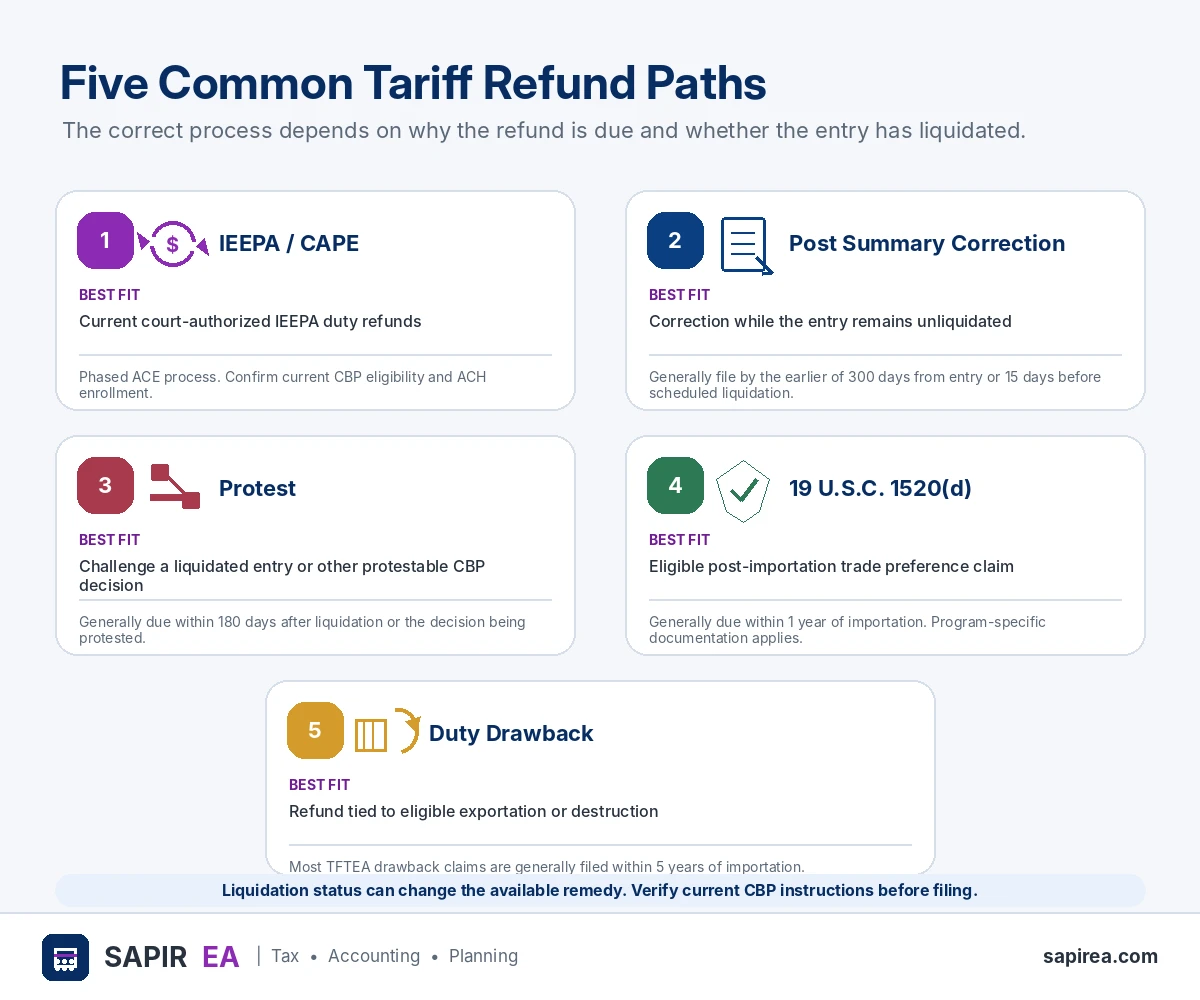
The same factual error can require a different remedy depending on when it is discovered. The following table is a high-level guide; specialized programs and court-ordered refunds can have different rules.
| Situation | Typical route | Key timing or condition |
|---|---|---|
| Eligible IEEPA duties under current CBP guidance | CAPE Declaration in ACE | Phased process. Confirm current eligibility, entry status, filing authority, and ACH enrollment. |
| Entry has not liquidated | Post Summary Correction (PSC) | Generally the earlier of 300 days from entry or 15 days before the scheduled liquidation date. |
| Entry liquidated or another protestable CBP decision was made | Protest under 19 U.S.C. 1514 | Generally within 180 days after liquidation or the decision being protested. |
| Eligible preference was not claimed at entry | Post-importation claim under 19 U.S.C. 1520(d) | Generally within one year of importation, with program-specific supporting documents. |
| Eligible merchandise was exported or destroyed | Duty drawback | Most TFTEA drawback claims are generally filed within five years of importation. |
| Final value or another approved issue was unknown at entry | Reconciliation | Entries must generally be flagged and the reconciliation filed under the program’s requirements. |
Why liquidation dates matter
Liquidation usually makes CBP’s duty determination final unless a timely protest or another specific statutory remedy applies. Importers should monitor liquidation dates in ACE and maintain an internal deadline calendar. Relying exclusively on a broker’s reminder system can create a gap, especially when a broker relationship changes, entries are extended or suspended, or responsibility is split among departments.
Do not rely on discretionary reliquidation
CBP has limited authority to reliquidate an entry on its own within a short statutory period, but an importer should not treat discretionary reliquidation as a substitute for filing the correct claim on time. The safer approach is to preserve rights through the procedure that clearly applies to the entry.
5. What importers should know before filing
The importer remains responsible
Under the reasonable-care standard, the importer of record is responsible for declaring the proper classification, customs value, duty rate, origin, and other required information. A licensed customs broker can prepare and transmit the entry, but using a broker does not transfer the importer’s legal responsibility. Management should understand who approved the original entry and who is authorized to file the correction or claim.
Evidence must match the theory of the refund
The supporting file should show both why the original amount was wrong and why the proposed amount is correct. Depending on the claim, useful documents may include:
- CBP Form 7501 data, ACE reports, duty statements, and proof of payment;
- commercial invoices, purchase orders, sales contracts, packing lists, and bills of lading;
- product specifications, technical drawings, composition data, catalogs, and samples;
- country-of-origin certifications, production records, bills of material, and supplier affidavits;
- customs valuation calculations, royalty agreements, assists, rebates, and transfer-pricing support;
- binding rulings, exclusion language, Federal Register notices, and CBP implementation instructions;
- export records, inventory records, manufacturing records, and proof of destruction for drawback; and
- the broker power of attorney and internal authorization for the person submitting the claim.
Refunds are now generally electronic
Beginning February 6, 2026, CBP generally issues refunds electronically through Automated Clearing House (ACH), subject to limited waiver exceptions. Importers should confirm that the legal entity name, importer number, ACE account, refund authorization, bank routing information, and designated refund recipient are accurate before a refund is released. A foreign importer may need a U.S. bank account or an authorized designated recipient under CBP procedures.
The final payment may differ from the headline estimate
CBP can review the entire entry when it liquidates or reliquidates it. An overpayment on one line can be netted against an underpayment on another. Refunds can also be diverted or offset against certain legally fixed federal debts. Interest may be payable under some authorities, but it should not be assumed unless the statute, regulation, liquidation rules, or court order provides for it.
Customs, accounting, and tax work should be coordinated
A tariff refund can affect more than cash. The original duties may have been capitalized into inventory, included in cost of goods sold, charged to a customer, allocated through landed-cost software, or deducted in an earlier tax year. The correct accounting and tax treatment depends on the facts and the taxpayer’s method of accounting. Before posting the refund as miscellaneous income, determine what portion relates to inventory still on hand, goods already sold, prior periods, customer credits, and professional fees.
Review contracts and commercial relationships
If duties were passed through to customers, reimbursed by a supplier, included in a government contract, or shared under a distribution agreement, the importer may have a contractual obligation to credit or allocate part of the refund. Incoterms alone do not answer every ownership or reimbursement question. Review the actual contract and the party that served as importer of record.
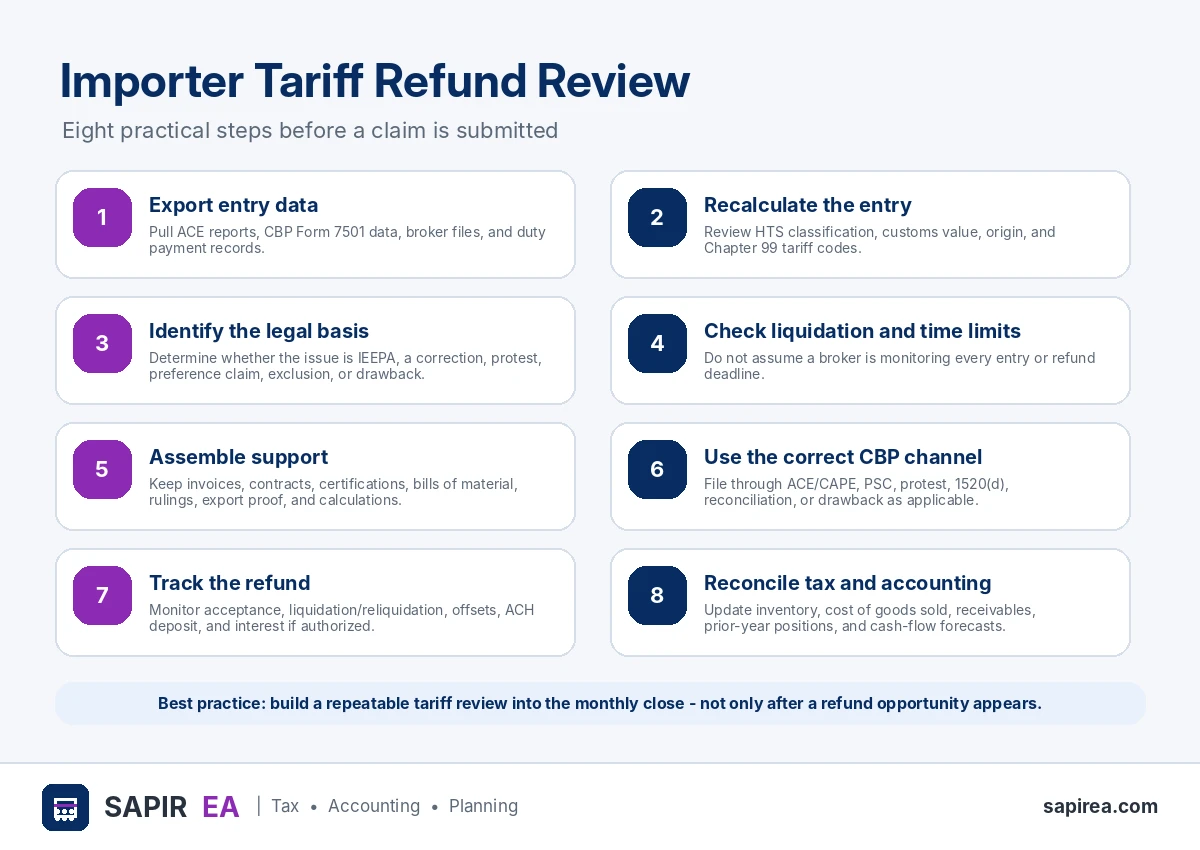
6. Tariff refund risks and warning signs
Using the wrong procedure
A PSC cannot generally be used after liquidation, and a protest is not a substitute for every special statutory claim. A drawback claim is not simply a correction to an entry. Start with the refund authority and entry status, then choose the form and filing channel.
Missing a deadline while researching
Importers sometimes wait for perfect documentation while the PSC, protest, preference, or drawback period continues to run. Create a deadline calendar as soon as a potential overpayment is identified and ask whether a protective filing, extension request, or other preservation step is available.
Assuming a lower HTS code always produces a refund
A revised classification may reduce the ordinary duty rate but trigger another Chapter 99 tariff, quota, marking rule, partner-government requirement, or antidumping/countervailing duty issue. Recalculate the complete entry - not only the base HTS line.
Submitting weak origin or valuation support
Supplier statements that merely repeat a desired conclusion may not establish origin or value. CBP can ask for production records, cost data, contracts, payment records, bills of material, or evidence of substantial transformation. A claim should be filed only after the supporting facts have been tested for consistency.
Double recovery or duplicate claims
The same duty should not be recovered twice through overlapping CAPE, PSC, protest, exclusion, drawback, supplier-credit, insurance, or customer-reimbursement processes. Maintain a claim register by entry number and line item, and document how each refund was calculated and allocated.
Refund scams and unauthorized bank changes
The volume of 2026 IEEPA refunds creates an opportunity for phishing and bank-change fraud. CBP says it does not charge a processing fee for IEEPA refunds. Verify messages through known CBP channels, limit ACE access, require dual approval for bank changes, and do not send credentials or routing information in response to an unsolicited message.
Unsupported or false claims
A refund request is not risk-free. Material false statements or omissions in customs submissions can create repayment obligations, audits, penalties, and other enforcement exposure. U.S. customs law authorizes penalties for fraud, gross negligence, and negligence. Claims should be reviewed by a licensed customs broker or trade attorney when the classification, valuation, origin, drawback, or litigation issue is material or uncertain.
7. A practical tariff refund review checklist
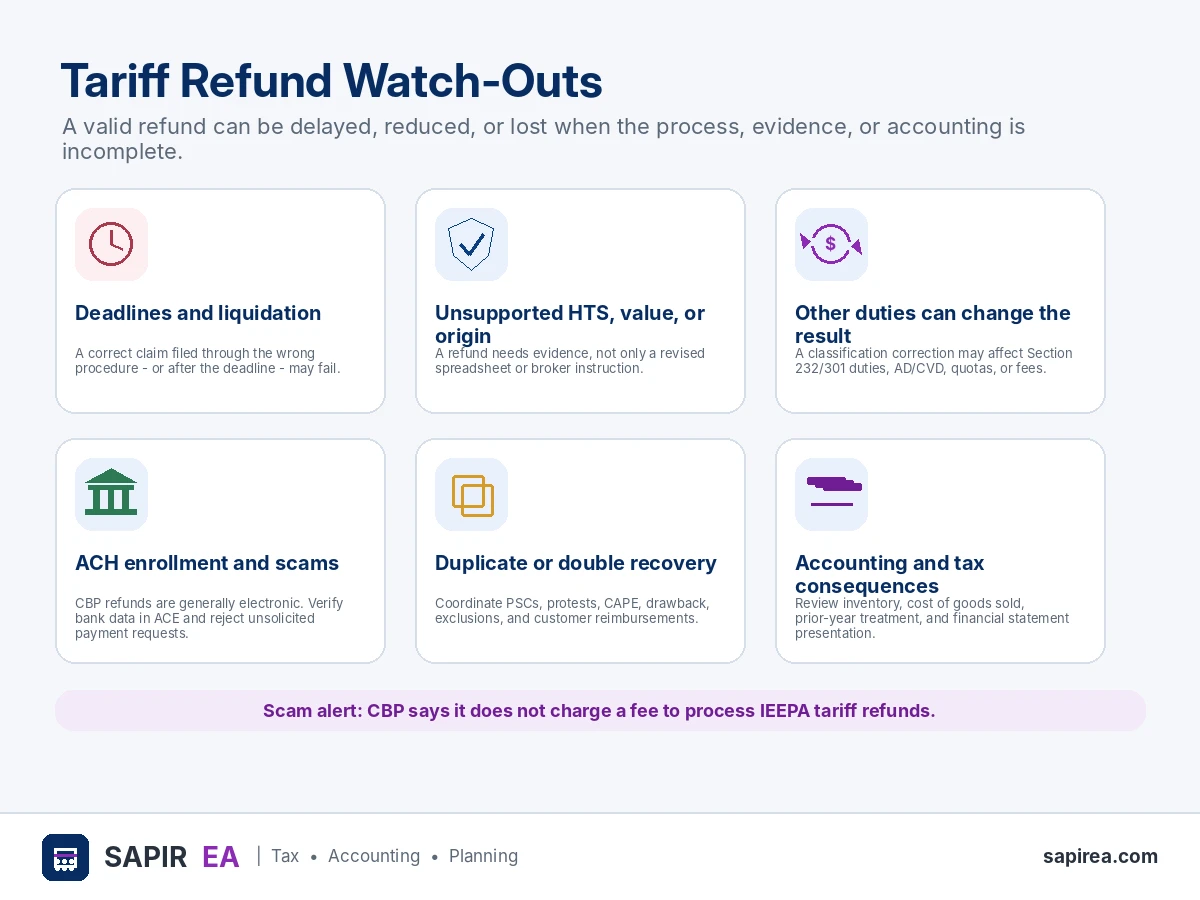
A disciplined review can identify refund opportunities while reducing the risk of filing an incomplete or inconsistent claim.
- Export the entry population. Pull ACE data, broker reports, CBP Form 7501 information, duty payment history, and liquidation status for the review period.
- Prioritize high-value and high-rate entries. Focus first on large duty amounts, repeated products, Chapter 99 tariffs, related-party imports, and entries approaching a deadline.
- Recalculate classification, value, and origin. Use the actual product facts and transaction documents, not only the descriptions copied from prior entries.
- Identify the refund authority. Determine whether the issue belongs in CAPE, a PSC, protest, 1520(d) claim, reconciliation, drawback claim, or another program.
- Confirm the claimant and filing authority. Verify the importer of record, broker authorization, refund recipient, and any assignment or transfer of drawback rights.
- Assemble a complete evidence file. Tie every proposed change to the entry number, line item, legal authority, documents, calculation, and responsible reviewer.
- Submit and monitor. Retain acceptance records, track CBP questions, liquidation or reliquidation, offsets, ACH deposits, and interest calculations.
- Reconcile the business impact. Record the refund consistently in customs, inventory, accounting, income tax, customer, supplier, and cash-flow systems.
8. Frequently asked questions
Can every U.S. importer receive a tariff refund?
No. A refund requires a valid legal basis, eligible entries or merchandise, a timely filing, and adequate support. Paying a high tariff by itself does not create a refund right.
How far back can an importer claim a refund?
It depends on the procedure. A PSC is generally limited by the 300-day/15-day rule, a protest is generally due within 180 days, a qualifying 1520(d) claim is generally due within one year, and most TFTEA drawback claims are generally filed within five years of importation. Current IEEPA procedures are phased and should be checked separately.
Can a customs broker file the claim?
Often, yes, when properly authorized and when the program permits. For current CAPE declarations, CBP states that the importer of record or the authorized broker that filed the entries may submit. The importer should still review the legal basis, entry list, calculations, and supporting evidence.
What happens if the entry already liquidated?
The importer may need a timely protest or another specific post-liquidation remedy. A PSC is generally no longer available. Current IEEPA guidance and court procedures should be reviewed for affected older entries.
Does CBP charge a tariff refund processing fee?
CBP states that it does not charge a fee to process IEEPA tariff refunds. Professional customs brokers, consultants, or attorneys may charge for their work, but those private fees are separate from CBP.
Will the refund include interest?
Sometimes. Interest depends on the legal authority, liquidation or reliquidation rules, and any applicable court order. It should not be included in a cash-flow forecast until the basis and calculation are confirmed.
Is a tariff refund taxable income?
There is no one-line answer. The treatment depends on how the original duty was accounted for - for example, whether it remained in inventory, flowed through cost of goods sold, was deducted, or was reimbursed. The refund may require inventory, COGS, income, basis, or prior-period analysis.
Can a refund claim trigger a CBP review?
Yes. CBP may validate entries, request information, review the entire entry, or examine the supporting records. A well-documented claim is easier to defend, and unsupported changes can create additional exposure.
How long does a tariff refund take?
Timing varies by procedure and complexity. For accepted CAPE declarations, CBP currently says valid IEEPA refunds are generally issued within 60 to 90 days unless compliance concerns or entry status require additional review. Other protests, drawback claims, and corrections can take materially longer.
Expecting or receiving a tariff refund?
SAPIR EA can help businesses evaluate the income-tax and accounting impact, reconcile refund amounts to inventory and cost of goods sold, update cash-flow forecasts, and coordinate financial documentation with a licensed customs broker or trade attorney.
Schedule a Business Tax and Accounting Review
Business tax services Bookkeeping and QuickBooks support
Customs eligibility, classifications, protests, drawback filings, and customs legal opinions should be handled by an appropriately licensed customs broker or trade attorney.
Official sources and further reading
- U.S. Supreme Court: Learning Resources, Inc. v. Trump (Feb. 20, 2026)
- CBP: IEEPA Duty Refunds and CAPE
- CBP: ACE Portal and ACH Refunds FAQs
- CBP: Post Summary Corrections
- CBP: Protests
- CBP: Post-Importation Preference Claims under 19 U.S.C. 1520(d)
- CBP: Drawback Overview
- CBP: Drawback Trade Remedies FAQs
- CBP: Reasonable Care
- CBP: Reconciliation
- eCFR: 19 CFR Part 163 - Recordkeeping
- U.S. Code: 19 U.S.C. 1592 - Customs penalties
- IRS Publication 551 - Basis of Assets