IRS Problems and Tax Resolution Guide
IRS Problems and Tax Resolution: A Complete Guide
What CP2000, CP14, CP501/503/504, and LT11 mean - plus payment plans, Offers in Compromise, penalty relief, unfiled returns, and professional representation.
An IRS letter is usually the start of a process, not the end of one. Some notices propose changes, some request payment, and others warn that collection or appeal deadlines are approaching. The right response depends on the notice, tax period, filing history, and whether the IRS information is correct.
Do not ignore the letter. Read every page, keep the envelope, identify the deadline, and gather the return and records for the year involved. This guide explains common notices, payment options, realistic Offer in Compromise eligibility, 2026 penalty relief, unfiled returns, and the differences among Enrolled Agents, CPAs, and tax attorneys.
Educational notice: This article provides general information, not individualized tax or legal advice. IRS procedures and available remedies depend on the taxpayer's complete facts, current compliance, deadlines, and financial condition.
IRS Problems at a Glance: What to Do First
Before choosing a resolution program:
- Identify the notice number, tax year, and deadline.
- Determine whether the IRS is proposing tax, billing tax, or collecting tax.
- Compare the notice with the return and source documents.
- Check filing compliance. Most collection alternatives require all required returns.
- Pay what you reasonably can. Interest and some penalties continue.
- Respond through the method listed in the notice. Use secure channels for sensitive records.
- Get representation early for levy deadlines, appeals, audits, payroll taxes, fraud concerns, or several unfiled years.
What Common IRS Notices Mean
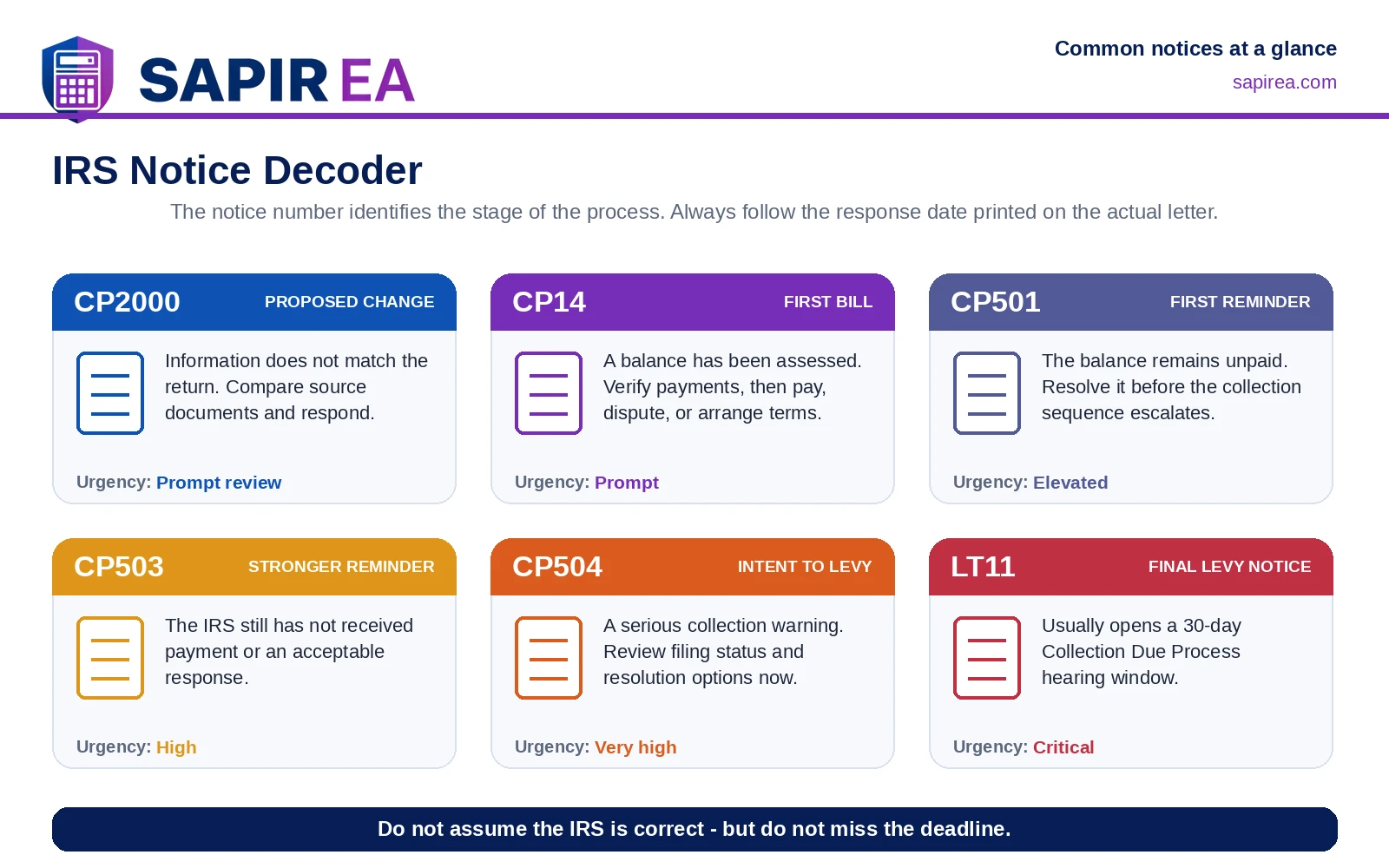
The notice number tells you what stage of the process you are in. The table below provides a practical starting point, but the actual notice controls.
| Notice | What it usually means | Urgency | First step |
|---|---|---|---|
| CP2000 | The IRS proposes a change because third-party information does not match the return | Prompt review | Compare the notice to the return and source documents; respond by the printed date |
| CP14 | The IRS says a balance is due and issues its first bill | Prompt | Verify the assessment and payments; pay, dispute, or request an arrangement |
| CP501 | First collection reminder after the bill remains unpaid | Elevated | Confirm the balance and address it before notices escalate |
| CP503 | A stronger reminder that the balance remains unpaid | High | Resolve the account or contact the IRS immediately |
| CP504 | Notice of intent to levy and warning of serious collection action | Very high | Review the balance, filing status, and collection options immediately |
| LT11 | Final notice of intent to levy and notice of the right to a hearing | Critical | Review the 30-day Collection Due Process deadline and consider Form 12153 |
CP2000: Proposed Underreported Income Adjustment
A CP2000 usually results when information from an employer, bank, brokerage, payment platform, or other payer does not match the return. It is a proposed adjustment, not a final bill or traditional audit.
Matching systems may not know cost basis, corrections, duplicate forms, nominee reporting, or where an item was properly reported. Review each proposed item separately. If the notice is correct, follow the agreement and payment instructions. If it is wrong, respond by the printed deadline with a clear explanation and supporting documents. Do not assume that Form 1040-X replaces the required CP2000 response. Review state and local returns after the federal issue is resolved.
CP14: The First Balance-Due Notice
A CP14 is generally the IRS's first bill after a tax balance has been assessed. It shows the tax period, amount due, penalties, interest, and payment date.
First, confirm that the IRS credited all payments, including withholding, estimated payments, extension payments, and amounts submitted with the return. If the balance is correct, pay as much as possible and select a payment option for the remainder. If the balance is wrong, respond with payment confirmations, the filed return, or other records that explain the difference.
Ignoring a correct CP14 usually leads to additional reminder notices, continued interest, and possible collection action.
CP501, CP503, and CP504: The Collection Sequence Is Escalating
A CP501 is generally the first reminder that an assessed balance remains unpaid. A CP503 is more urgent and indicates that the IRS still has not received full payment or an acceptable response.
A CP504 is a serious notice of intent to levy. It can warn that the IRS may levy a state tax refund and may proceed against income, bank accounts, or other property after applicable legal requirements are met. At this stage, confirm whether all returns are filed, obtain current account balances, and determine whether the correct route is full payment, a short-term plan, an installment agreement, a financial hardship request, or a dispute of the underlying account.
Do not wait for the next letter merely because no levy has occurred yet.
LT11: Final Notice of Intent to Levy and Hearing Rights
An LT11 states that the IRS intends to levy and provides the right to request a Collection Due Process hearing. The request is generally due within 30 days from the letter date. A timely Form 12153 can preserve appeal and judicial-review rights and allow collection alternatives to be considered.
An Equivalent Hearing may sometimes be requested within one year after a missed deadline, but it does not provide the same Tax Court review rights. Treat the original LT11 deadline as critical.
CP504 versus LT11: Both are serious. CP504 warns that levy action is approaching. LT11 is the final levy notice that normally opens the formal 30-day Collection Due Process hearing window.
I Cannot Pay My Taxes: Payment Plans and Other Options
File the return even when you cannot pay. The failure-to-file penalty can be substantially more damaging than the failure-to-pay penalty, and many resolution options require filing compliance.
Pay what you can by the due date. Then choose the option that matches your ability to pay, not the option with the most appealing advertisement.
Short-Term Payment Plan
Individuals who can pay the balance within 180 days may qualify for a short-term plan. The IRS does not charge a setup fee for this arrangement, although penalties and interest continue until the balance is paid.
This option can work well when cash is expected from a bonus, asset sale, financing event, or predictable business collection. It is usually less suitable when the taxpayer has no realistic source of full payment within six months.
Long-Term Installment Agreement
A long-term installment agreement allows monthly payments. Individuals may generally apply online when they owe $50,000 or less in combined tax, penalties, and interest and have filed all required returns. Higher balances may require financial disclosure.
Interest and penalties continue, future refunds usually offset the debt, and a new unpaid liability or missing return can default the agreement. Payroll tax debt is especially urgent because responsible individuals may face personal assessment for trust fund taxes.
Partial-Payment Installment Agreement
A partial-payment installment agreement may be available when the taxpayer can make monthly payments but cannot fully pay before the IRS collection period expires. The IRS generally requires detailed financial information, and the agreement is subject to periodic review. If income rises or expenses fall, the required payment can increase.
Currently Not Collectible Status
If paying the IRS would prevent a taxpayer from meeting necessary living expenses, the IRS may temporarily report the account as currently not collectible. This is not forgiveness. Interest and penalties generally continue, future refunds may be applied, a federal tax lien may be filed, and the IRS may later review the taxpayer's ability to pay.
Comparing Common IRS Collection Options
| Option | Best fit | Financial disclosure | Does the debt disappear? | Important caution |
|---|---|---|---|---|
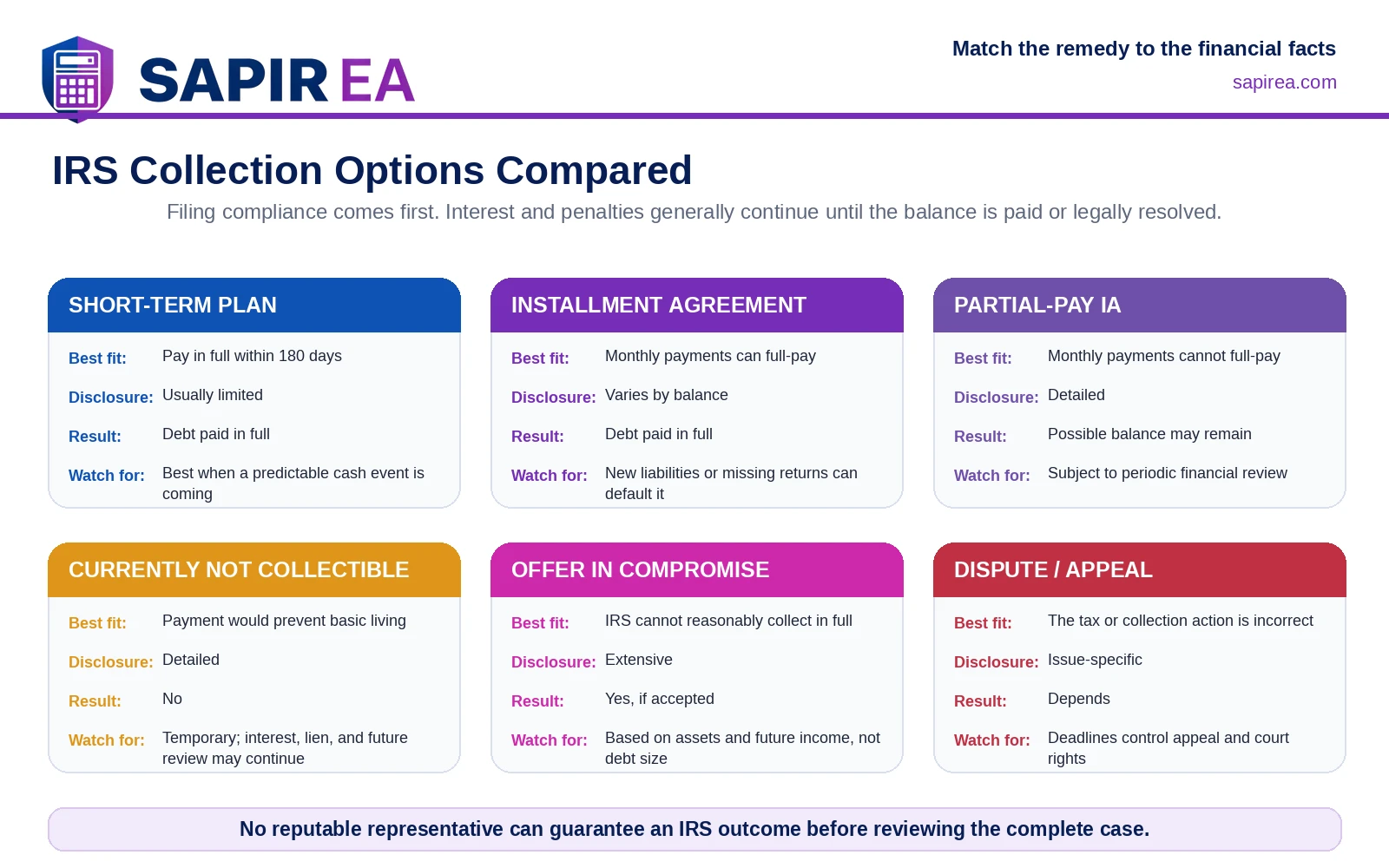
| Short-term plan | Full payment possible within 180 days | Usually limited | No | Interest and penalties continue |
| Streamlined installment agreement | Predictable monthly payment can fully resolve the debt | Often limited within thresholds | No | Must remain current on future filings and taxes |
| Partial-payment installment agreement | Monthly payment is possible, but full payment is not | Yes | Possibly some balance expires, subject to law | IRS can review the payment every two years |
| Currently not collectible | Payment would prevent basic living expenses | Yes | No | Temporary status; lien and future review remain possible |
| Offer in Compromise | IRS cannot reasonably collect in full, or special grounds apply | Extensive | Yes, if accepted and all terms are satisfied | Most taxpayers do not qualify merely because the debt is large |
Offer in Compromise: Who Realistically Qualifies?
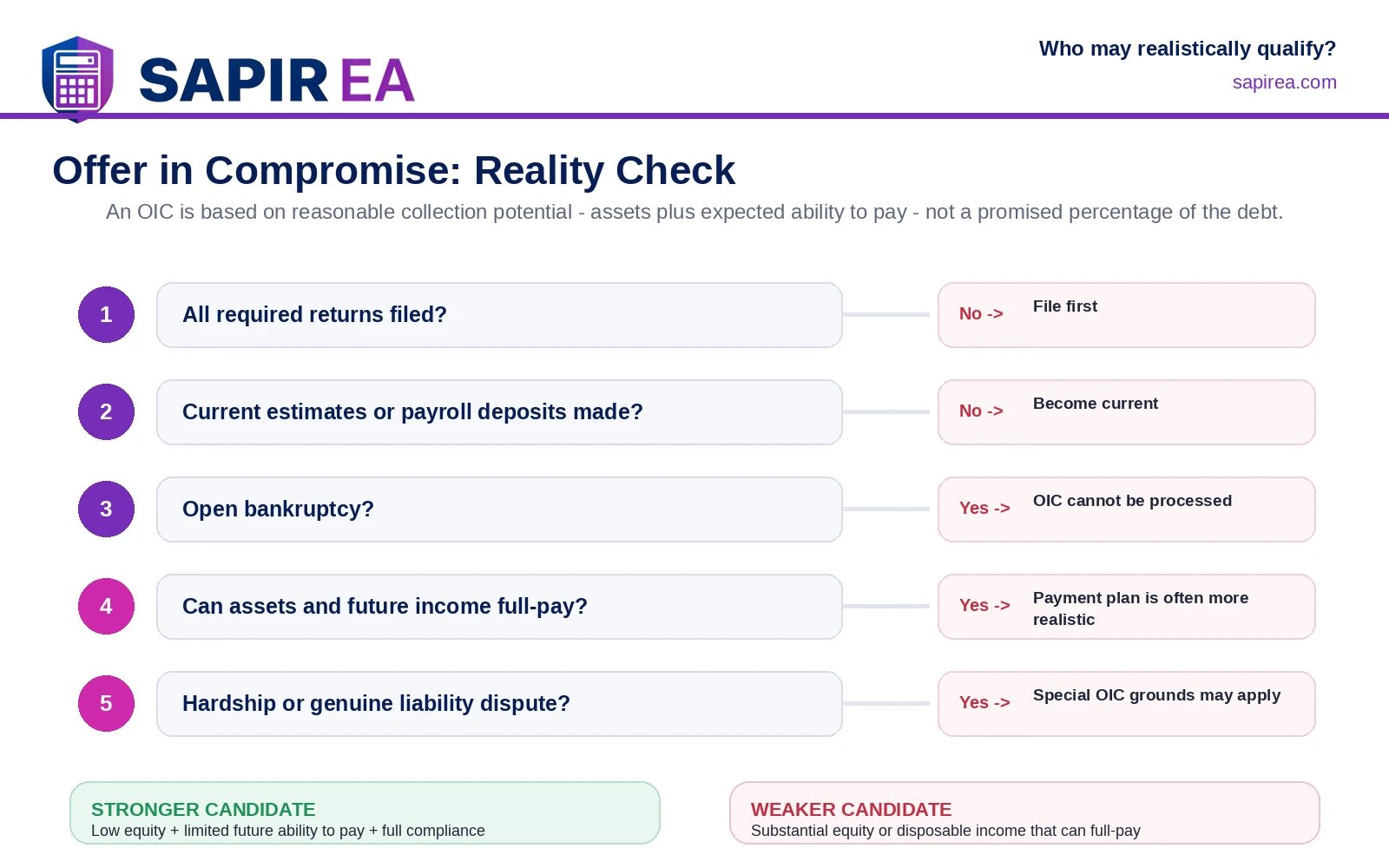
An Offer in Compromise can settle tax debt for less than the full amount, but it is not a general discount program. The IRS evaluates cash, asset equity, income, necessary expenses, collection time, and current compliance.
A taxpayer with substantial home equity, investments, cash, or disposable income may owe a large amount but still be able to pay through an installment agreement. A taxpayer with limited equity and little realistic future ability to pay may be a stronger candidate. The offer is calculated from the financial facts, not selected as a percentage of the debt.
Three Legal Bases for an Offer
- Doubt as to collectibility: The taxpayer cannot fully pay through assets and future income. This is the most common basis.
- Doubt as to liability: A genuine dispute exists about whether the assessed tax is legally or factually correct.
- Effective tax administration: The debt is correct and technically collectible, but full collection would create economic hardship or be inequitable because of exceptional circumstances.
Basic Eligibility Requirements
Before the IRS considers an offer, the taxpayer generally must:
- File all required returns
- Make required current-year estimated payments
- Make required federal tax deposits if the taxpayer is an employer
- Avoid an open bankruptcy proceeding
- Submit complete financial forms and supporting documents
- Pay the applicable fee and initial payment unless the low-income certification applies
Taxpayers should be skeptical of companies that guarantee settlement for "pennies on the dollar" before reviewing transcripts, assets, income, expenses, and compliance. No representative can guarantee acceptance.
Penalty Abatement: First Time Abate, AEP, and Reasonable Cause
Penalty relief can reduce a balance, but the correct procedure changed in 2026.
First Time Abate and the 2026 Transition
First Time Abate, or FTA, has historically allowed eligible individuals and businesses with a three-year history of timely compliance to request relief from certain failure-to-file, failure-to-pay, and failure-to-deposit penalties. The taxpayer generally did not need to prove unusual circumstances; the IRS reviewed the account history.
Beginning in summer 2026, the IRS started transitioning to Automatic Exemption from Penalty, or AEP. For eligible original 2025 annual returns and 2026 quarterly returns, AEP can prevent covered penalties from being assessed during processing when the taxpayer has the required clean history. No separate request is needed when AEP applies.
During the transition, some qualifying taxpayers may still receive penalty notices and need to request FTA. For eligible original returns due on or after January 1, 2027, AEP replaces FTA.
Reasonable-Cause Relief
A taxpayer who does not qualify for administrative relief may still request reasonable-cause relief. The IRS evaluates all facts and circumstances, including whether the taxpayer exercised ordinary care and prudence but could not comply.
Examples may include serious illness, death, fire, natural disaster, inability to obtain essential records, or a documented system failure. Lack of funds alone, lack of knowledge, or simple oversight generally is not enough.
Supporting documents matter. A strong request explains what happened, when it happened, how it prevented compliance, what the taxpayer did to comply, and how quickly the problem was corrected.
Penalty abatement generally does not remove the underlying tax. If a penalty is reduced, the IRS generally adjusts the interest attributable to that penalty, while interest on unpaid tax usually remains.
Unfiled Returns: How to Catch Up on Years of Back Taxes
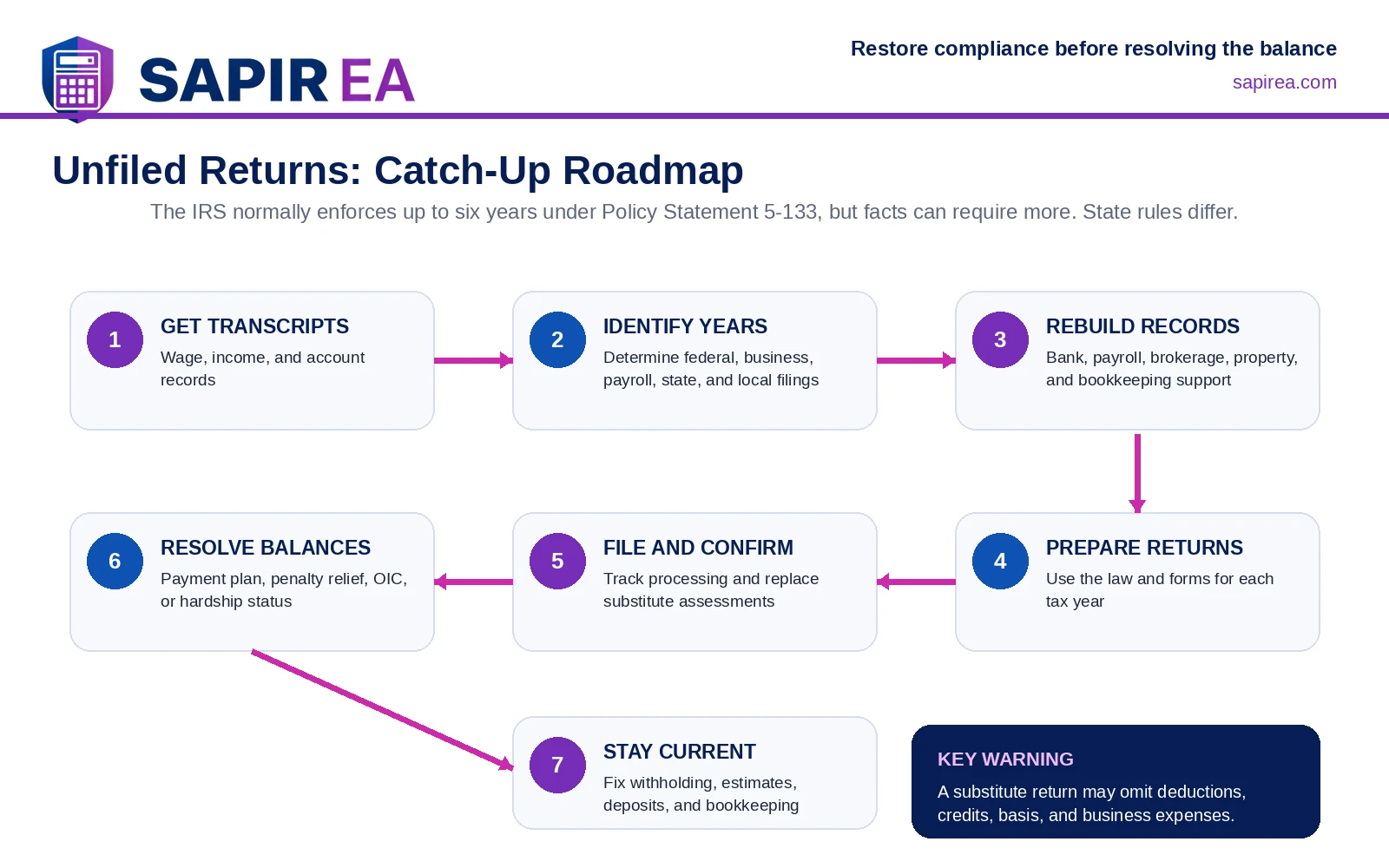
Unfiled returns usually must be addressed before the IRS will approve a long-term collection resolution. The process should be organized, not improvised.
Step 1: Obtain IRS Transcripts and Account Records
Use IRS wage-and-income transcripts to identify Forms W-2, 1099, 1098, and other information reported under the taxpayer's identification number. Account transcripts help identify prior filings, assessments, payments, and IRS-prepared substitutes.
Transcripts are a starting point, not a complete set of books. They may not show basis, business expenses, cash income, rental costs, foreign items, or state information.
Step 2: Determine Which Returns Are Required
IRS Policy Statement 5-133 says delinquency enforcement will normally cover not more than six years, but that is an administrative policy, not a universal guarantee. The IRS may require more years when facts such as fraud, willfulness, prior noncompliance, revenue, or collectibility justify it. State and local agencies follow their own rules.
Step 3: Reconstruct Income, Expenses, and Basis
Gather bank statements, credit-card statements, bookkeeping files, brokerage records, payroll reports, property closing documents, vehicle records, and prior returns. Reasonable reconstruction may be possible when original records are unavailable, but unsupported estimates create risk.
Step 4: Prepare Accurate Original Returns
Use the law and forms applicable to each tax year. Do not simply accept an IRS substitute for return. A substitute return may omit deductions, credits, filing-status benefits, business expenses, basis, and other information that a properly prepared return would include.
Step 5: Protect Refunds and Social Security Credits
A taxpayer generally must file within three years of the return due date to claim a refund. Self-employed individuals who do not file may also lose Social Security earnings credits for the unreported self-employment income.
Step 6: File, Confirm Processing, and Resolve the Balances
After the required returns are filed, confirm that they post correctly and that substitute assessments are adjusted when appropriate. Then evaluate payment plans, penalty relief, OIC, or hardship status using the final balances.
Step 7: Fix Current-Year Compliance
A resolution will fail if the taxpayer immediately creates a new liability. Adjust withholding, estimated payments, payroll deposits, bookkeeping, and filing procedures so the current year remains compliant.
What Is an Enrolled Agent? EA vs. CPA vs. Tax Attorney
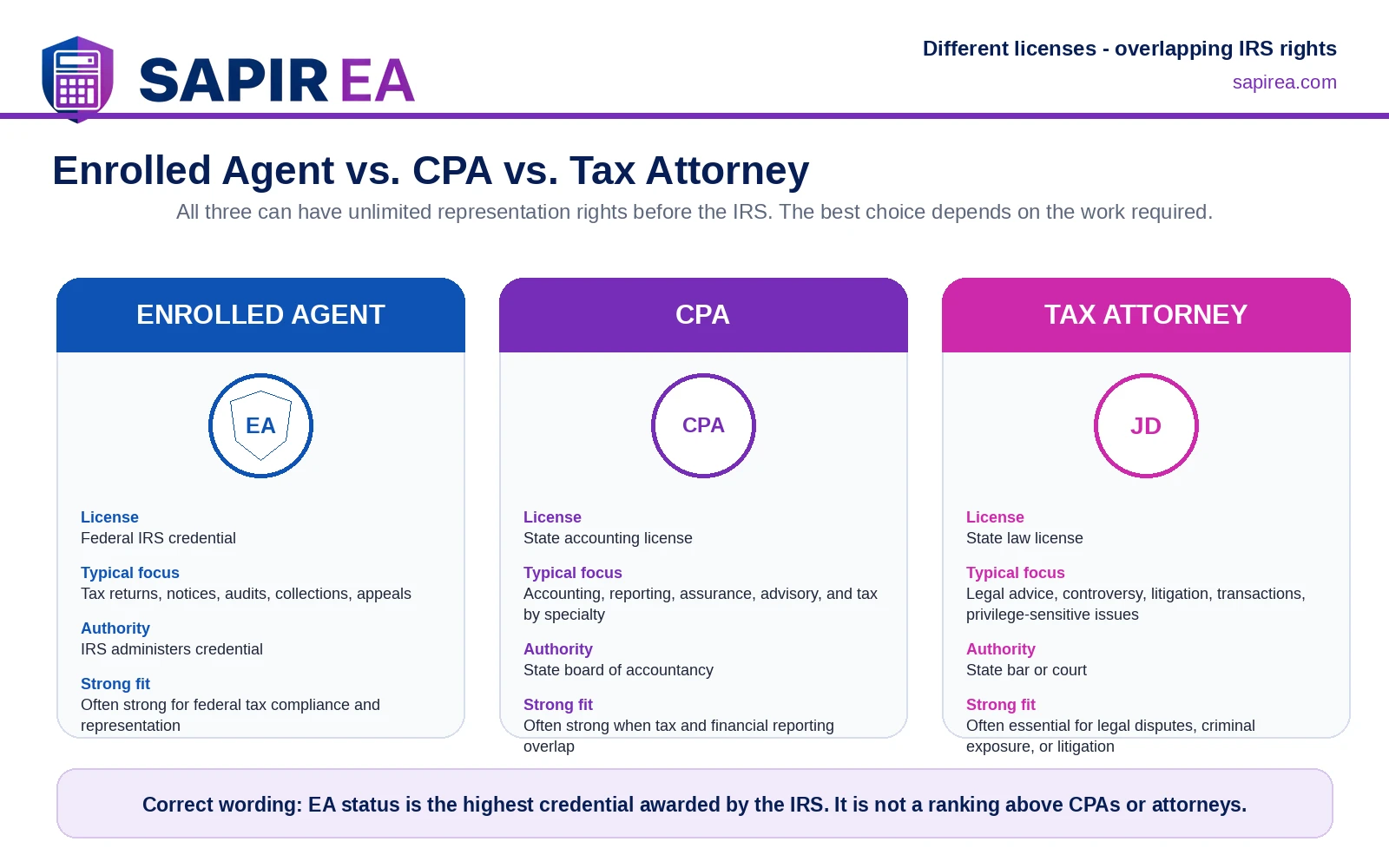
An Enrolled Agent is a federally licensed tax practitioner authorized to represent taxpayers before the IRS. EAs generally qualify through a three-part IRS examination or qualifying former IRS experience and must meet ethics and continuing-education requirements.
The IRS calls EA status the highest credential it awards. That does not mean an EA is "higher than" a CPA or tax attorney. CPAs and attorneys hold different state licenses, and all three credentials have unlimited IRS representation rights when the professional is eligible and in good standing.
| Credential | Licensing authority | Typical focus | IRS representation rights | Often a strong fit for |
|---|---|---|---|---|
| Enrolled Agent | Federal credential administered by the IRS | Federal tax compliance, planning, notices, audits, collections, and appeals | Unlimited | Tax preparation and IRS representation for individuals and businesses |
| Certified Public Accountant | State board of accountancy | Accounting, financial reporting, assurance, business advisory, and tax depending on specialty | Unlimited | Financial statements, accounting systems, attest work, and tax matters when the CPA specializes in tax |
| Tax Attorney | State bar or court licensing system | Legal advice, contracts, controversy, litigation, privilege-sensitive matters, estates, and tax law depending on specialty | Unlimited | Tax Court or other litigation, criminal investigations, complex legal disputes, and transactions requiring legal advice |
The right professional depends on the problem. EAs often focus on returns and IRS controversy, CPAs may combine tax with accounting or financial-statement work, and tax attorneys may be essential for litigation, criminal exposure, or legal advice. Some matters require a coordinated team.
Recommended credential wording for the website: "Enrolled Agent status is the highest credential awarded by the IRS. Enrolled Agents, CPAs, and attorneys each have unlimited representation rights before the IRS. The credentials are different, and the right professional depends on the work required."
How SAPIR EA Helps With IRS Problems
SAPIR EA provides nationwide federal tax representation for individuals and businesses. A case may involve reviewing notices and deadlines, obtaining transcripts, correcting assessments, filing missing returns, preparing authorizations and financial disclosures, comparing realistic options, and communicating with the IRS.
The objective is to match the facts to the correct procedure, preserve rights, and avoid creating a new tax problem while resolving the old one.
Internal resources: Learn more about IRS representation and tax resolution, tax preparation and year-round planning, bookkeeping and QuickBooks support, or request a confidential case review.
Have an IRS Letter in Front of You?
Upload the complete notice through a secure process and have the deadline, tax period, and realistic response options reviewed before the matter escalates.
Frequently Asked Questions
Is a CP2000 an audit?
A CP2000 is an automated matching proposal, not a traditional audit. It can become an assessment if the taxpayer does not respond.
Should I file an amended return after receiving a CP2000?
No. Follow the CP2000 instructions first. Any federal or state amendment should be coordinated with that response.
Is CP504 the same as an actual levy?
No. CP504 is a serious notice of intent to levy. Waiting for the next notice can reduce available options.
What should I do if I receive LT11?
Review it immediately. LT11 generally provides 30 days to request a Collection Due Process hearing and preserve important rights.
Can I get an installment agreement if I have unfiled returns?
Usually not until required returns are filed. Filing compliance is a basic condition for most payment agreements and collection alternatives.
Does an installment agreement stop interest and penalties?
No. Interest and applicable penalties generally continue, although the agreement can prevent more aggressive collection while its terms are met.
Does the IRS really settle tax debt for pennies on the dollar?
An OIC is based on assets, income, expenses, and collection potential, not a standard percentage. Many taxpayers do not qualify.
Who is a realistic Offer in Compromise candidate?
A stronger candidate is compliant, has limited equity, and cannot reasonably full-pay through future income. Hardship or a genuine liability dispute may also apply.
What penalties can First Time Abate or AEP cover?
It can cover certain failure-to-file, failure-to-pay, and failure-to-deposit penalties. It does not erase the tax or all interest.
How many years of unfiled returns must I file?
IRS policy normally results in enforcement for up to six years, but the actual requirement depends on the facts and can extend further. State and local requirements may differ.
Can an Enrolled Agent represent me if I live outside Pennsylvania?
Yes. IRS representation is federal. An Enrolled Agent with active authority can represent taxpayers before the IRS nationwide, subject to the engagement and authorization.
Is an EA better than a CPA or tax attorney?
The credentials are different, not a ranking. EAs focus on federal tax practice, CPAs hold state accounting licenses, and tax attorneys provide legal services. The best fit depends on the work.
Official IRS Resources
- IRS Payment Plans and Installment Agreements
- IRS Offer in Compromise
- IRS Filing Past-Due Tax Returns
- IRS Administrative Penalty Relief
- IRS Penalty Relief for Reasonable Cause
- IRS Publication 594: The IRS Collection Process
- IRS Enrolled Agent Information
Last reviewed: September 2026. Tax rules and IRS procedures can change. Confirm current requirements before acting.