How Much Tax Comes Out of Your Paycheck? A Complete 2026 Guide to W-4 Withholding

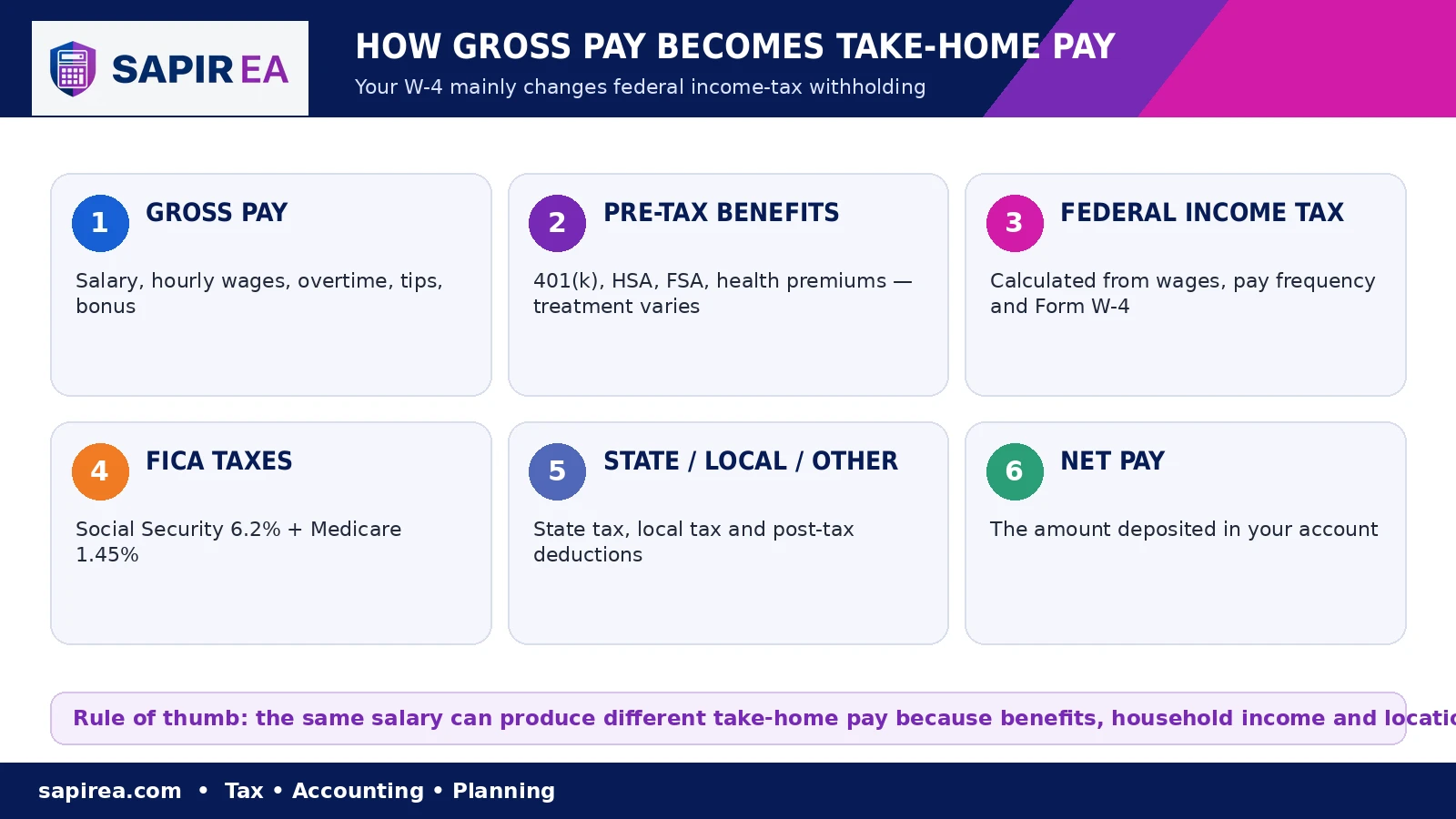
Your salary may be the largest number on a job offer, but it is not the amount that reaches your bank account. Every paycheck can include federal income tax withholding, Social Security tax, Medicare tax, state and local taxes, retirement contributions, health insurance, and other deductions. The result is your net pay, often called take-home pay.
There is no single percentage that comes out of every paycheck. Employees with the same salary can have different net pay because of filing status, household jobs, dependents, benefits, retirement contributions, state and local taxes, bonuses, and Form W-4 entries.
This guide explains the 2026 Form W-4, the main paycheck deductions, and when withholding needs attention. Use the SAPIR EA W-4 Withholding Planner to model your pay frequency and W-4 entries.
Key point: Form W-4 adjusts federal income tax withholding. It generally does not turn Social Security, Medicare, state tax, retirement contributions, insurance premiums, or other payroll deductions on or off.
What Is the Difference Between Gross Pay and Net Pay?
Gross pay is compensation before taxes and deductions. A $78,000 salary paid biweekly produces $3,000 of gross pay for each of 26 pay periods. Hourly gross pay can include regular hours, overtime, commissions, tips, and bonuses.
Net pay is what remains after deductions:
Gross pay − pre-tax benefits − payroll taxes − federal, state, and local income tax − post-tax deductions = net pay
The order matters because benefits can affect federal, Social Security, and Medicare wages differently. Roth retirement contributions generally do not reduce current taxable wages.
The Main Amounts That Can Come Out of a Paycheck
The following items are common, but not every employee will have all of them.
| Paycheck item | What it pays for | Does Form W-4 control it? | Important 2026 point |
|---|---|---|---|
| Federal income tax withholding | Prepayment toward federal income tax | Yes | Based on wages, pay frequency, filing status, and W-4 entries |
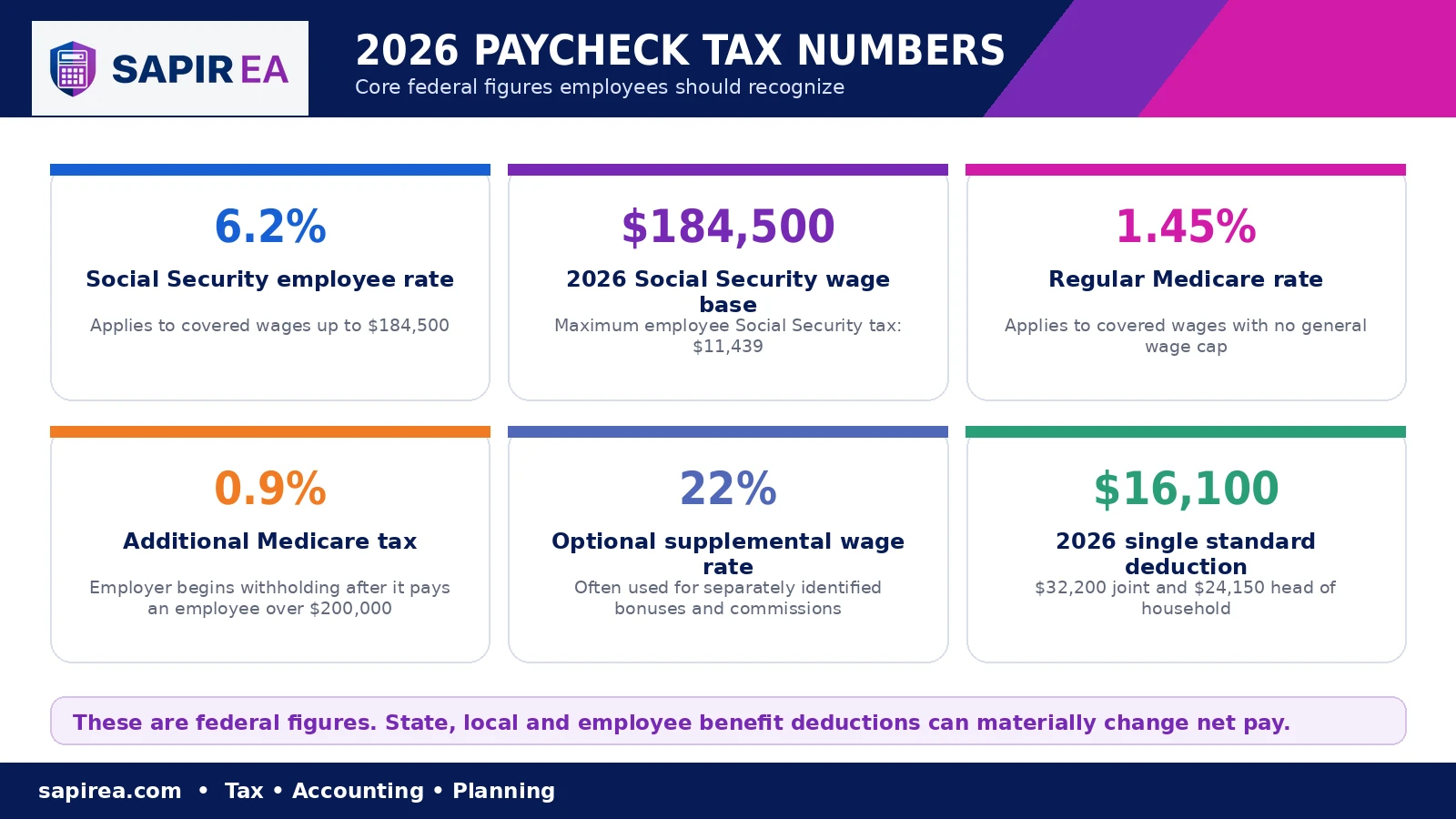
| Social Security tax | Old-Age, Survivors, and Disability Insurance | No | 6.2% of covered wages up to $184,500 |
| Medicare tax | Hospital Insurance | No | 1.45% of covered wages, with no general wage cap |
| Additional Medicare tax | Additional 0.9% Medicare tax | No direct W-4 control | Employer begins withholding after wages from that employer exceed $200,000 |
| State income tax | State tax prepayment | Usually separate state form | Rules differ by state; some states have no individual wage tax |
| Local tax | City, county, school, or earned-income tax | Usually no | Depends on work and residence locations |
| Retirement contribution | 401(k), 403(b), 457, or similar plan | No | Traditional and Roth contributions affect taxes differently |
| Health and benefit deductions | Medical, dental, vision, HSA, FSA, disability, life insurance | No | Tax treatment depends on the benefit and payroll arrangement |
| Other deductions | Union dues, garnishments, charitable payroll gifts, loan repayments | No | May be pre-tax or post-tax depending on the item |
Federal income tax withholding
Federal withholding is an estimated prepayment. Your employer calculates it using IRS payroll tables in Publication 15-T, your taxable wages for that pay period, your pay frequency, and your Form W-4 information.
Withholding is not a separate tax. When you file Form 1040, all federal income tax withheld is credited against your actual annual tax. If withholding and other payments exceed the final liability, you may receive a refund. If they are too low, you may owe a balance and possibly an underpayment penalty.
Social Security tax
For 2026, the employee Social Security rate is 6.2% on covered wages up to $184,500, for a maximum employee amount of $11,439. If multiple employers collectively withhold more than the annual maximum, the excess may generally be claimed on the federal return.
Medicare tax and Additional Medicare tax
The regular employee Medicare rate is 1.45% on covered wages with no general annual cap. Employers generally match it.
An additional 0.9% Medicare tax may apply once combined Medicare wages and self-employment income exceed $250,000 for married filing jointly, $125,000 for married filing separately, or $200,000 for most other filers. An employer must begin withholding the extra 0.9% after it pays one employee more than $200,000 during the year, regardless of that employee's filing status or a spouse's wages.
Because the employer threshold differs from the joint-return threshold, married couples can be under- or overwithheld. Form 8959 reconciles the result.
State and local taxes
State withholding follows state rules and often requires a separate form. Pennsylvania employees may also see local earned-income tax or Philadelphia wage tax. Moving, remote work, and multi-state employment can change these obligations, so a federal W-4 review is not enough.
How the 2026 Form W-4 Works
Form W-4 no longer uses withholding allowances. It uses filing status, household jobs, credits, other income, deductions, and optional extra withholding.
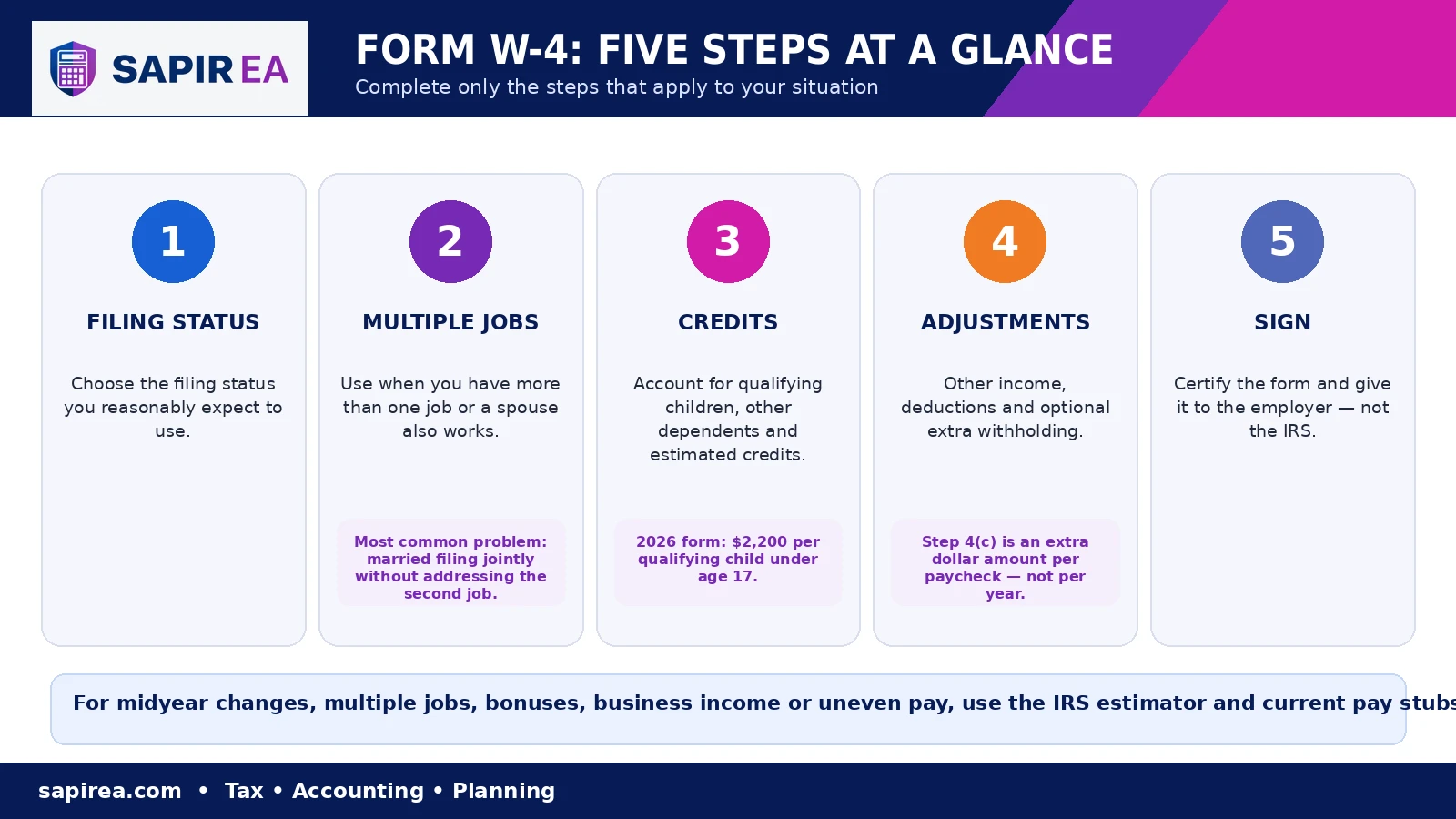
Step 1: Personal information and filing status
Step 1(c) asks whether you expect to file as:
- Single or married filing separately;
- Married filing jointly or qualifying surviving spouse; or
- Head of household.
This selection determines the rate schedule and standard-deduction assumptions used for withholding. Choosing married filing jointly does not tell payroll that a spouse also works. That issue belongs in Step 2 and is one of the most common causes of underwithholding.
For 2026, the basic standard deduction is $16,100 for single and married filing separately, $32,200 for married filing jointly, and $24,150 for head of household. Federal tax brackets are progressive: reaching a higher bracket does not cause all income to be taxed at the higher rate.
Step 2: Multiple jobs or a working spouse
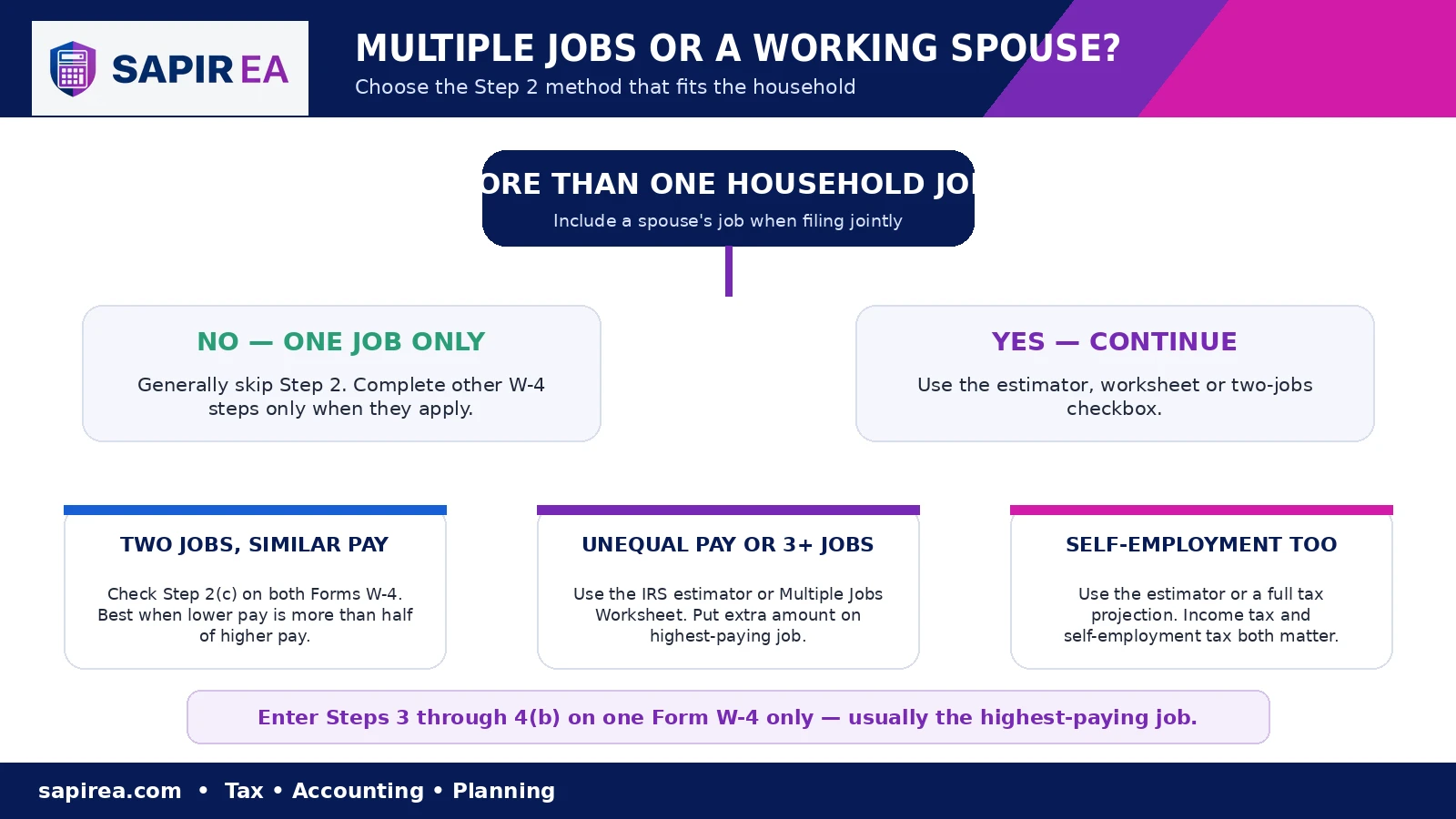
Complete Step 2 when you hold more than one job at the same time or when you file jointly and your spouse also works. Each payroll system usually sees only the wages it pays. Without an adjustment, two employers can each apply a full standard deduction and lower tax brackets, causing the household to withhold too little.
The 2026 form provides three approaches:
| Step 2 method | Best use | Advantage | Main risk |
|---|---|---|---|
| IRS estimator | Multiple jobs, self-employment, midyear changes, uneven pay | Usually the most accurate | Requires current pay stubs and annual estimates |
| Multiple Jobs Worksheet | Two or three jobs with predictable wages | Keeps detailed income off the form given to payroll | Can become inaccurate when pay changes |
| Step 2(c) checkbox | Exactly two jobs with similar pay | Fast and simple | Can overwithhold when the lower-paying job is much smaller |
If the checkbox is used, it generally must be checked on both Forms W-4. The IRS notes that it works best when the lower-paying job earns more than half of the higher-paying job. Complete Steps 3 through 4(b) on only one Form W-4, preferably for the highest-paying job.
Step 3: Dependents and other credits
Step 3 reduces withholding to account for expected tax credits. The 2026 form uses 2, 200perqualifyingchildunderage17 * *and * *500 per other dependent when projected income is within the thresholds stated on the form. Other anticipated credits, such as certain education or foreign tax credits, may also be included when reasonably estimated.
Step 3 changes withholding, not final eligibility. Payroll spreads the annual reduction across pay periods. In a multiple-job household, do not duplicate the same credits on several forms.
Step 4(a): Other income
Step 4(a) can account for interest, dividends, retirement income, and other income without withholding. Complex business income, rental, capital-gain, or investment situations usually require the IRS estimator or a full projection. The SAPIR EA Estimated Tax Calculator can compare projected tax with payments already made.
Step 4(b): Deductions
Step 4(b) can reduce withholding when you expect deductions beyond the basic standard deduction. The 2026 worksheet includes itemized deductions and certain above-the-line or special deductions, including qualified tips, qualified overtime compensation, qualifying passenger-vehicle loan interest, student-loan interest, IRA deductions, and eligible senior deductions.
Use a realistic annual estimate. Entering gross itemized deductions without considering the standard deduction can reduce withholding too far.
Step 4(c): Extra withholding
Step 4(c) is an additional dollar amount withheld from every paycheck. It is often the cleanest solution when you want to cover:
- Household income from several sources;
- Self-employment or partnership income;
- A projected year-end shortfall;
- Investment or rental income;
- Additional Medicare tax;
- A spouse's underwithholding; or
- A specific refund or balance-due target.
An entry of $150 on Step 4(c) means $150 more comes out each pay period, not $150 for the year. Divide the desired annual adjustment by the remaining pay periods before submitting the form.
Claiming exemption from withholding
You may generally claim exempt only if you had no federal income tax liability for 2025 and expect none for 2026. A prior refund does not prove zero liability. Exemption stops federal income tax withholding, not usually Social Security, Medicare, state tax, or benefits, and it must be renewed for the next year.
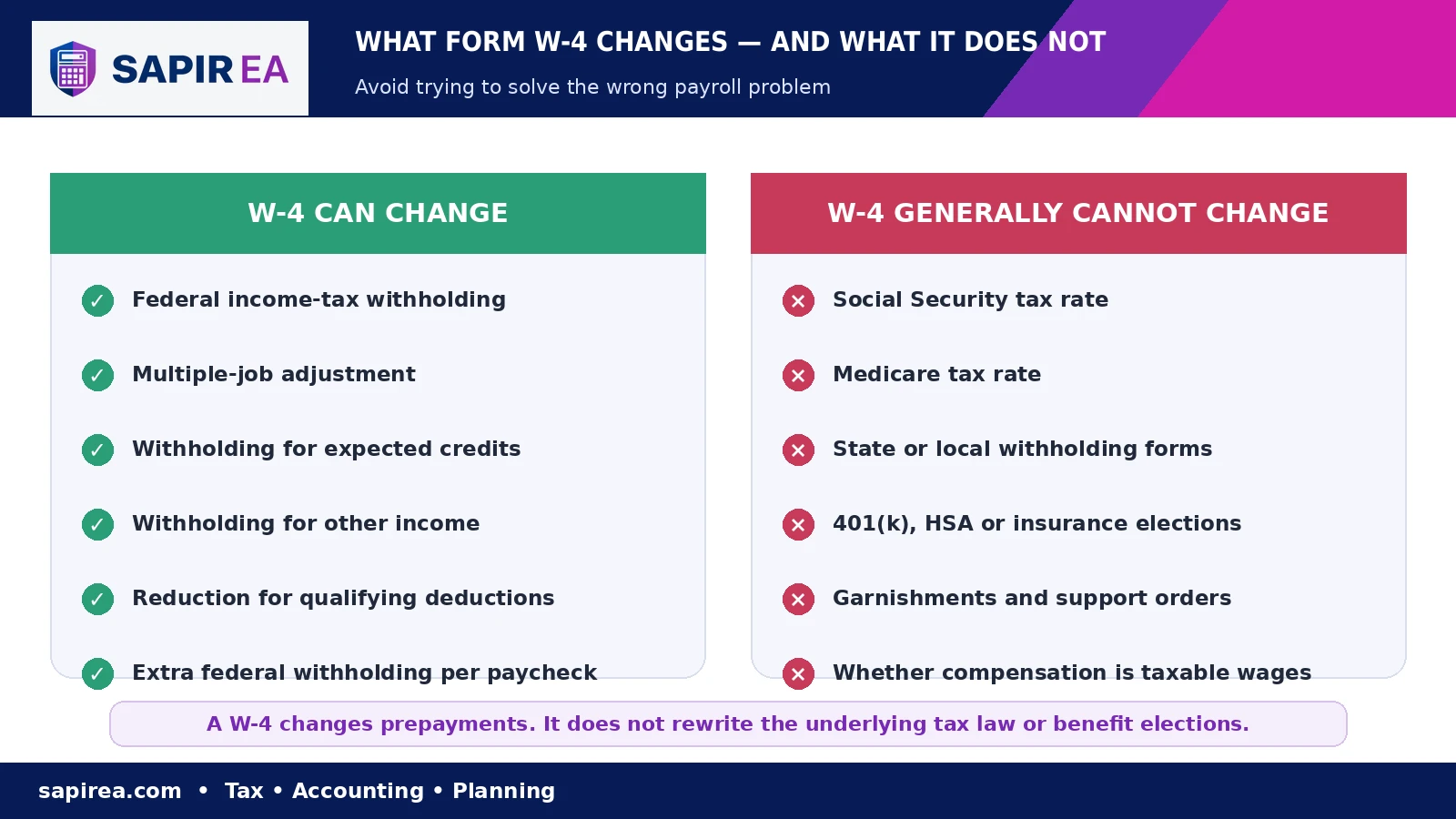
What Form W-4 Can and Cannot Change
| Form W-4 can change | Form W-4 generally cannot change |
|---|---|
| Federal income tax withholding | Social Security tax rate |
| Treatment of multiple W-2 jobs | Medicare tax rate |
| Withholding for expected credits | State or local withholding forms |
| Withholding for other income | 401(k), HSA, or insurance elections |
| Reduction for qualifying deductions | Wage garnishments or support orders |
| Extra federal withholding per paycheck | Whether compensation is taxable wages |
A W-4 can improve cash flow, but it does not change the underlying tax law. Increasing credits or deductions on the form without a supportable basis does not eliminate the tax; it merely reduces prepayments and can create a filing-time balance.
Pre-Tax Benefits Can Change Take-Home Pay
The label “pre-tax” is not one universal treatment. Different deductions affect different taxes.
| Employee deduction | Federal income-tax wages | Social Security and Medicare wages | Current paycheck effect |
|---|---|---|---|
| Traditional 401(k) contribution | Usually reduced | Usually not reduced | Lowers federal withholding but FICA generally remains |
| Roth 401(k) contribution | Not reduced | Not reduced | Contribution is generally after federal and payroll taxes |
| HSA through a qualifying cafeteria plan | Often reduced | Often reduced | Can reduce federal and payroll taxes when properly structured |
| Employee health premium through cafeteria plan | Often reduced | Often reduced | Treatment depends on plan design and coverage |
| Health FSA contribution | Often reduced | Often reduced | Reduces available cash but may lower taxes |
| After-tax insurance or other deduction | Not reduced | Not reduced | Directly reduces net pay with no current tax benefit |
A larger pre-tax contribution can lower both take-home pay and current tax. Ending it may increase the paycheck by less than the deduction because taxable wages rise.
How Bonuses, Commissions, Tips, and Overtime Are Withheld
Bonuses and commissions are often treated as supplemental wages. When paid separately or identified separately, an employer may use an optional flat federal withholding rate of 22%. Supplemental wages above $1 million paid by one employer during the year are generally subject to a 37% mandatory rate on the excess.
A 22% withholding rate is not a special 22% final tax rate. Your actual tax depends on total annual income, deductions, credits, filing status, and tax bracket. A taxpayer in a lower bracket may receive some of the withholding back; a taxpayer in a higher bracket may still owe more.
Qualified tips and qualified overtime may generate federal deductions under current law, but the compensation can still be subject to payroll withholding when paid. The 2026 W-4 deductions worksheet allows eligible employees to reflect an estimate in Step 4(b). Because eligibility, income phaseouts, and reporting rules matter, use a complete projection rather than assuming “no tax” means nothing should be withheld from the paycheck.
A Simplified Paycheck Example
Assume a single employee earns $78,000 annually and is paid biweekly. Gross pay is $3,000. Before federal income tax, state tax, or benefits, Social Security is about $186 and Medicare is about $43.50, leaving $2,770.50. Federal withholding then depends on Form W-4 and Publication 15-T.
A $300 traditional 401(k) contribution may reduce federal taxable wages but generally not Social Security or Medicare wages. Net pay therefore falls by less than $300 because federal withholding may also decrease. This simplified example shows why one take-home percentage cannot fit every employee.
When Should You Review or Update Form W-4?
The IRS recommends checking withholding every January and after major life or financial changes. The same review belongs on a year-end tax-planning checklist. Review it when you:
- Start a new job or add a second job;
- Get married, divorced, or separated;
- Have a child, adopt, or lose a dependent claim;
- Experience a major raise, pay cut, bonus, or commission change;
- Start freelance, rental, partnership, or S corporation income;
- Sell investments, real estate, or a business;
- Begin receiving pension, Social Security, or retirement distributions;
- Move or begin working in another state;
- Change retirement, HSA, or benefit elections;
- Receive a large refund you did not intend to create;
- Owe more than you can comfortably pay; or
- Expect credits or deductions to change.
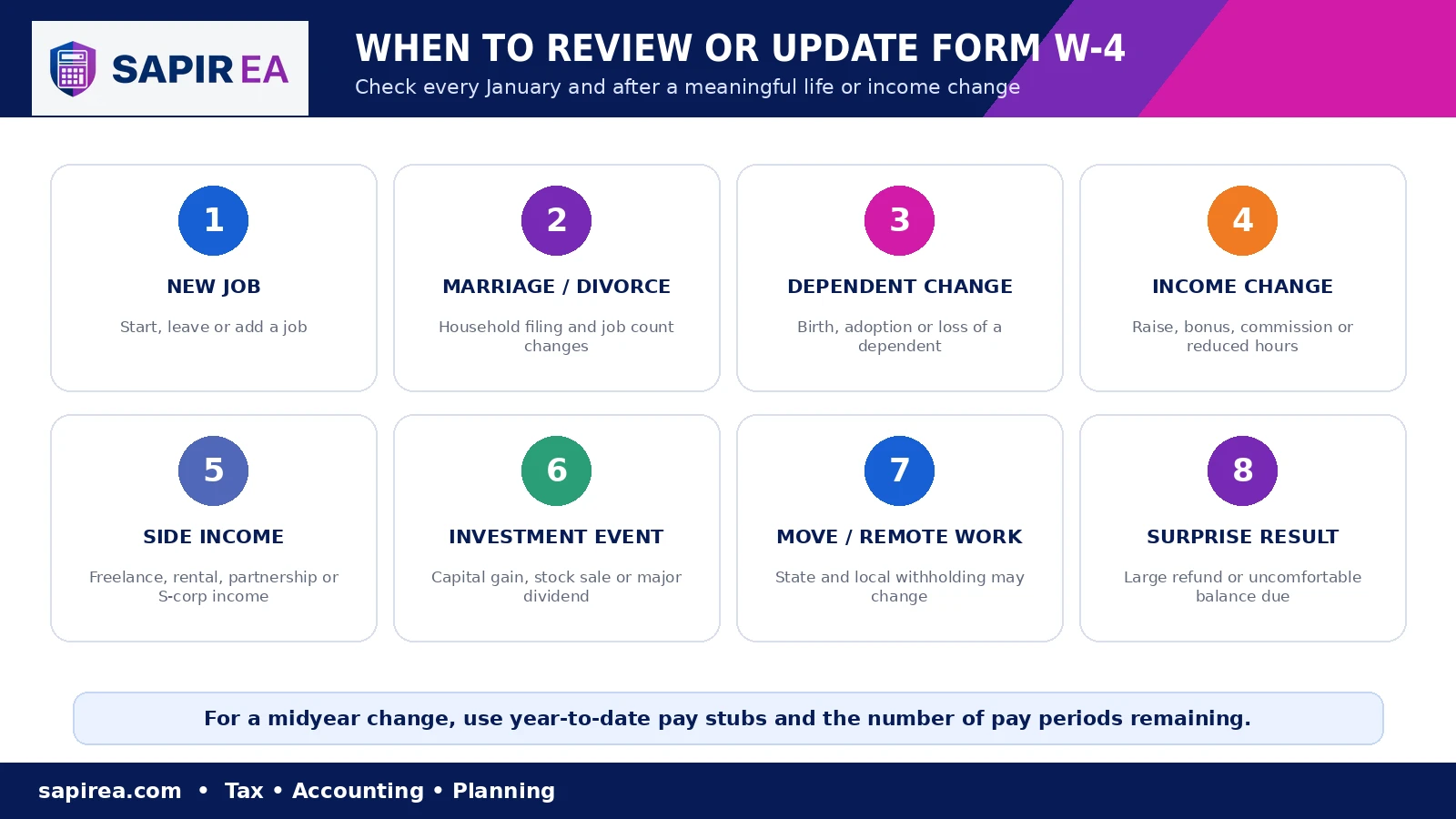
A midyear update should account for what has already been withheld. Simply completing a fresh W-4 as if January had just begun may not correct the year properly. The IRS Tax Withholding Estimator asks for current pay stubs and can generate a prefilled Form W-4.
Avoiding a Tax Bill and Underpayment Penalty
The federal system is pay-as-you-go. Many taxpayers avoid an individual estimated-tax penalty when they owe less than $1,000 after withholding and refundable credits, or when timely payments equal at least the smaller of 90% of current-year tax or 100% of prior-year tax. The prior-year percentage generally becomes 110% for higher-income taxpayers whose prior-year AGI exceeded $150,000, or $75,000 if married filing separately.
These are penalty safe harbors, not tax caps, so a balance can remain. Withholding may help with a late-year correction because it is generally treated as paid ratably during the year, while estimates are generally credited when paid. Model the adjustment rather than guessing.
Taxpayers with wages plus business, partnership, investment, or rental income should coordinate Form W-4 with quarterly estimates. If an existing balance has already moved into notices or collection, review SAPIR EA's IRS representation services. SAPIR EA's tax preparation and year-round planning services can connect the paycheck decision to the complete household return.
Ten Common W-4 and Paycheck Mistakes
- Using old “allowance” language. Current W-4 forms do not use the old zero-or-one allowance system.
- Selecting married filing jointly while ignoring the spouse's job. Filing status alone does not coordinate two payroll systems.
- Claiming the same dependent credits on multiple jobs. Duplicate Step 3 entries can substantially reduce withholding.
- Checking Step 2(c) when job pay is very unequal. The checkbox can withhold more than necessary when one job is much smaller.
- Entering self-employment income without considering self-employment tax. Business income can require more than ordinary income-tax withholding.
- Treating a bonus's 22% withholding as the final tax. Supplemental withholding and final tax are separate calculations.
- Confusing a refund with accurate withholding. A large refund may reflect refundable credits or excessive prepayments.
- Claiming exempt because the prior year produced a refund. The test is whether there was federal income tax liability, not whether a refund check arrived.
- Updating federal withholding but ignoring state and local forms. Remote work, moving, and multi-state employment can create separate problems.
- Making a midyear change without reviewing year-to-date amounts. Remaining pay periods must be considered.
A Practical W-4 Review Checklist
Before changing your Form W-4, gather:
- The most recent pay stub from every household job;
- Your spouse's pay stubs if filing jointly;
- Year-to-date federal and state withholding;
- Expected bonuses, commissions, tips, and overtime;
- Projected business, rental, investment, and retirement income;
- Estimated deductions and credits;
- Prior-year Form 1040 and total tax;
- Estimated payments already made; and
- The number of pay periods remaining.
Then decide whether the objective is a small refund, close-to-zero balance, or a larger planned refund. A refund is not a tax strategy by itself; it is generally the return of an overpayment. The best target should also consider cash flow, savings discipline, and the risk of income changing before year-end.
For an initial calculation, use the SAPIR EA W-4 Withholding Planner. For a household with several income sources, use the Estimated Tax Calculator and consider a professional projection.
How SAPIR EA Can Help
A paycheck calculator addresses one payroll period; a sound strategy considers the full return. SAPIR EA reviews federal, state, and local withholding, multiple jobs, credits, deductions, business and investment income, safe harbors, bonuses, and midyear corrections. Explore SAPIR EA's tax services, visit the Tax and Accounting FAQ page, or schedule a consultation using your current pay stubs and prior return.
Withholding Review
Is Your Paycheck Withholding Actually on Track?
Use current pay stubs, your prior return, and projected household income to check whether Form W-4 and estimated payments match the full tax picture.
Frequently Asked Questions About Paycheck Taxes and Form W-4
What percentage of my paycheck goes to taxes?
There is no universal percentage. Federal income-tax withholding depends on wages, pay frequency, filing status, W-4 entries, and annual tax assumptions. Social Security is generally 6.2% up to the annual wage base, Medicare is generally 1.45% with no general wage cap, and state or local taxes vary.
Does Form W-4 change Social Security and Medicare tax?
Generally, no. Form W-4 controls federal income tax withholding. Social Security and Medicare are calculated under separate payroll-tax rules.
Should I claim single or married on Form W-4?
Choose the filing status you reasonably expect to use on the federal return. If married filing jointly and both spouses work, also complete Step 2. Selecting married without addressing the second income can cause underwithholding.
What happened to claiming zero or one allowance?
Allowances were removed from the redesigned Form W-4 beginning in 2020. The current form uses filing status, multiple jobs, credits, other income, deductions, and extra withholding.
Will putting dependents on Form W-4 increase my paycheck?
Usually. Step 3 reduces federal withholding for anticipated credits, which generally increases net pay and reduces the refund or balance credit available at filing. Eligibility is determined on the tax return.
Can I ask my employer to withhold a fixed extra amount?
Yes. Enter an additional amount per pay period in Step 4(c). Be sure to divide the desired annual increase by the remaining number of paychecks.
Why was 22% withheld from my bonus?
Employers may use a 22% optional flat federal rate for separately identified supplemental wages. That is withholding, not necessarily the final tax rate on the bonus.
Can I use my W-4 to cover freelance income?
Yes, additional wage withholding can help cover income and self-employment taxes. The IRS recommends using its estimator when you or a spouse has self-employment income. Quarterly estimates may also be appropriate.
Why do I still owe tax when federal tax came out of every paycheck?
Withholding may have been calculated without considering a second job, spouse's wages, investment income, business income, capital gains, or reduced credits. It can also be too low after a midyear change.
When does Social Security tax stop in 2026?
Employee Social Security withholding generally stops after one employer pays the employee more than the 2026 wage base of $184,500. Medicare withholding continues. With multiple employers, each generally applies the wage base separately, and excess Social Security may be reconciled on the return.
Do I need a separate state withholding form?
Often, yes. State and local systems have their own forms and rules. A federal W-4 change does not automatically create the correct state or local result.
What should I bring to a withholding review?
Bring recent pay stubs for all jobs, your spouse's pay stubs, the prior-year tax return, projected non-wage income, expected credits and deductions, estimated payments, and information about major changes during the year.
This article is for general educational purposes and does not constitute individualized tax, legal, payroll, or financial advice. Withholding results depend on the taxpayer's complete facts, payroll system, benefit elections, and applicable federal, state, and local law.
Plan With the Whole Return in View
Turn a Paycheck Estimate Into a Year-Round Tax Plan
SAPIR EA helps individuals, dual-income households, and business owners coordinate withholding, estimated payments, credits, deductions, and state obligations.