Traditional, Roth, SEP & Backdoor Roth IRAs in 2026: The Complete Tax Strategy Guide
Every IRA decision is really a tax decision. Deduct now or withdraw tax-free later? Fund a Roth directly or go through the back door? Open a SEP for your business or a solo 401(k)? Convert this year or wait for a lower bracket? The account paperwork takes ten minutes; the tax consequences last decades — and in several cases, a wrong move creates a bill the IRS will not let you undo.
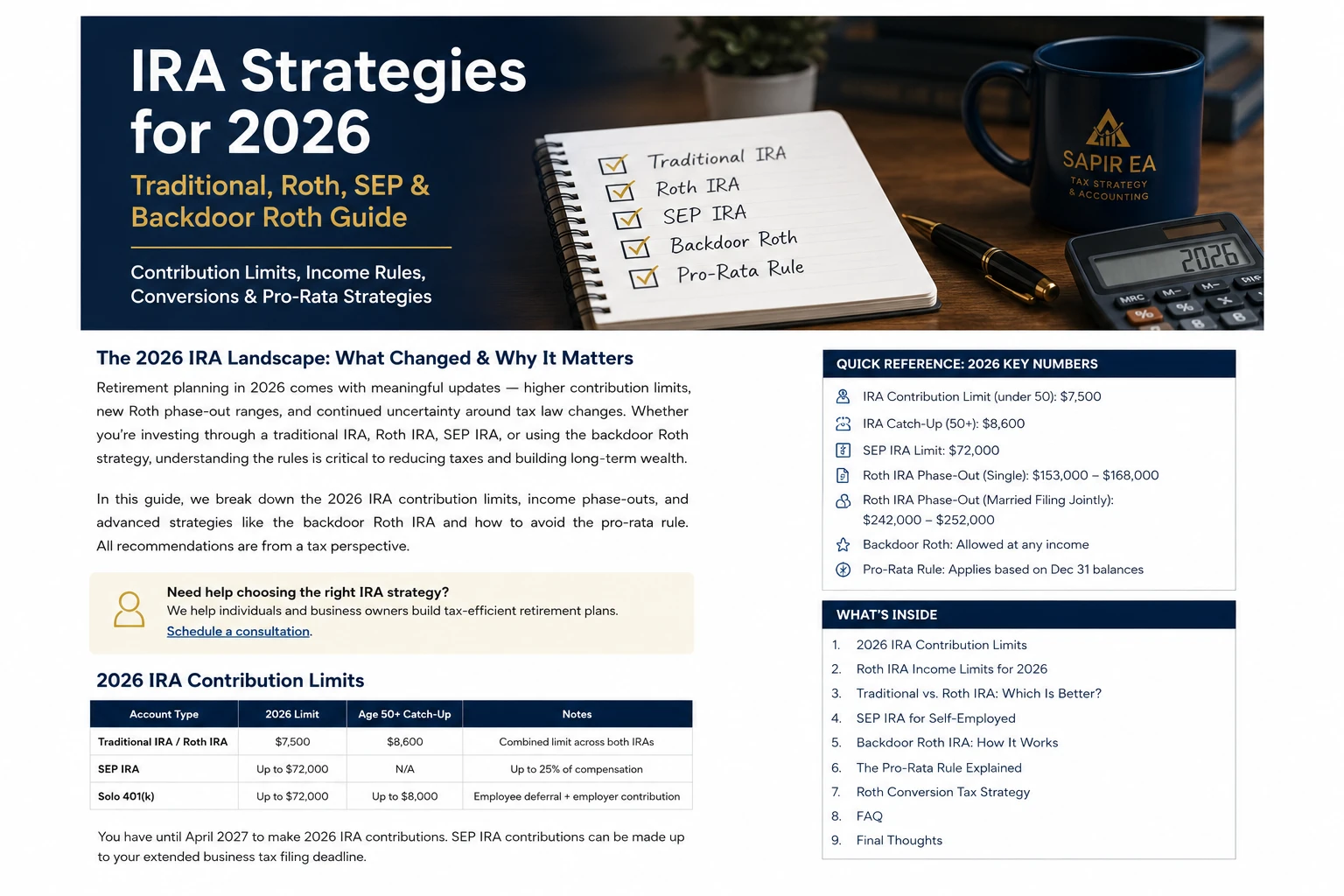
For 2026, the IRS raised the IRA contribution limit to $7,500 ($8,600 if you're 50 or older), pushed the SEP ceiling to $72,000, and widened every income phase-out range. Those new numbers change who qualifies for what — and they make this a good year to revisit which accounts you're funding and in what order.
As an Enrolled Agent preparing returns for families, professionals, and business owners nationwide, I see the same handful of IRA mistakes every filing season: nondeductible contributions with no Form 8606, backdoor conversions poisoned by an old SEP balance, and self-employed clients leaving five-figure deductions unclaimed. This guide walks through all four strategies — traditional, Roth, SEP, and backdoor conversions — with the 2026 numbers, the traps, and the planning angles that actually move your tax bill.
- The four IRA strategies at a glance
- Traditional IRA: the deduction question
- Roth IRA: tax-free growth, if you qualify
- SEP IRA: the self-employed powerhouse
- Backdoor Roth conversions, step by step
- The pro-rata rule: the trap that catches everyone
- Strategic Roth conversions beyond the backdoor
- Household-level strategy: spouses, kids, and stacking accounts
- 2026 limits, phase-outs, and deadlines
- Frequently asked questions
1. The Four IRA Strategies at a Glance
All four strategies use individual retirement accounts, but they solve different tax problems. A traditional IRA gives you a deduction today in exchange for taxable withdrawals later. A Roth IRA flips that: no deduction now, but qualified withdrawals — including decades of growth — come out tax-free, with no required minimum distributions during your lifetime. A SEP IRA is an employer plan for the self-employed that multiplies the contribution ceiling nearly tenfold. And the backdoor Roth is not an account at all — it's a two-step maneuver that gets money into a Roth when your income is too high to contribute directly.
2. Traditional IRA: The Deduction Question
Anyone with earned income can contribute to a traditional IRA — there is no income cap on contributing. The income limits apply only to deducting the contribution, and only if you (or your spouse) are covered by a workplace retirement plan.
For 2026, if you're covered by a plan at work, the deduction phases out between $81,000 and $91,000 of modified AGI for single filers, and between $129,000 and $149,000 for married filing jointly. If you're not covered but your spouse is, you can deduct fully up to $242,000 joint MAGI, phasing out at $252,000. Not covered by any plan? Full deduction at any income.
The strategic question is whether the deduction is worth taking when you qualify. A deduction at a 32% marginal rate that turns into withdrawals taxed at 22% in retirement is a clear win. The reverse — deducting at 12% early in your career and withdrawing at 24% later — is a loss dressed up as a refund. The traditional IRA earns its keep when your current bracket is meaningfully higher than your expected retirement bracket, or when the deduction itself unlocks something else on the return (lowering AGI to qualify for credits, reduce IRMAA exposure, or — as we covered in our guide to income-driven student loan repayment — shrink a loan payment calculated from AGI).
Two cautions. First, a nondeductible traditional contribution standing alone is usually the worst of both worlds — no deduction now, taxable growth later — unless it's step one of a backdoor Roth. Second, if you make nondeductible contributions, Form 8606 is mandatory for every year you do. Miss it and the IRS has no record of your basis, which means you can be taxed twice on the same dollars. We rebuild missing 8606 histories for new clients regularly; it is far cheaper to file them right the first time.
3. Roth IRA: Tax-Free Growth, If You Qualify
The Roth IRA's pitch is simple: pay tax on the seed, never on the harvest. Qualified withdrawals after age 59½ (and five years) are completely tax-free, there are no required minimum distributions during your lifetime, heirs receive the account income-tax-free, and your contributions (not earnings) can be withdrawn at any time without tax or penalty — which makes a Roth a serviceable backup emergency fund.
For 2026, direct Roth contributions phase out between $153,000–$168,000 MAGI for singles and heads of household, and $242,000–$252,000 for joint filers. Married filing separately is nearly shut out, with a $0–$10,000 phase-out — a detail that matters if you're filing separately for student-loan reasons.
Who should prioritize Roth? Anyone whose current marginal rate is low relative to where they're headed: early-career professionals, business owners in a down year, retirees in the gap years between retirement and RMDs, and anyone who believes tax rates have more room to rise than fall. Roth dollars also buy flexibility — retirees with both pre-tax and Roth buckets can manage their taxable income year by year, filling low brackets from the traditional side and topping up from the Roth side tax-free.
Contributing directly to a Roth and then discovering your MAGI landed in the phase-out triggers a 6% excise tax per year until corrected. The fix — withdrawing or recharacterizing the excess before the deadline — is routine if caught early. This is a standard checkpoint in our tax preparation review, especially for clients whose income jumped mid-year.
4. SEP IRA: The Self-Employed Powerhouse
If you have self-employment income — a business, a side consultancy, freelance work on top of a W-2 job — the SEP IRA raises your ceiling dramatically: the lesser of 25% of compensation or $72,000 for 2026, entirely deductible, with no income phase-out. For sole proprietors the math works out to roughly 20% of net self-employment earnings after the SE-tax deduction; for S corporation owners it's 25% of W-2 wages, which makes your reasonable compensation figure a direct input into your retirement ceiling.
The SEP's superpower is timing: you can open and fund one as late as your business return's extended due date. A profitable year that ended months ago can still generate a five-figure deduction — the SEP is the last big lever available after December 31.
But the SEP has two structural drawbacks worth weighing before you default to it:
- It blocks the backdoor. SEP balances count in the pro-rata calculation (next section). A high earner with a growing SEP cannot do clean backdoor Roth conversions without first moving that money.
- A solo 401(k) often beats it. The solo 401(k) reaches the same $72,000 ceiling but stacks a $24,500 employee deferral (2026) on top of the employer percentage — so you hit the max at much lower income. It also accepts incoming rollovers (solving the pro-rata problem) and can include a Roth deferral option. The trade-off: it must generally be established by year-end, and it adds a filing requirement once assets exceed $250,000.
If you have employees, a SEP requires contributing the same percentage for eligible staff as for yourself — a feature that surprises owners who thought they were funding only their own account. Entity structure, payroll, and plan choice interact heavily here; this is core territory for our business services practice, and our S-Corp vs. LLC calculator shows how entity choice shifts the whole picture.
5. Backdoor Roth Conversions, Step by Step
Earn above the Roth phase-out and the front door is closed — but the back door is open, and it remains fully legal in 2026. The strategy exploits a simple asymmetry: traditional IRA contributions have no income limit, and Roth conversions have no income limit either. Chain them together and any earner can move $7,500 ($8,600 at 50+) into a Roth every year.
Done cleanly, the sequence looks like this:
- Confirm your pre-tax IRA balances are $0 (or will be by December 31) — traditional, SEP, and SIMPLE IRAs all count. This is the step everyone skips.
- Contribute up to $7,500 to a traditional IRA as a nondeductible contribution. Park it in cash or a money market fund.
- Convert the balance to your Roth IRA promptly — most custodians process this in days. Minimal time invested means minimal taxable earnings.
- File Form 8606 with your return, reporting the nondeductible contribution and the conversion. This form is what proves the conversion is tax-free.
- Repeat annually. Married couples can each run the strategy — $15,000 per year combined, $17,200 if both are 50+.
6. The Pro-Rata Rule: The Trap That Catches Everyone
Here is the mistake I unwind more than any other. The IRS does not let you choose which IRA dollars you convert. For conversion purposes, every traditional, SEP, and SIMPLE IRA you own is one combined pot, and each converted dollar carries the pot's overall ratio of pre-tax money to basis — measured on December 31 of the conversion year, not the day you convert.
| Clean backdoor (no pre-tax IRAs) | With a $67,500 SEP balance | |
|---|---|---|
| Nondeductible contribution (basis) | $7,500 | $7,500 |
| Total IRA balances at Dec 31 | $7,500 | $75,000 |
| Basis percentage | 100% | 10% |
| Tax-free portion of conversion | $7,500 | $750 |
| Taxable income created | $0 | $6,750 |
| At a 32% marginal rate | $0 tax | ≈ $2,160 tax |
Note what the rule does not count: workplace plans. 401(k), 403(b), and solo 401(k) balances are outside the calculation. That's the standard cure — roll your pre-tax IRA money into an employer plan or solo 401(k) before year-end, leaving your IRA slate clean for the conversion. For self-employed clients, this is exactly why the SEP-vs-solo-401(k) choice above matters: the solo 401(k) both replaces the SEP's deduction and swallows the old SEP balance that was blocking the backdoor.
Also note the timing subtlety: because the test runs on December 31, converting in January and then opening a SEP in November of the same year retroactively poisons the January conversion. Sequence matters, and it has to be planned across the whole calendar year — which is why we map this out in planning engagements rather than discovering it at filing time.
7. Strategic Roth Conversions Beyond the Backdoor
The backdoor is a small annual conversion of after-tax money. Full-scale Roth conversions — deliberately moving pre-tax traditional, SEP, or old 401(k) rollover dollars to Roth and paying tax now — are a different tool, and 2026's environment makes them worth a fresh look for many clients.
A conversion makes sense when you can pay tax at a rate lower than the rate you (or your heirs) would otherwise pay later. The classic windows: a low-income business year, the gap years between retirement and RMDs, a year with large deductions or losses to absorb the income, or early retirement before Social Security begins. Converting "up to the top of your current bracket" each year — filling the 12% or 22% or 24% bracket without spilling into the next — is the disciplined version of the strategy.
Remember three hard edges. Conversions are irrevocable — recharacterization of conversions was eliminated in 2018, so a market drop after you convert doesn't refund your tax. Conversions must be completed by December 31 to land in that tax year (unlike contributions, which get until April). And conversion income raises AGI, which can ripple into IRMAA surcharges, credit phase-outs, and — for borrowers on income-driven plans — next year's student loan payment. If you'll owe meaningful tax on a conversion, plan the estimated payments too; our estimated tax calculator and W-4 planner help you avoid an underpayment penalty on top of the conversion bill.
A worked example: filling the bracket
Suppose a married couple retires at 62 with $900,000 in pre-tax IRAs and plans to claim Social Security at 70. In the intervening years their taxable income is minimal — perhaps $40,000 of interest and part-time work. For 2026, the 22% bracket for joint filers runs well past $200,000 of taxable income, so the couple could convert roughly $150,000 per year and never pay more than 22 cents on the dollar — versus the 24%+ they'd likely face once RMDs and two Social Security checks stack up in their late 70s. Over eight gap years, that's more than a million dollars moved to tax-free status at a discount, a smaller RMD problem later, and a far better outcome for heirs, who since the SECURE Act must generally empty inherited pre-tax IRAs within 10 years — often during their own peak earning years. The same logic applies in miniature to a business owner with one bad year: a loss year is a terrible thing to waste.
8. Household-Level Strategy: Spouses, Kids, and Stacking Accounts
IRA planning works best at the household level, and three moves are chronically underused:
The spousal IRA. A non-working or low-earning spouse can fund a full traditional or Roth IRA — $7,500, or $8,600 at 50+ — based on the working spouse's income, as long as the couple files jointly and has enough combined earned income. A one-income household can therefore still shelter $15,000–$17,200 per year in IRAs alone. Couples routinely miss this because the non-working spouse "has no income"; the tax code disagrees.
Roth IRAs for working kids. A teenager with W-2 wages or legitimate self-employment income (including wages properly paid by a family business) can fund a Roth IRA up to their earnings or $7,500, whichever is less. Decades of compounding on a 16-year-old's summer earnings is the cheapest tax-free growth money can buy — and if your business employs your children, the wages are deductible to the business too. The operative word is legitimate: real work, reasonable pay, actual payroll records. We help business-owner clients set this up correctly through our business services practice.
Stacking accounts in the right order. For most households the funding sequence is: capture any employer 401(k) match first (free money), then HSA if eligible (triple tax benefit), then IRA dollars — Roth or traditional by bracket, backdoor if income requires it — then unmatched 401(k) deferrals, then, for the self-employed, the SEP or solo 401(k) employer layer on top. Order matters because each dollar has a different after-tax value, and because AGI-sensitive items elsewhere on your return (credits, IRMAA, student-loan payments) respond to which account the dollar enters.
9. 2026 Limits, Phase-Outs, and Deadlines
| Item | Traditional IRA | Roth IRA | SEP IRA |
|---|---|---|---|
| 2026 contribution limit | $7,500 / $8,600 at 50+ (shared with Roth) | $7,500 / $8,600 at 50+ (shared with traditional) | Lesser of 25% of comp or $72,000 |
| Income limit to contribute | None | Phase-out: $153k–$168k single; $242k–$252k MFJ; $0–$10k MFS | None |
| Income limit to deduct | If covered at work: $81k–$91k single; $129k–$149k MFJ; spouse covered: $242k–$252k | N/A — never deductible | Fully deductible, no phase-out |
| Funding deadline (2026 tax year) | April 2027 filing deadline | April 2027 filing deadline | Business return due date incl. extensions |
| Withdrawals in retirement | Taxable as ordinary income | Tax-free if qualified | Taxable as ordinary income |
| Lifetime RMDs | Yes | No | Yes |
| Counts against pro-rata rule | Yes | No | Yes |
Contributions are backward-looking (you can fund 2026 IRAs until April 2027, and SEPs even later), but conversions are strictly calendar-year — December 31 is a hard stop, and the pro-rata test runs on that same date. The fourth quarter is when this planning has to happen; see our tax due dates page to keep the calendar straight.
10. Frequently Asked Questions
What are the IRA contribution limits for 2026?
$7,500 for traditional and Roth IRAs combined, or $8,600 if you're 50 or older. SEP IRAs are separate: up to the lesser of 25% of compensation or $72,000. Regular IRA contributions for 2026 can be made until the April 2027 filing deadline; SEP contributions until your business return's extended due date.
What are the Roth IRA income limits for 2026?
Direct Roth contributions phase out between $153,000 and $168,000 MAGI for single filers and heads of household, and between $242,000 and $252,000 for joint filers. Married filing separately phases out between $0 and $10,000. Above your range, the backdoor Roth remains available at any income.
Is the backdoor Roth IRA still legal in 2026?
Yes. It has been proposed for restriction in past legislation but never enacted. The requirements are procedural: make the contribution nondeductible, file Form 8606, and keep pre-tax traditional, SEP, and SIMPLE IRA balances at zero on December 31 to avoid pro-rata taxation.
What is the pro-rata rule?
All your traditional, SEP, and SIMPLE IRAs are treated as one pot, and any conversion is taxable in proportion to the pot's pre-tax share as of December 31. Convert $7,500 of basis while holding $67,500 of pre-tax SEP money and 90% of the conversion is taxable. The standard fix is rolling pre-tax IRA balances into a 401(k) or solo 401(k) first — those plans don't count.
SEP IRA or solo 401(k) — which should a self-employed person choose?
Both cap at $72,000 for 2026, but the solo 401(k) reaches the max at lower income (employee deferral plus employer share), offers a Roth option, and absorbs old pre-tax IRA balances so backdoor conversions stay clean. The SEP wins on simplicity and can be opened after year-end. Income level, entity type, employees, and your Roth plans decide it.
Is a Roth conversion taxable?
Converting pre-tax money adds it to your taxable income in the conversion year; converting basis reported on Form 8606 is tax-free. Conversions are irrevocable — recharacterizing a conversion hasn't been allowed since 2018 — so size them against your bracket before pulling the trigger, and plan estimated payments for the tax due.
When is the deadline to contribute for 2026?
Traditional and Roth contributions: the April 2027 filing deadline (extensions don't help). SEP contributions: your business return's due date including extensions. Roth conversions: December 31, 2026 — a hard calendar-year cutoff.
Get Your IRA Strategy Working With Your Tax Return — Not Against It
Sapir EA helps individuals, families, and business owners nationwide choose the right accounts, execute clean backdoor conversions, and time contributions and conversions against their brackets. One plan, both sides of the ledger.
Schedule a Free ConsultationOr explore our tax planning services, read more on the Sapir EA blog, or see our FAQ.
This article is for general educational purposes and reflects federal tax law and IRS limits for 2026 as of July 2026. It is not individualized tax, legal, or investment advice. Contribution limits, phase-out ranges, and plan rules are set by the IRS and subject to change; verify current figures at IRS.gov. Consult a qualified professional about your own situation before acting. Sapir EA • 2370 York Road, Suite G1 #357, Jamison, PA 18929 • Contact us.