IRS Automatic Exemption from Penalty (AEP)
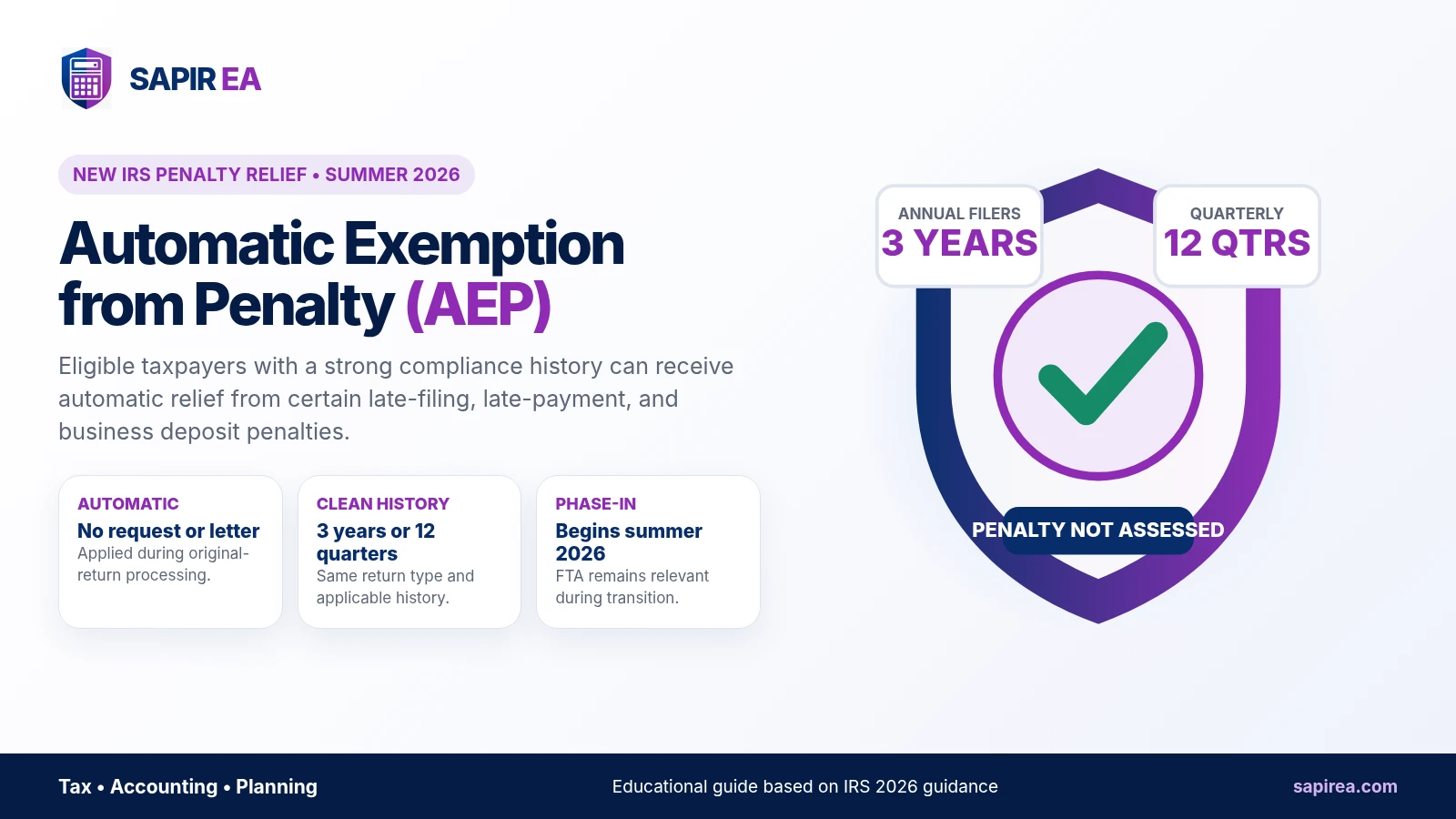
IRS Automatic Exemption from Penalty (AEP): How the New 2026 Penalty Relief Program Works
Updated July 16, 2026
Beginning in summer 2026, the IRS's new Automatic Exemption from Penalty, or AEP, can prevent certain failure-to-file, failure-to-pay, and failure-to-deposit penalties from being assessed when an otherwise compliant taxpayer has an isolated filing, payment, or deposit problem.
The major change is procedural. Under First Time Abate, or FTA, an eligible taxpayer generally had to receive a penalty and then request relief. Under AEP, the IRS should identify qualifying taxpayers during original-return processing and suppress the covered penalty automatically. No application, abatement letter, or client call should be required when the system works as intended.
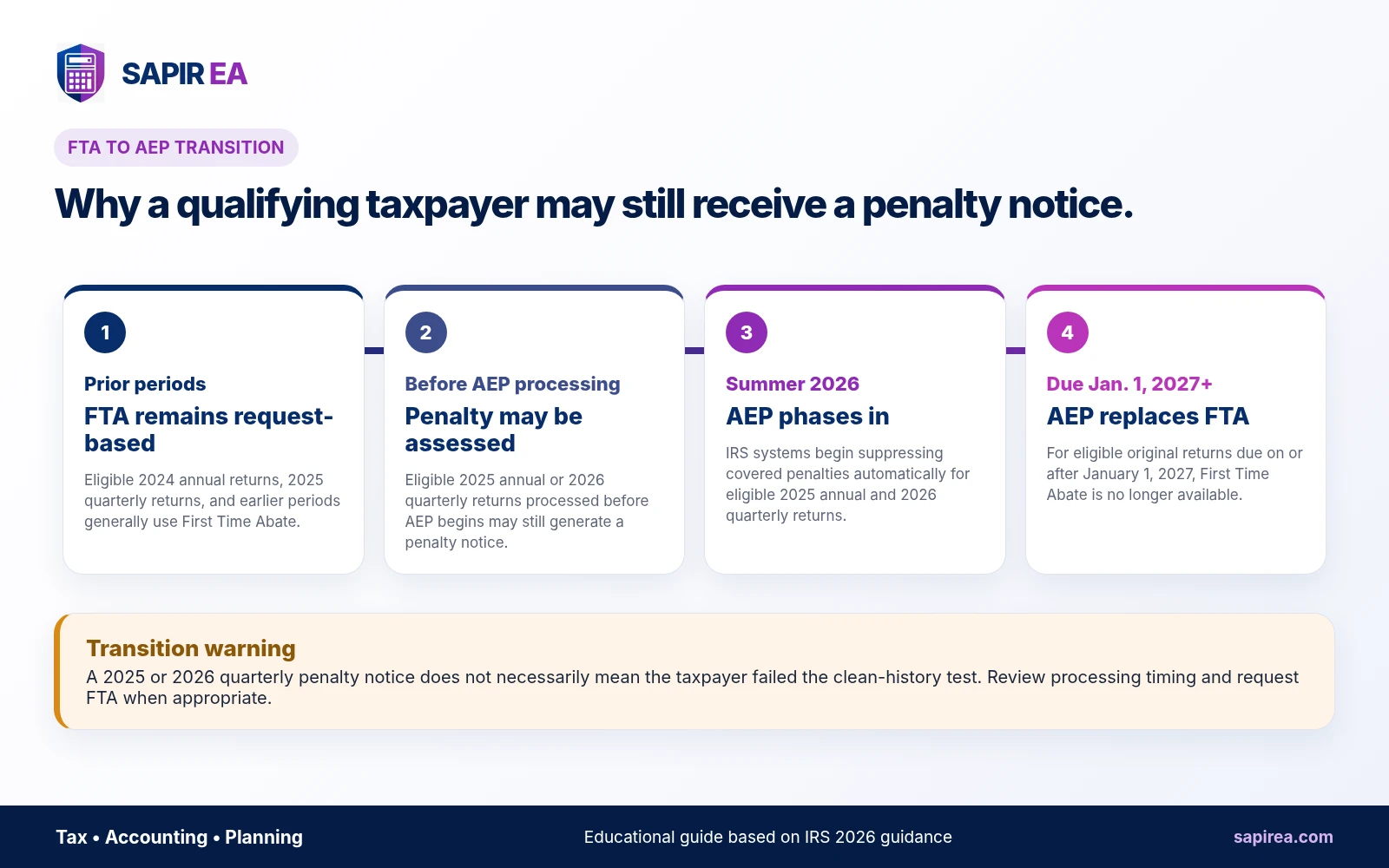
The rollout is gradual. AEP begins with eligible 2025 annual returns and 2026 quarterly returns, but some qualifying taxpayers will still receive penalty notices because their returns were processed before AEP became active. FTA remains available for certain transition periods. For eligible original returns due on or after January 1, 2027, AEP replaces FTA.
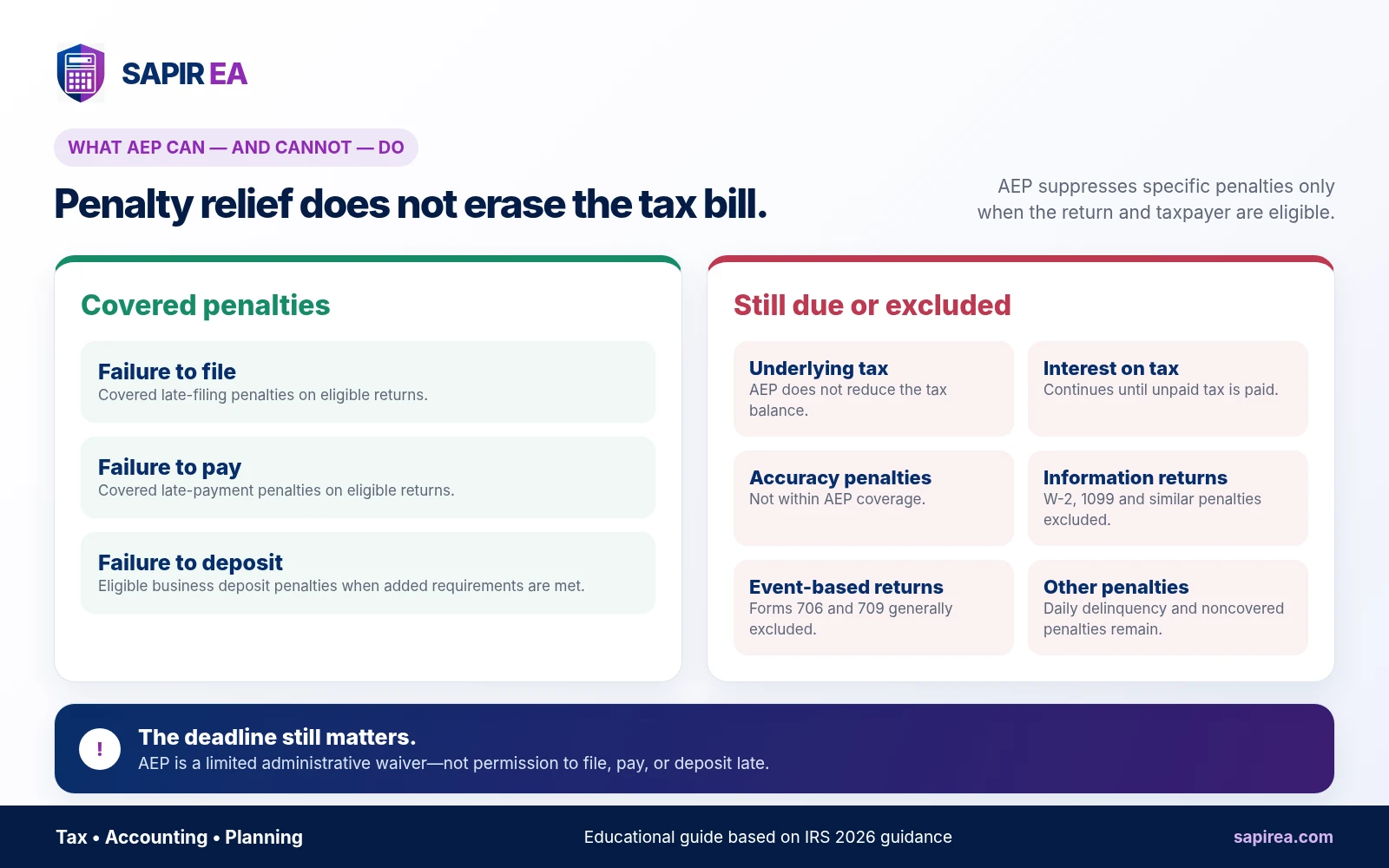
Quick answer: AEP can automatically prevent certain failure-to-file, failure-to-pay, and failure-to-deposit penalties when IRS records show timely compliance for the prior three years, or 12 consecutive quarters for quarterly filers. It does not erase tax, interest, information-return penalties, accuracy-related penalties, or penalties on excluded event-based returns.
Download the AEP and FTA Eligibility Review Workbook Download the Penalty Notice Review Checklist
AEP at a Glance
| Question | Practical answer |
|---|---|
| What is AEP? | An IRS administrative waiver that automatically prevents certain penalties from being assessed during original return processing. |
| When does it begin? | The IRS began phasing it in during summer 2026. |
| Which periods are first covered? | Eligible 2025 tax-year returns and eligible 2026 quarterly returns, plus later periods. |
| What history is generally required? | Three prior years for annual returns or 12 consecutive quarters for quarterly returns. |
| Which penalties may be covered? | Failure to file, failure to pay, and, for eligible business filers, failure to deposit. |
| Does a taxpayer have to request it? | No. The IRS applies AEP automatically when its records show all requirements are met. |
| Will the IRS communicate the result? | Yes. The IRS says it will send a notice confirming that the covered penalty was not assessed. |
| Does AEP erase the tax balance? | No. Tax, interest on unpaid tax, and penalties outside AEP remain due. |
| What happens to First Time Abate? | It is being phased out and is replaced by AEP for eligible original returns due on or after January 1, 2027. |
What Is the Automatic Exemption from Penalty?
AEP is a systemic IRS administrative-relief program for taxpayers who generally file, pay, and deposit on time but have a one-time compliance failure. When an eligible original return completes processing, the IRS reviews the account history. If all requirements are met, the covered penalty is not assessed.
AEP is not a permanent exemption and does not change any filing, payment, or deposit deadline. It changes the delivery of relief:
- The IRS considers relief automatically.
- The covered penalty is suppressed before assessment.
- The IRS sends a notice confirming that relief was applied.
The taxpayer generally does not need to respond to the confirmation notice. This approach reduces calls, letters, practitioner time, and the risk that an eligible taxpayer pays a penalty simply because the taxpayer did not know First Time Abate was available.
Why This Change Matters
The covered penalties can grow quickly, especially when a large balance is due or a business return has many partners or shareholders.
Failure-to-file penalty
For many income tax returns, the penalty is generally 5% of unpaid tax for each month or part of a month the return is late, up to 25%. Partnership and S corporation penalties can be calculated per partner or shareholder and per month, so a pass-through entity can owe a large penalty even when it has little or no entity-level income tax.
Failure-to-pay penalty
The common rate is generally 0.5% of unpaid tax for each month or part of a month, up to 25%. Interest on unpaid tax continues even if AEP prevents the penalty.
Failure-to-deposit penalty
Employers can be penalized when federal tax deposits are late, short, or made incorrectly. Rates generally increase from 2% to 15% based on timing and notice status. AEP may prevent an eligible deposit penalty, but it does not excuse the underlying payroll tax.
Which Returns Are Eligible for AEP?
The IRS identifies the following return series for AEP consideration:
- Forms 1040.
- Form 1065.
- Forms 1120.
- Forms 940, 941, 943, 944, and 945.
- Form CT-1.
AEP begins with eligible 2025 tax-year returns and 2026 quarterly returns, followed by later periods. It applies during processing of an eligible original return. Do not assume that amended returns, information returns, elections, or transaction-based forms receive the same automatic review.
Eligibility is return-specific. An owner's clean Form 1040 history does not replace the partnership's Form 1065 history, and a clean corporate return history does not substitute for an employer's Form 941 and deposit history.
The Three-Year Clean-History Test for Annual Filers
For an annual return, the same return type generally must have been timely filed for the prior three years. The IRS also looks for a qualifying payment history and no disqualifying penalty during that period.
A prior penalty may still be treated favorably if it was later removed for reasonable cause or IRS error. Estimated-tax penalties do not by themselves break the clean-history test, but AEP does not remove a current estimated-tax penalty.
A prior administrative abatement is not necessarily treated the same as reasonable-cause or IRS-error relief. Review the actual account transcript rather than assuming that every prior abatement preserves eligibility.
Example
A taxpayer files the 2025 Form 1040 late. The 2022, 2023, and 2024 Forms 1040 were timely, taxes were paid as required, and no disqualifying penalty remains. If the other criteria are met and the return processes after AEP is active, the IRS may suppress the covered failure-to-file or failure-to-pay penalty.
The 12-Consecutive-Quarter Test for Quarterly Filers
Quarterly filers generally need a compliant history for the prior 12 consecutive quarters of the same return type. This can be harder to satisfy because one late quarter can affect the lookback for several future quarters.
For example, an employer seeking AEP on a 2026 Form 941 quarter should review each of the 12 preceding Form 941 periods, including filing, payment, and deposit history.
Additional Requirements for Business Taxpayers
For failure-to-deposit relief, the business must also show that:
- The IRS did not waive failure-to-deposit penalties four or more times during the prior three years or 12 quarters.
- The penalty was not charged for avoiding the required EFTPS deposit method.
These limitations keep AEP from becoming a recurring deposit-error waiver. Repeated problems may signal a payroll schedule, cash-flow, banking, provider, or EFTPS-control issue that should be corrected immediately. Business owners can coordinate payroll compliance with broader business tax consulting and compliance.
How AEP Works During IRS Processing
AEP is applied when an eligible original return completes processing:
- The taxpayer files the return or has a covered payment or deposit failure.
- IRS systems review the prior compliance history for the same return type.
- If all criteria are met, the covered penalty is not assessed.
- The IRS sends a notice confirming the relief.
- The taxpayer remains responsible for tax, interest, and penalties outside AEP.
An AEP notice may arrive even when a balance remains due. Retain the notice with the return and account records. The National Taxpayer Advocate also explains that once AEP is granted for an eligible period, covered penalties should not later be assessed for that period merely because additional tax is assessed or the original balance remains unpaid.
The Summer 2026 Transition: Why Some Eligible Taxpayers May Still Receive Penalty Notices
The IRS is phasing in AEP during summer 2026, creating temporary overlap with First Time Abate. FTA still applies to:
- Eligible 2024 tax-year returns.
- Eligible 2025 quarterly returns.
- Eligible 2025 tax-year returns processed before AEP begins.
- Eligible 2026 quarterly returns processed before AEP begins.
For those periods, the taxpayer generally must request relief. A qualifying taxpayer may therefore receive an ordinary penalty notice during the transition. For eligible original returns due on or after January 1, 2027, AEP replaces FTA.
AEP vs. First Time Abate
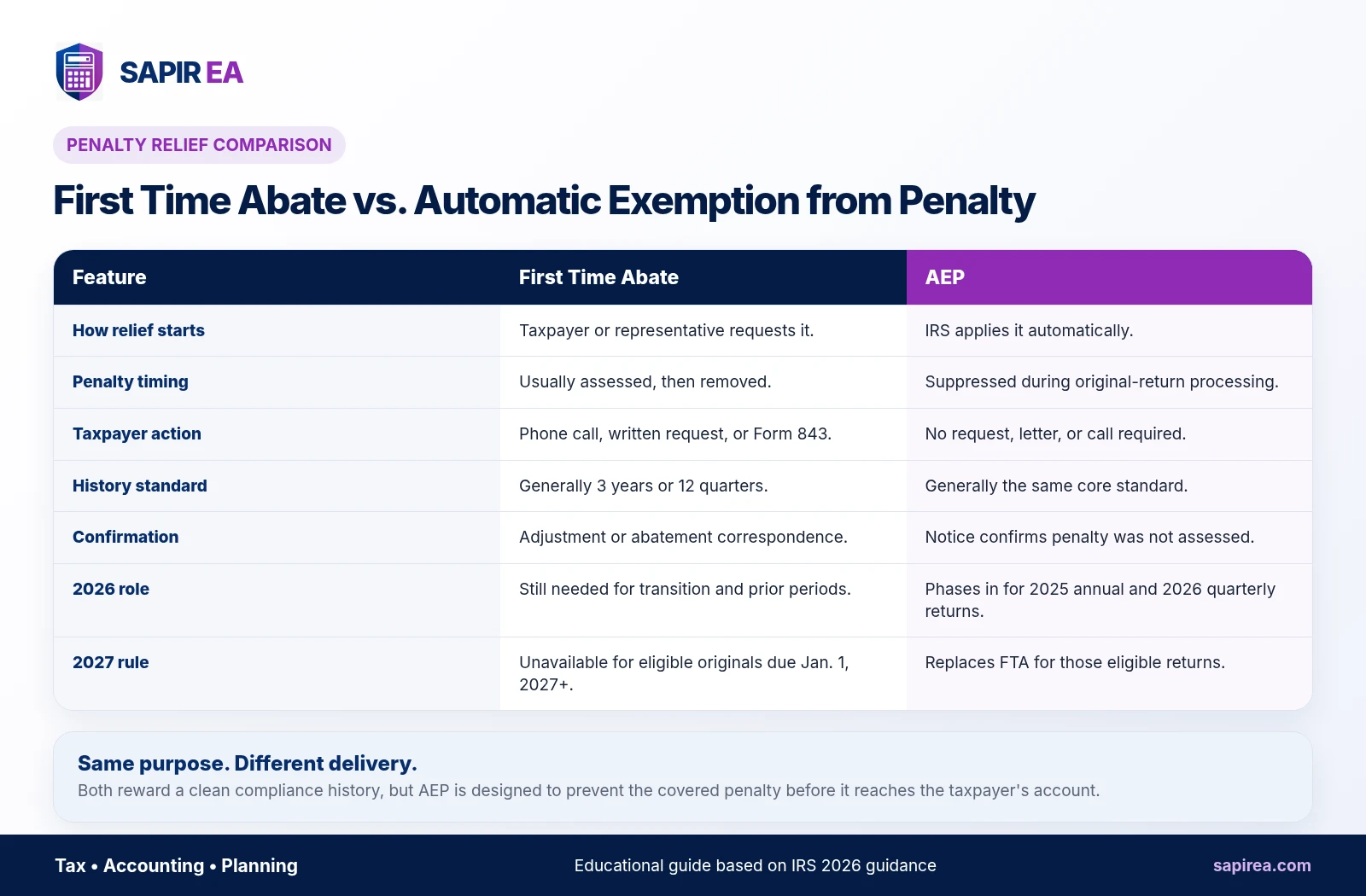
| Feature | First Time Abate | Automatic Exemption from Penalty |
|---|---|---|
| Delivery | Taxpayer or representative requests relief | IRS applies relief automatically when records show eligibility |
| Timing | Penalty is generally assessed first and removed later | Covered penalty is suppressed during original-return processing |
| Taxpayer action | Call, written request, or sometimes Form 843 | No application, letter, or phone call required to receive AEP |
| History | Generally three compliant years or 12 quarters | Generally the same core history requirement |
| Transition | Remains relevant for older periods and returns processed before AEP | Begins with eligible 2025 annual and 2026 quarterly returns |
| Long-term rule | Phased out for eligible original returns due on or after Jan. 1, 2027 | Replaces FTA for those returns |
AEP is designed to stop a qualifying penalty before it appears on the account; FTA usually requires action after assessment.
What to Do If You Receive a Penalty Notice During the Transition
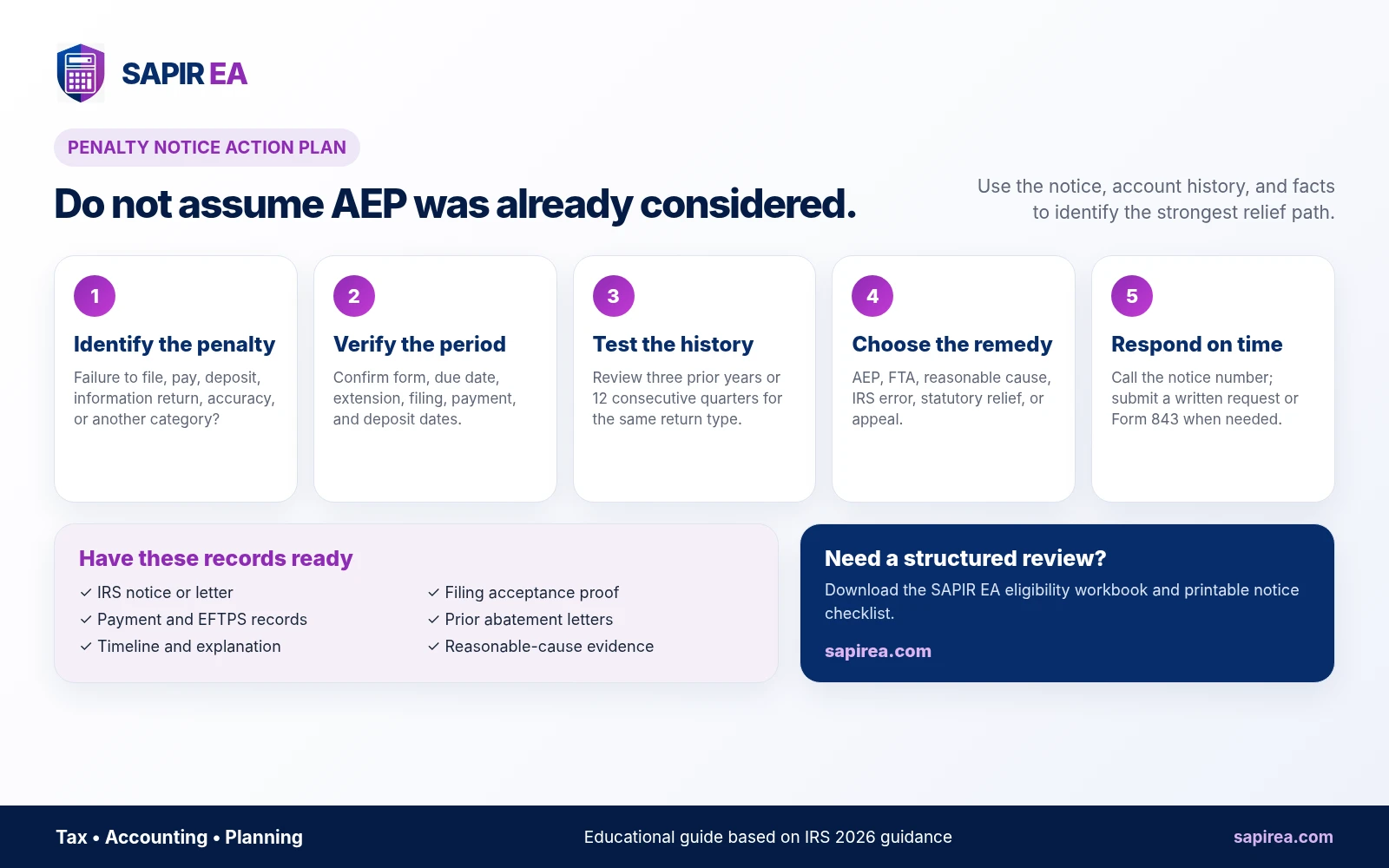
Do not assume the notice is correct or that every relief option was considered.
- Identify the exact penalty, return, period, amount, and response deadline.
- Confirm filing, extension, payment, and deposit dates. An account-posting error may look like a relief issue.
- Review the same return type for three prior years or 12 quarters.
- Determine whether AEP, transition-period FTA, reasonable cause, an IRS-error correction, or another formal relief program applies.
- Contact the IRS using the notice instructions when action is required. If the issue cannot be resolved by phone, a written statement or Form 843 may be appropriate.
- Review appeal rights if relief is denied.
SAPIR EA's IRS representation and tax resolution process begins with the notice, account transcript, and a complete timeline. A generic abatement letter can miss a stronger legal or administrative basis.
Records to Gather for an AEP, FTA, or Reasonable-Cause Review
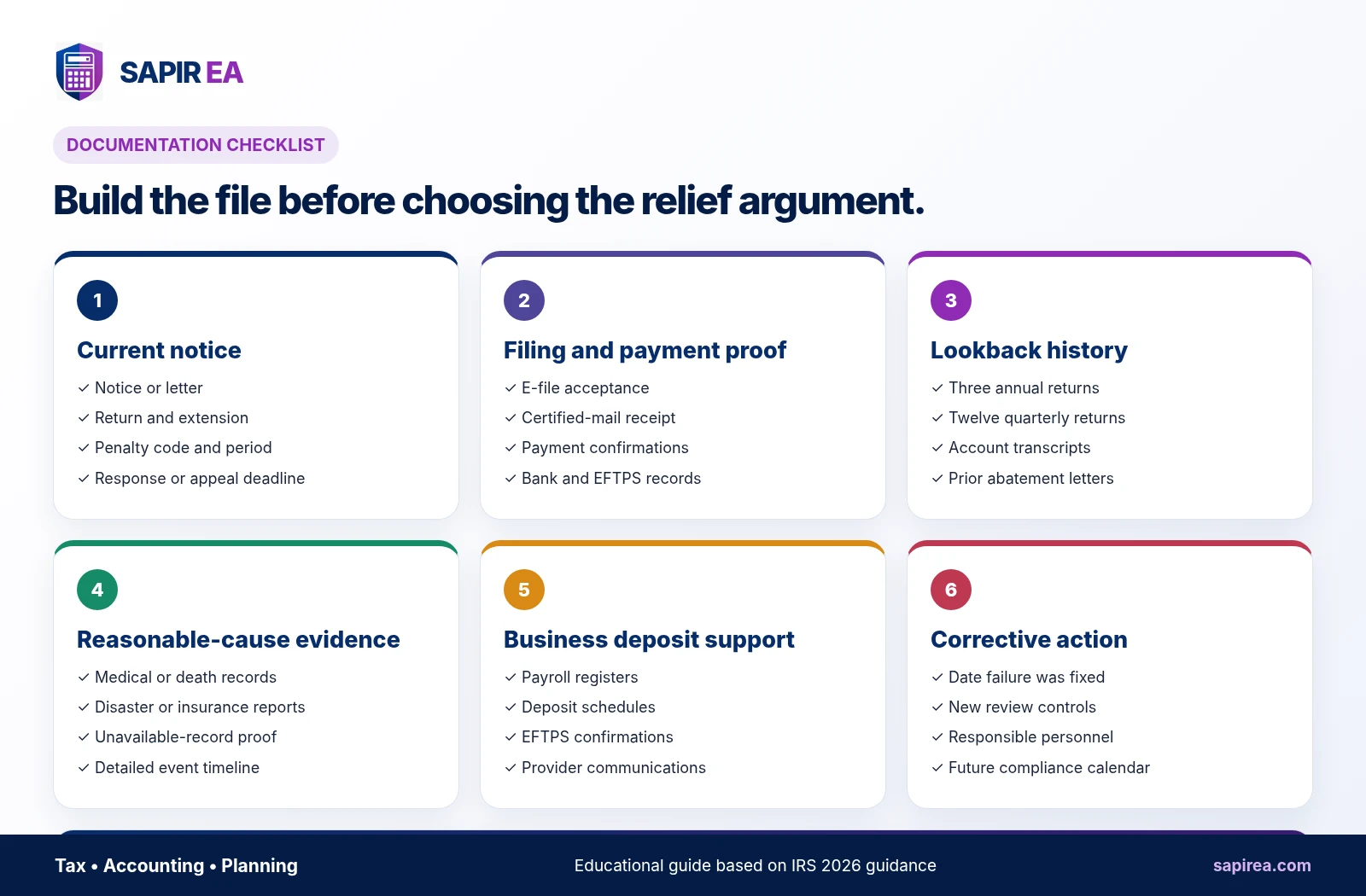
The IRS system relies on account history, but a taxpayer responding to a notice should build an independent file. Gather the notice, the original return and extension, e-file acknowledgments or certified-mail proof, payment confirmations, EFTPS records, bank statements, and account transcripts for the current and lookback periods.
Also preserve documents explaining why the failure occurred. Examples include medical records, death certificates, insurance or fire reports, disaster records, correspondence showing unavailable tax documents, payroll-provider communications, and proof of corrective action. For a business deposit issue, retain payroll registers, deposit schedules, EFTPS confirmations, and evidence showing who was responsible for approving and transmitting the deposit.
A clean file helps distinguish four very different outcomes: automatic AEP, transition-period FTA, reasonable-cause relief, or correction of an IRS posting error. It also supports an appeal if the initial request is denied. Keep the final AEP or abatement letter with the tax return and permanent entity records.
Six Implementation Details to Watch in 2026
AEP is simple in concept, but the first rollout year can produce uneven results.
1. Processing date can matter
Two otherwise identical late returns may be treated differently if one is processed before AEP becomes active and the other after. The first taxpayer may receive an assessment and need to request FTA; the second may receive an AEP confirmation.
2. IRS records control the automatic test
AEP is based on the IRS account history. A missing return posting, misapplied payment, rejected extension, or unresolved prior penalty can interfere with the system even when the taxpayer believes the history is clean.
3. Original-return status matters
The IRS says AEP is applied when an eligible original return completes processing. Do not assume an amended return, examination adjustment, or separate information-return penalty will receive the same automatic review.
4. The notice type matters
An AEP confirmation says a covered penalty was not assessed and generally requires no response. A penalty-assessment notice requires review and may have a response or appeal deadline.
5. AEP is federal only
A state or local agency may still impose its own late-filing, late-payment, or payroll-deposit penalty, even when the IRS grants AEP.
6. Relief should not delay correction
File the return, make the deposit, and pay as much as possible immediately. AEP does not stop interest on unpaid tax and does not protect penalties outside the program.
What AEP Does Not Cover
AEP is intentionally limited. The IRS says it generally does not apply to:
- Returns filed only once or infrequently because of a transaction or event.
- Estate tax returns such as Form 706.
- Gift tax returns such as Form 709.
- Daily Delinquency Penalties.
- Accuracy-related penalties.
- Information return penalties.
- Information reporting that depends on another filing.
- Penalties outside the listed failure-to-file, failure-to-pay, and failure-to-deposit categories.
AEP is not a general solution for Forms W-2, 1099, 5471, 5472, 3520, 8938, FBAR filings, or other information-reporting penalties, which have separate rules and remedies.
AEP also does not remove:
- The underlying tax.
- Interest on unpaid tax.
- Penalties that do not qualify.
- The obligation to file missing returns or make missing deposits.
If an eligible penalty is reduced or removed, related interest on that penalty is generally adjusted automatically. Interest on the unpaid tax itself normally remains.
Reasonable Cause Still Matters
A taxpayer who does not qualify for AEP may request reasonable-cause relief by showing ordinary business care and prudence but an inability to comply because of circumstances beyond the taxpayer's control. Relevant facts can include serious illness, death, fire, natural disaster, inability to obtain essential records, or other documented disruption.
A strong submission explains what happened, when it began and ended, how it caused the failure, what efforts were made to comply, how quickly the issue was corrected, and what controls were added. Forgetfulness, cash-flow pressure, or reliance on a professional does not automatically establish reasonable cause.
A planning concern
The National Taxpayer Advocate has noted that automatic AEP could be applied even when the taxpayer had genuine reasonable cause. That may matter because AEP is tied to a clean-history cycle. Taxpayers who receive AEP after a serious reasonable-cause event should preserve the documentation and discuss whether any procedure is available to reflect the correct relief basis.
Five Practical Examples
1. Late 2025 individual return processed after AEP begins
An individual with three clean Form 1040 years files the 2025 return late. AEP may suppress covered failure-to-file or failure-to-pay penalties. Tax and interest remain due.
2. Late 2025 partnership return processed before AEP begins
The partnership appears eligible, but a section 6698 penalty is assessed during the transition. It should review and request FTA rather than assume AEP was denied.
3. Employer misses a 2026 payroll deposit
The employer has 12 clean Form 941 quarters, fewer than four prior deposit waivers, and no EFTPS-avoidance issue. AEP may prevent the covered deposit penalty.
4. Gift tax return filed late
Form 709 is event-based and generally excluded. The taxpayer should evaluate reasonable cause or another remedy.
5. Information return penalty
A Form 1099 penalty generally is not covered by AEP even when the business has a clean income-tax history.
What Taxpayers and Businesses Should Do Now
Individuals
File and pay on time, retain prior filing and payment records, and review any 2025 penalty notice before paying. AEP does not remove tax or interest.
Partnerships and corporations
Track return-specific compliance, preserve e-file acknowledgments and extensions, and remember that pass-through late-filing penalties can grow by partner or shareholder.
Employers and payroll filers
Review all 12 prior quarters, reconcile liabilities to EFTPS deposits, verify bank debits, and correct recurring payroll-process failures before they affect future eligibility.
Tax professionals
Do not assume every 2025 or 2026 notice reflects an AEP denial. Check processing timing, transcripts, penalty codes, prior abatements, and reasonable-cause evidence before choosing a remedy.
Frequently Asked Questions About AEP
What does AEP stand for?
Automatic Exemption from Penalty, the IRS process for preventing certain penalties when an eligible taxpayer has a timely prior history.
When does AEP begin?
During summer 2026, beginning with eligible 2025 annual returns and 2026 quarterly returns.
Is an application required?
No. The IRS applies AEP during eligible original-return processing and sends a confirmation notice.
Which penalties can AEP cover?
Certain failure-to-file, failure-to-pay, and failure-to-deposit penalties.
What is the clean-history requirement?
Generally timely compliance for the same return type during the prior three years, or 12 consecutive quarters, plus payment and penalty-history requirements.
Which forms are listed as eligible?
Forms 1040, 1065, 1120, 940, 941, 943, 944, 945, and CT-1, subject to the complete rules.
Does AEP cover Forms 1099 or W-2?
Generally, no. Information-return penalties are outside AEP.
Does AEP cover Forms 706 or 709?
Generally, no. Estate and gift tax returns are examples of excluded event-based filings.
Why might a qualifying taxpayer still get a notice?
The return may have been processed before AEP was active. FTA or reasonable cause may still be available.
Is First Time Abate ending?
Yes, gradually. AEP replaces FTA for eligible original returns due on or after January 1, 2027.
Does AEP remove tax and interest?
No. Tax remains due and interest on unpaid tax generally continues.
Can reasonable cause still be requested?
Yes, when the facts and documentation satisfy the applicable standard.
Can AEP apply more than once?
It is not described as once in a lifetime. Later eligibility depends on the three-year or 12-quarter history and prior penalty treatment.
Does AEP apply to state penalties?
No. State and local agencies have separate rules.
How SAPIR EA Can Help
AEP is automatic only when IRS records are complete and the return and penalty qualify. SAPIR EA can help:
- Review IRS notices and account transcripts.
- Test the three-year or 12-quarter history.
- Distinguish AEP, FTA, reasonable cause, and IRS-error correction.
- Prepare and submit penalty-relief requests.
- Communicate with the IRS under a valid power of attorney.
- Review payroll and business filing controls to reduce repeat problems.
Learn more about IRS representation and tax resolution, tax preparation and planning, and business tax compliance, or contact SAPIR EA for a confidential consultation.
Key Takeaway
AEP can automatically prevent certain failure-to-file, failure-to-pay, and failure-to-deposit penalties for taxpayers with a qualifying history. It starts with eligible 2025 tax-year and 2026 quarterly returns, while FTA remains relevant during the summer 2026 transition. For eligible original returns due on or after January 1, 2027, AEP replaces FTA.
Automatic does not mean universal. Review the return type, penalty, processing date, clean-history period, prior abatements, and business deposit record. Tax and interest remain due, excluded penalties require a different remedy, and reasonable cause may still be available.
Download the AEP and FTA Eligibility Review Workbook Download the Printable Penalty Notice Checklist
Primary IRS Sources
- IRS News Release IR-2026-83
- IRS Administrative Penalty Relief
- IRS Fact Sheet FS-2026-12
- IRS Reasonable-Cause Penalty Relief
- IRS Failure-to-File Penalty
- IRS Failure-to-Pay Penalty
- IRS Failure-to-Deposit Penalty
This article is for general educational purposes and does not constitute individualized tax, legal, accounting, payroll, or penalty-relief advice. Eligibility depends on the return, period, processing date, account transcript, payment history, deposit history, and other facts.