International Tax Reporting Penalties and Relief
International tax reporting is often misunderstood. A U.S. taxpayer can live abroad, pay tax to another country, owe little or no additional U.S. tax, and still face significant U.S. filing obligations. The reason is that the U.S. system combines worldwide income reporting with separate information returns for foreign accounts, assets, businesses, trusts, gifts, and treaty positions.
The penalties for missing those forms can be much larger than the tax itself. Some start at $10,000 or $25,000 per form and per year. Others are calculated as a percentage of an account balance, a foreign gift, trust property, or transferred assets. Several can continue to grow after the IRS sends a notice.
The good news is that taxpayers who discover a past omission may have ways to correct it. The proper remedy depends on the facts - especially whether the conduct was non-willful, whether income was omitted, where the taxpayer lived, whether prior returns were filed, and whether the IRS has already made contact.
1. What international tax reporting covers
U.S. citizens and resident aliens generally report income from all sources worldwide, regardless of where they live or where the income is earned. Credits, exclusions, and treaty rules may reduce double taxation, but they usually operate after the income is reported. See the IRS international taxpayer guidance and Publication 54.
International tax compliance can therefore involve several overlapping layers:
- Income reporting - foreign wages, pensions, interest, dividends, rent, capital gains, self-employment income, and business income.
- Account reporting - foreign bank, brokerage, retirement, insurance, and certain other financial accounts.
- Asset reporting - foreign stock, securities, contracts, and interests in foreign entities.
- Entity reporting - foreign corporations, partnerships, disregarded entities, branches, and reportable transfers.
- Trust and gift reporting - foreign trusts, trust distributions, ownership, and significant gifts or bequests from foreign persons.
- Treaty disclosure - certain return positions that rely on a U.S. income tax treaty.
2. Who should review foreign reporting obligations
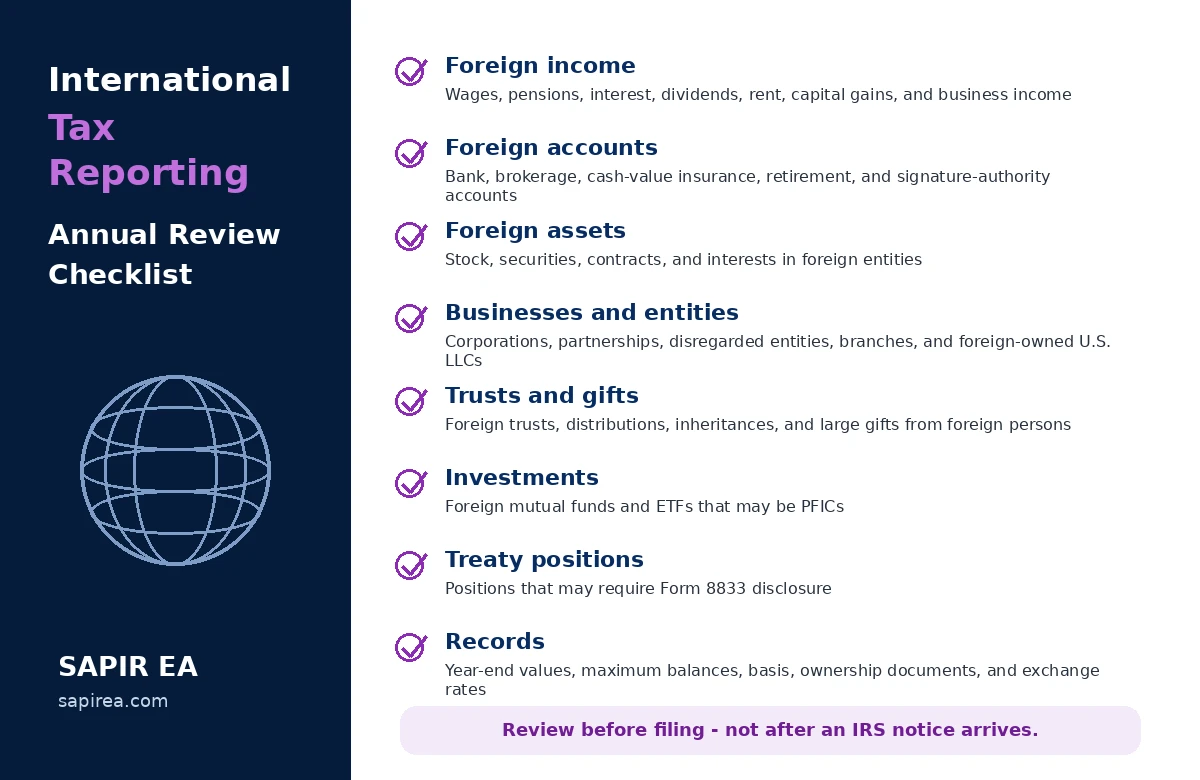
A review is particularly important for any U.S. person who had one or more of the following during the year:
- A bank, brokerage, pension, insurance, payment-platform, or investment account outside the United States.
- Foreign wages, self-employment income, rental income, dividends, interest, capital gains, or pension income.
- Ownership, control, a transfer, or a transaction involving a foreign corporation, partnership, trust, branch, or disregarded entity.
- A foreign mutual fund or exchange-traded fund.
- A large gift or inheritance from a foreign person, or a distribution from a foreign trust.
- Signature authority over a foreign account owned by an employer, business, family member, or organization.
- A foreign-owned U.S. single-member LLC with reportable transactions.
- A tax-treaty position that changes the normal result under U.S. tax law.
3. Common forms and penalty exposure
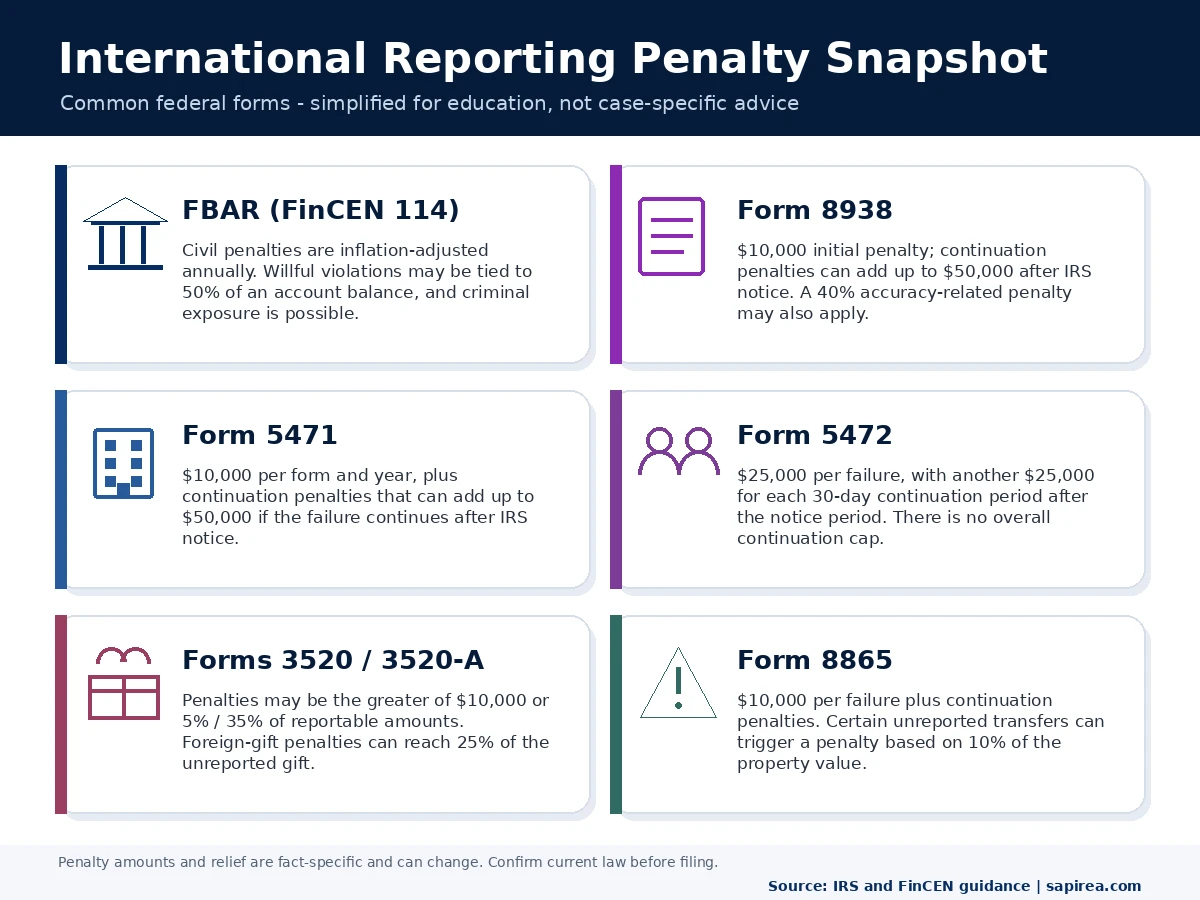
The correct form depends on citizenship or residency, asset type, value, ownership percentage, transactions, and other technical rules. The following chart is a high-level guide, not a filing determination.
| Form | What it generally reports | Potential consequence of nonfiling |
|---|---|---|
| Form 1040 and schedules | Worldwide income, foreign tax credits, exclusions, business and investment items | Regular late-filing, late-payment, tax, and interest rules may apply. |
| FBAR - FinCEN Form 114 | Foreign financial accounts when aggregate value exceeds $10,000 at any time during the year | Civil penalties are inflation-adjusted; willful violations and criminal cases can be severe. |
| Form 8938 | Specified foreign financial assets above applicable thresholds | $10,000 initial penalty; continued nonfiling can add up to $50,000, plus other tax penalties. |
| Form 5471 | Certain ownership, control, or transactions involving foreign corporations | $10,000 per form/year, with continuation penalties that can add up to $50,000. |
| Form 5472 | Reportable transactions of certain foreign-owned U.S. corporations and foreign-owned disregarded entities | $25,000 per failure, followed by additional $25,000 continuation penalties after notice. |
| Forms 3520 / 3520-A | Foreign trusts, trust transactions, distributions, and certain foreign gifts | Penalties may be based on 5%, 25%, or 35% of reportable amounts, subject to detailed rules. |
| Form 8865 | Certain foreign partnerships and reportable transfers | $10,000 per failure, possible continuation penalties, and transfer-based penalties. |
| Form 8858 | Certain foreign disregarded entities and foreign branches | $10,000 per annual accounting period, with possible continuation penalties. |
| Form 8621 | Ownership in a passive foreign investment company, often including foreign mutual funds and ETFs | Tax and interest computations can be punitive, and late reporting can complicate the assessment period. |
| Form 926 / Form 8833 | Certain transfers to foreign corporations / treaty-based return positions | Transfer-based percentage penalties or fixed treaty-disclosure penalties may apply. |
4. Ten common international tax pitfalls
1. Assuming foreign tax paid means no U.S. filing is required
Foreign tax credits, exclusions, and treaty provisions may reduce double taxation, but they generally do not erase the obligation to report worldwide income. A taxpayer can owe no additional U.S. income tax and still need to file a U.S. return, FBAR, Form 8938, or another international information return.
2. Treating the FBAR and Form 8938 as interchangeable
The FBAR is filed electronically with FinCEN, while Form 8938 is attached to a federal income tax return. The definitions, thresholds, and asset categories are not identical. Filing one does not satisfy the other when both apply.
3. Looking at each foreign account separately
For FBAR purposes, the $10,000 threshold is an aggregate test. Several smaller accounts can create a filing obligation even when no single account ever exceeded $10,000. Joint accounts and accounts over which a person has only signature authority can also matter.
4. Overlooking pensions, insurance, mutual funds, and digital accounts
Foreign retirement plans, cash-value insurance, brokerage accounts, pooled investments, and certain online payment or investment accounts may create reporting issues. Foreign mutual funds and ETFs can also be passive foreign investment companies, or PFICs, with complicated Form 8621 and tax calculations.
5. Missing foreign corporation, partnership, or disregarded-entity filings
A taxpayer may need an information return because of ownership, control, a transfer, or a reportable transaction - not only because cash was distributed. Foreign-owned U.S. single-member LLCs are a frequent trap because they may need a pro forma Form 1120 with Form 5472 even when the LLC has no taxable income.
6. Treating foreign gifts and inheritances as paperwork-free
A genuine gift or inheritance from a foreign person may not be taxable income, but significant receipts can still require Form 3520. Foreign-trust distributions and ownership are subject to separate, highly technical reporting rules.
7. Filing an incomplete form
An international information return may be treated as not filed when schedules, ownership chains, transactions, or required statements are missing. That can trigger the same penalties as a completely omitted form.
8. Using inconsistent exchange rates and weak records
U.S. reporting is generally completed in U.S. dollars. Taxpayers should preserve the source of exchange rates, year-end and maximum account values, tax basis, dates of transfers, and ownership records. Reconstructing these items years later can be expensive and imprecise.
9. Relying on a preparer who did not ask international questions
A foreign-country accountant may not know U.S. reporting rules, and a domestic preparer may not recognize a foreign pension, entity, or trust issue. Taxpayers should affirmatively disclose every foreign account, asset, entity, gift, trust, and source of income to the preparer.
10. Waiting for perfect records while deadlines pass
Filing extensions can protect income-tax-return deadlines, but they do not extend every international form in the same way, and an extension to file is not an extension to pay. A coordinated plan should be made before the due date.
5. Consequences of failing to file
The consequences depend on what was missed, why it was missed, and how quickly the taxpayer acts. Potential exposure includes:
Additional tax and interest
Unreported foreign wages, pensions, interest, dividends, rent, gains, or business income can produce income tax, self-employment tax, net investment income tax, and interest. Foreign tax credits or exclusions may reduce the result, but they must be properly claimed and documented.
Regular late-filing and late-payment penalties
The federal failure-to-file penalty is generally 5% of unpaid tax for each month or part of a month, up to 25%. The failure-to-pay penalty is generally 0.5% per month, up to 25%. When both apply in the same month, the combined monthly charge is generally 5%. For returns required to be filed in 2026, a return more than 60 days late can carry a minimum failure-to-file penalty equal to the lesser of $525 or 100% of the unpaid tax.
Stand-alone information-return penalties
Forms such as 8938, 5471, 5472, 3520, 3520-A, 8865, and 8858 can generate penalties without regard to how much income tax is due. Continuation penalties may keep increasing after the IRS sends notice.
FBAR civil and criminal exposure
FBAR penalties depend on the facts and circumstances and are adjusted annually for inflation. Willful cases can involve a penalty tied to 50% of the account balance, and criminal prosecution is possible in serious cases.
Longer or suspended assessment periods
Certain international reporting failures can keep the assessment period open for the omitted item - and, in some circumstances, for more of the return - until the required information is filed. Form 8938-related omissions can also create a six-year assessment period when more than $5,000 of income attributable to specified foreign financial assets is omitted.
Higher accuracy-related penalties
An understatement attributable to an undisclosed foreign financial asset can carry a 40% accuracy-related penalty. Fraud can carry a 75% penalty, and intentionally false filings may create criminal exposure.
Loss or delay of tax benefits
A late filing can jeopardize elections, delay refunds, reduce foreign tax credit benefits in certain entity-reporting cases, and make it harder to establish basis or the character of foreign income.
Notices, collection activity, and professional cost
Once penalties are assessed, the taxpayer may face notices, collection action, appeals, refund claims, or litigation. The cost of reconstructing years of records and defending a penalty can exceed the cost of timely compliance.
6. Remedies for missed international filings
There is no single correction program that fits every taxpayer. Filing a stack of amended returns without first evaluating the facts can be risky, particularly when willfulness may be an issue. The IRS lists several options for taxpayers with undisclosed foreign financial assets and encourages professional tax or legal advice.
Step 1: Preserve current-year compliance
File current returns and extensions on time whenever possible. Correcting prior years does not excuse a new late filing. Pay the current-year tax by the payment deadline even when more time is needed to finish the return.
Step 2: Build a complete fact pattern
Prepare a year-by-year inventory of foreign accounts, maximum values, income, entities, ownership percentages, transfers, gifts, trusts, prior returns, professional advice, and IRS notices. Document when the taxpayer first learned of the requirement and what steps were taken afterward. These facts can determine whether a reasonable-cause or non-willfulness certification is supportable.
Step 3: Select the correction path before filing
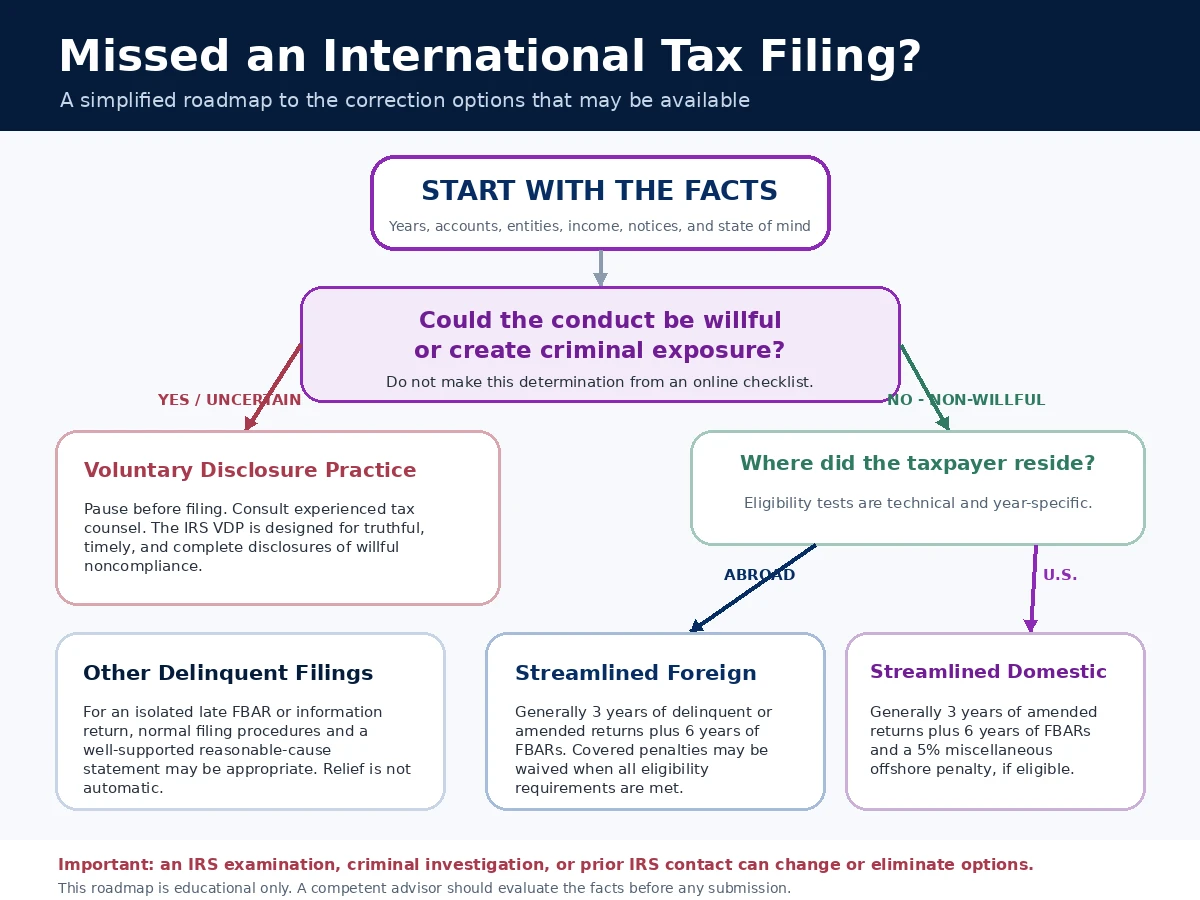
| Possible path | When it may fit | General mechanics and cautions |
|---|---|---|
| Normal delinquent or amended filing | An isolated omission, no potential willfulness, and facts that do not fit a special procedure | File using current instructions; attach required information returns. A detailed reasonable-cause statement may be appropriate. Penalties can still be assessed. |
| Late FBAR filing | FBAR was missed, particularly where related income was properly reported | File electronically as soon as possible and provide the required explanation. Reasonable-cause relief depends on the facts and is not automatic. |
| Streamlined Foreign Offshore Procedures | Eligible non-willful taxpayers who satisfy the non-residency test | Generally 3 years of delinquent or amended returns and 6 years of FBARs, plus tax and interest. Covered penalties may be waived if all requirements are met. |
| Streamlined Domestic Offshore Procedures | Eligible non-willful taxpayers residing in the United States who generally filed prior returns | Generally 3 years of amended returns and 6 years of FBARs, plus tax, interest, and a 5% miscellaneous offshore penalty. |
| IRS Voluntary Disclosure Practice | Potentially willful noncompliance or criminal exposure | Truthful, timely, and complete disclosure through Form 14457, full cooperation, filing, and payment. It is not automatic immunity, but it is the principal IRS path for willful noncompliance. |
| Penalty abatement, appeal, or refund claim | A penalty has already been proposed or assessed | Respond to the notice, present reasonable-cause evidence, use administrative appeal rights, or pay and file Form 843 when appropriate. Payment arrangements may also be available. |
Normal delinquent or amended filings and reasonable cause
The IRS instructs taxpayers to file most delinquent international information returns with an amended income tax return under normal procedures. Forms 3520 and 3520-A follow their own filing instructions. A taxpayer may include a detailed reasonable-cause statement, but the IRS may still assess a penalty and require the taxpayer to contest it. A strong statement should connect specific facts to the legal standard, explain responsible conduct, and include supporting documents. Generic language rarely helps.
Streamlined Foreign Offshore Procedures
This procedure may be available to eligible taxpayers whose failures were non-willful and who satisfy the non-residency requirement. The submission generally includes the most recent 3 years of delinquent or amended income tax returns and required information returns, 6 years of delinquent FBARs, a signed non-willfulness certification, and payment of tax and interest. Covered penalties may be waived when all requirements are met. Review the IRS foreign streamlined requirements.
Streamlined Domestic Offshore Procedures
This procedure may be available to eligible non-willful taxpayers residing in the United States who generally filed the required income tax returns but omitted foreign income or reporting. The submission generally covers 3 years of amended returns and required information returns, 6 years of FBARs, a non-willfulness certification, payment of tax and interest, and a 5% miscellaneous offshore penalty. Review the IRS domestic streamlined requirements.
IRS Voluntary Disclosure Practice
Taxpayers concerned that the conduct was willful or could create criminal exposure should not submit a streamlined certification or quiet disclosure without advice from experienced tax counsel. The IRS Voluntary Disclosure Practice uses Form 14457 and requires a truthful, timely, and complete disclosure, cooperation, filing, and payment or a payment arrangement. It does not provide automatic immunity, but a timely voluntary disclosure may reduce the risk of criminal prosecution.
Penalty abatement, appeals, refund claims, and payment plans
When the IRS proposes or assesses a penalty, the taxpayer should respond by the notice deadline. Depending on the stage, remedies may include a written reasonable-cause request, administrative appeal, payment followed by Form 843 claim for refund and abatement, or litigation. When the liability is correct but cannot be paid immediately, an installment agreement or other collection alternative may be available.
Avoid an uninformed quiet disclosure
A quiet disclosure usually means filing amended returns and delinquent forms without using the procedure that best matches the facts. That approach does not guarantee penalty protection and can be especially dangerous where willfulness is possible. The correction method should be selected before documents are submitted.
7. A practical correction checklist
- Identify every year that may be affected and whether the IRS or FinCEN has already made contact.
- List all foreign income, accounts, pensions, insurance, investments, entities, trusts, gifts, transfers, and treaty positions.
- Obtain statements, entity records, ownership documents, tax returns filed abroad, and proof of foreign taxes paid.
- Reconstruct maximum account values, year-end values, income, basis, and U.S.-dollar conversions using a consistent method.
- Determine every required U.S. return and information form - not only the FBAR.
- Evaluate reasonable cause, non-willfulness, or potential willfulness with a qualified professional before signing any certification.
- Compare normal filing, streamlined procedures, and voluntary disclosure based on eligibility and risk.
- Prepare complete, internally consistent filings and a documented explanation where appropriate.
- Retain submission receipts, certified-mail records, e-file confirmations, supporting documents, and copies of all signed forms.
- Create an annual international reporting checklist so the same omission does not recur.
8. Frequently asked questions
Do I have to report foreign income if I paid tax in another country?
Usually, yes. U.S. citizens and resident aliens generally report worldwide income. A foreign tax credit, exclusion, deduction, or treaty provision may reduce double taxation, but the income still generally must be reported.
Is an FBAR the same as Form 8938?
No. The FBAR is filed separately with FinCEN. Form 8938 is attached to the federal income tax return. They have different thresholds and definitions, and a taxpayer may need both.
Can I be penalized when no additional U.S. tax is due?
Yes. Many international forms are information returns. Penalties can apply because a form was late, incomplete, or inaccurate even when foreign tax credits or exclusions eliminate the additional U.S. income tax.
Can late international forms be filed without penalties?
Sometimes, but there is no universal amnesty. Relief may depend on reasonable cause, non-willfulness, residence, prior filing history, whether the IRS has contacted the taxpayer, and which forms were missed.
What is the difference between the streamlined procedures and voluntary disclosure?
The streamlined procedures are designed for eligible taxpayers whose conduct was non-willful. The IRS Voluntary Disclosure Practice is the principal path for taxpayers concerned about willful noncompliance or criminal exposure. A qualified advisor should evaluate the facts before any filing is made.
How many years do I need to file to catch up?
It depends on the procedure and the facts. Streamlined submissions generally cover 3 years of income tax returns and 6 years of FBARs. Normal delinquent filings, an IRS examination, or a voluntary disclosure can involve different years.
Should I wait until the IRS contacts me?
No. Some correction options are available only before an examination, criminal investigation, or other IRS contact begins. Prompt, informed action generally preserves more options.
Need help correcting a missed international filing?
SAPIR EA can help identify reporting gaps, organize delinquent or amended filings, prepare required information returns, and represent taxpayers before the IRS. When potential willfulness or criminal exposure exists, experienced tax counsel should be involved before any submission is made.
Official sources and further reading
- IRS: International taxpayers and worldwide income
- IRS Publication 54
- IRS: International information reporting penalties
- FinCEN: FBAR filing requirements
- IRS: FBAR guidance
- IRS: FATCA and Form 8938 reporting
- IRS: Correction options for undisclosed foreign assets
- IRS: Streamlined Filing Compliance Procedures
- IRS: Delinquent international information return procedures
- IRS Criminal Investigation: Voluntary Disclosure Practice
- IRS: Failure-to-file penalty
- IRS: Failure-to-pay penalty